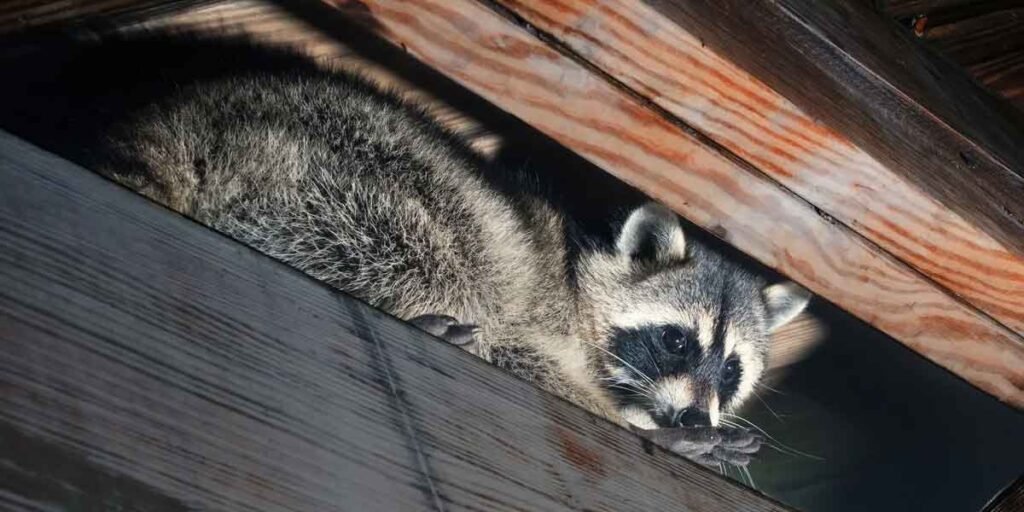
Wildlife removal starts at the entry point, not at the animal.
Find how it got in, prove nothing is still up there, and seal the gap last; skip a step and the same species returns next season, or a different one claims the opening.
The call usually starts with a 4 a.m. scratch, a flashlight sweep of the attic, and a fast decision made in the driveway. What looks like one animal is often a longer story: an entry open for months, insulation packed flat along a walkway, droppings under the ridge beam. Most of that happened while everyone slept two floors down.
An attic is the one part of a home where a wild animal shares air with the people below it. That is why the sequence in wildlife removal matters more than the tool on the truck.
What Attic Wildlife Removal Actually Covers
Attic wildlife removal covers three problems in order: the animal’s access, the damage it left behind, and whatever attracted it. A service that traps and leaves has handled one of the three and billed for all of them.
Access is the part most homeowners skip. Squirrels, raccoons, and bats reuse the same openings for years, and a house rarely has only one entry: a gap at a soffit joint, a chimney without a cap, a dryer vent flap that stopped closing, a hole where cable enters the gable.
Exclusion is the term for closing those openings with material tough enough to resist chewing and pushing.
It is a separate line of work from trapping, and separate again from repair.
Damage comes next, and it is usually the expensive part. Compacted insulation has to be replaced, not re-fluffed; stained ceiling board and soaked drywall come down; chewed cable gets replaced by an electrician instead of taped.
Attraction is the cheapest piece and the one that decides whether the work lasts. A feeder hung near the roofline, a bin without a locking lid, and a branch resting on the shingles all read as an invitation.
Why an Attic Animal Outranks One in the Yard
An animal in the yard is a nuisance; an animal above the ceiling is a health and fire question. Droppings, chewed cable, and flattened insulation accumulate where nobody looks, and the repair bill in wildlife removal usually passes the fee for catching the animal.
The Health Side Homeowners Underrate
Bat and bird droppings are the reason attic work is not a gloves-and-ladder chore. CDC guidance on Histoplasma capsulatum, the fungus behind histoplasmosis, notes it grows well in soil or material enriched with large amounts of bird or bat droppings. CDC/NIOSH also lists attics among the spaces that should carry a health-risk warning when contamination is known or suspected.
The danger travels on dust. Spores go airborne when dried droppings are swept, shoveled, or vacuumed with ordinary equipment, so CDC/NIOSH tells workers to wet the material first. It treats a disposable N95 respirator as the minimum protection, and moves to a powered air-purifying respirator with HEPA filters for heavy accumulations.
That hierarchy produces the advice people find hard to believe. If an accumulation sits undisturbed in an attic nobody walks through, CDC/NIOSH says leaving it alone may be the best course of action.
A small amount of fresh droppings is a different situation from a pile deep enough to shovel. Wet the surface, wear gloves and a respirator, bag the material, and hand anything larger to a cleanup crew that follows the same CDC sequence.
Rabies sits in the same conversation. CDC’s 2019 Vital Signs report ties bats to roughly seven in ten human rabies deaths in the United States, while reporting that about 94 percent of bats submitted for testing do not carry the virus, which is why indiscriminate killing is the wrong response.
CDC’s practical rule is short. Never handle a bat with bare hands, and if you wake up with a bat in the room, or find one where someone was sleeping, treat it as an exposure and get medical advice the same day.
Raccoon roundworm, Baylisascaris procyonis, is the third item on that list. County and state wildlife guidance names it, along with distemper, parvovirus, and mange, as one reason raccoons are not relocated.
What Chewed Cable and Flattened Insulation Cost You
Squirrels and rodents gnaw because their incisors keep growing, not because they are hungry. Extension guidance from Penn State, Utah State, and the University of Georgia documents attic damage to wiring, insulation, and framing. UGA adds that a dry leaf nest near a bare conductor is a fire waiting on a spark.
Be careful with the number that circulates on this subject. The claim that rodents start 20 to 25 percent of American house fires has no counterpart in NFPA’s electrical-fire cause data, and no original study behind it.
What does have a paper trail is the outage record kept by the Internet Center for Wildlife Damage Management. Squirrels caused 177 power outages in Lincoln, Nebraska, in 1980, about 24 percent of that city’s total for the year, and reported costs fell 78 percent once squirrel guards went up.
Chewed cable stays dangerous after the animal leaves, and tape does not restore an insulation rating. A licensed electrician should inspect and replace damaged runs before new insulation goes over them.
The Four Ways an Animal Leaves a Building
Four exits are realistic, and two are common in attics: a one-way door at the entry, a live trap with on-site release, hand removal of an animal already grounded, and lethal control where a state requires it for a rabies-vector species.
A one-way door converts the opening the animal already uses into an exit only. The animal pushes out and cannot get back in.
Eviction first, and lethal control only where the law insists: that split is the center of humane wildlife removal methods, and it is also the practical order of work in an attic, since a trap settles the animal while the opening stays open.
A live trap with on-site release is the second option, and it has limits. It works on an animal that can be caught at the entry; raccoons often learn to avoid a cage after one encounter, and a trap that catches a mother separates her from the litter.
Hand removal applies to an animal already on the floor of a living space, usually a bat. That is also the case where the animal may need rabies testing, so the local health department or animal control should be called before anyone picks it up.
Lethal control is last on the list and rarely a homeowner’s call. Some states require euthanasia rather than release for rabies-vector species, which makes the question legal before it is ethical.
Why “Wait Until Dark, Then Seal It” Fails
Sealing an entry after watching animals leave at dusk is the most common do-it-yourself mistake, and Bat Conservation International names it directly: bats still inside are trapped, and the smell follows within days. BCI guidance is to leave a one-way device in place for at least five to seven days, sometimes two weeks, before anything is sealed permanently.
BCI also advises against canned spray foam for bat work, since animals caught in it die inside the gap, and it treats ultrasonic devices and chemical repellents as non-solutions.
Proving a building is empty takes evidence, not silence. The Washington Department of Fish and Wildlife suggests a visual inspection, a one-way door, or a wadded-up newspaper or tracking patch at the opening to show that nothing has moved through it.
WDFW also advises searching the attic near the active entry for a nest or young before sealing, because litters are left behind more often than homeowners expect.
Reading the Signs Before You Spend Anything
Timing, droppings, and the shape of the opening are the three useful clues. Together they point to a species, and the species decides the legal season and who is allowed to handle the wildlife removal work.
Sound alone does not identify an animal.
A rolling, dragging thump at night fits a raccoon; light scratching at dawn and late afternoon fits a squirrel; steady high-pitched chattering just before dark, with dark stains under a gable vent, fits bats.
| What you notice | Likely animal | Entry size | Maternity risk | Reasonable next step |
|---|---|---|---|---|
| Scratching at dawn and late afternoon, shredded insulation, a hole about 2 inches across | Tree squirrel | About 2 inches wide | Spring and late-summer litters | One-way door, outside any maternity window |
| Heavy thumping and rolling at night, torn soffit, pushed-in roof vent, strong odor | Raccoon | 4 inches or larger | Spring litters; young heard as chatter | Licensed operator; roof access and rabies rules |
| Chattering before dusk, dark stains below a gable vent, a bat on an indoor floor | Bat colony | Gap the width of a pinky finger | Late spring through late summer | State permit rules and BCI timing apply |
| Birds flying in and out of a soffit or vent, nesting material visible | Sparrows, starlings, pigeons | Openings and missing vent covers | Nesting season | Wait until the nest is empty, then seal |
| Musky odor at a ground-level or roofline gap, torn vent screen | Skunk or opossum | Ground level or low roof | Spring litters | No; spray risk and state trapping rules |
Two rows change the plan more than the others. A bat colony is a permit question in states such as Florida and New Jersey, and any sign of young animals moves the work to an operator licensed for maternity colonies.
The Timing Rule That Decides Your Options
Bat exclusion is seasonal by law across much of the country, because flightless young cannot leave with their mothers. Florida blocks it from April 16 through August 14 without a permit, and New Jersey restricts it from May 15 through July 31.
The reason is easy to picture. A one-way door on a nursery colony lets mothers out to feed at dusk and leaves the pups inside, which kills them, produces odor inside walls, and can count as an illegal take when a protected species is involved.
Federal guidance runs on the same clock. The U.S. Fish and Wildlife Service sets a pup season for listed bat species, roughly mid-May through the end of July in most states, and restricts structure work inside that window.
Dates are not uniform, so the state wildlife agency’s page is the source that counts for a specific address.
A second restricted window covers winter, when hibernating bats occupy the roost, which leaves early spring and late summer into fall as the practical seasons for exclusion work in wildlife removal.
Squirrels and raccoons complicate the calendar for a different reason. A female sealed away from her litter will chew a new opening to reach it, often in the same corner of the roof, so waiting a few weeks can cost less than patching the second hole.
When Relocation Is Not an Option
“Trap it and release it in the woods” is illegal in many states and unreliable nearly everywhere else. Virginia prohibits relocating trapped wildlife, Florida bars transporting and releasing raccoons, and Kansas requires release at least 10 miles away with written landowner permission.
Colorado caps raccoon relocation at about two miles from the capture point. These rules exist for disease control, rabies in particular, before they exist for animal welfare.
Even where a move is legal, it often fails. Fairfax County’s wildlife guidance notes that translocated animals struggle to find food, water, and shelter in unfamiliar ground, face aggression from resident animals, and frequently die.
There is a second problem with relocation as a plan in wildlife removal. An attic with the same open vent and the same warm space is a vacancy, so an animal removed without exclusion is replaced by the next one looking for shelter.
A Neutral Decision Framework
Three questions settle most cases: is the work legal right now, has the building been proven empty, and does the damage in front of you belong to a licensed trade? Answer them in order and the do-it-yourself question answers itself.
Doing the work yourself is reasonable when a single animal is involved, the entry is reachable without a ladder above the second story, the calendar is outside every maternity window, and the opening can be inspected from inside the attic.
Hiring out is the right call in a short list of situations: a maternity colony, a permit requirement, droppings deep enough to shovel, chewed cable or the smell of hot plastic, an animal that reached living space, or any work that puts you on a steep roof.
A third call belongs earlier in that sequence. The state wildlife agency writes the rules for the species and the season, and its nuisance-wildlife page is where the permit question gets answered before money changes hands.
Costs run in a wide band, so an estimate is only useful when it is itemized. HomeAdvisor’s 2025 survey data puts typical wildlife removal near $400 on average, with most homeowners paying between about $190 and $615.
Attic work sits higher. Angi’s 2025 figures put attic jobs between $200 and $1,500, with raccoon work averaging $550 to $975 and squirrel work $280 to $920 once the animal is inside the building.
Large infestations move past that band: HomeGuide puts a small attic infestation at $500 to $1,500 and a large one at $1,500 to $3,500 once trapping, repair, and insulation are combined.
Whatever the total, the line items should name the exclusion work and its price per entry point, cleanup and sanitizing, insulation replacement, the number of follow-up visits, and who repairs the roof or siding.
HomeAdvisor lists one-way door installation at roughly $225 to $400 per opening, which is the line most estimates fold into “removal.”
Maintenance: The Year After the Noise Stops
Exclusion is a maintenance cycle rather than a single repair. Attics fail at predictable points, and one afternoon a year at those points is what keeps wildlife removal from becoming an annual bill.
The checklist is short and physical:
- Soffit and fascia joints, where a finger-width gap can run the length of the roofline.
- Gable and roof vents, plus the ridge, where screens rust through and pull loose.
- Chimney caps and dampers, along with dryer and bath exhaust flaps that no longer close.
- Utility penetrations for cable, gas, and air-conditioning lines.
- Tree limbs within 6 to 10 feet of the roof, the clearance Maine’s Department of Agriculture, Conservation and Forestry lists in its squirrel guidance.
Material matters as much as effort. Quarter-inch hardware cloth stops squirrels and rodents, finer mesh plus caulk closes the gaps bats use, and a metal flashing patch outlasts any sealant. Canned spray foam by itself is not exclusion, and BCI advises against it wherever bats are involved.
Two dates are worth setting: late summer, before the fall push indoors, and early spring, before litters arrive. If part of the repair is a contractor’s responsibility, put the follow-up visit in writing while the weather is mild.
Common Questions
What is the best way to get rid of animals in my attic?
The best method is a one-way door at the entry the animal already uses, followed by permanent sealing once the building is proven empty. That ends the access instead of only moving the animal, and it works the same way for a squirrel, a raccoon, or a bat colony.
How much does wildlife removal from an attic cost?
Attic wildlife removal generally runs $200 to $1,500, with raccoon jobs around $550 to $975 and squirrel jobs around $280 to $920 in the 2025 Angi and HomeAdvisor figures. Cleanup, insulation, and roof repair are usually billed separately from the removal itself.
How can I tell what animal is in my attic?
The noise schedule and the entry size identify most animals in a wildlife removal call. Scratching at dawn and late afternoon through a hole about two inches wide points to a squirrel, heavy nighttime thumping with torn soffit points to a raccoon, and chattering before dusk with stains under a gable vent points to bats.
How do you get animals to leave your attic?
Animals leave on their own through a one-way door fitted to the opening they already use, which is why exclusion works without trapping.
Leaving lights and a radio running around the clock is a slower alternative, and lethal control stays reserved for cases where a state rule requires it.
A finished job looks quieter than the noise that started it: one sealed opening, a repaired ceiling, a replaced run of cable, and a note on the calendar for next fall.
