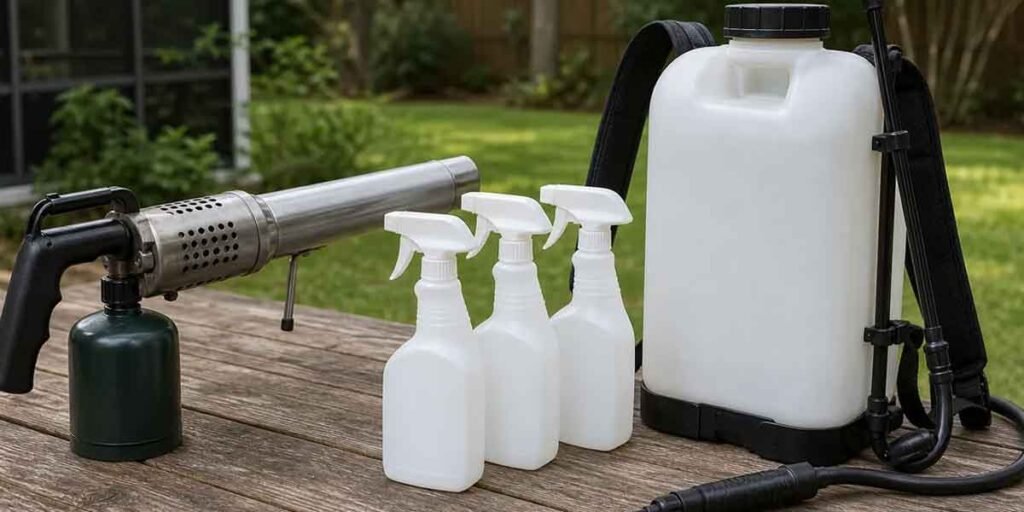
A one-time mosquitoes treatment runs about $135 to $251 on a typical lot. A full season of visits runs $373 to $694 with an average near $518, according to Fixr’s mosquito control cost page.
What that money buys is narrower than most residents expect: a measured band of foliage, a fixed number of visits, and the surfaces a product label permits a technician to spray.
How many insects are biting never enters the arithmetic. Two yards on the same street can price $300 apart for reasons a resident can measure, and acreage is only one of them. Planted cover, access, and the standing water on the property move a quote farther than any swarm does. Knowing which of those three drives the number is the difference between negotiating and guessing.
What a mosquitoes treatment cost estimate is built from
Five items carry the total: product volume, labor hours, visit count, treated area, and the parts of the property that cannot be treated at all.
Product is the cheapest of the five, and a heavier mosquito season almost never explains a heavier invoice.
| Line item | Published range | Source |
|---|---|---|
| Single barrier treatment, quarter-acre lot | $125 to $225, average $175 | HomeAdvisor, 2025 |
| One-time treatment, typical property | $135 to $251 | Fixr |
| Season of treatments, typical property | $373 to $694, average $518 | Fixr |
| Season of treatments, one acre | $800 to $2,000 | Fixr |
| Outdoor pest service, per visit | $99 to $249, most near $157 | Thumbtack |
| Installed misting system | $1,900 to $3,600 | Angi, 2025 |
A $135 treatment and a $2,000 season share a name and little else. The first is one pass over a small lot; the second covers a large property through a long warm season, with water treated as well and visits three weeks apart.
A phone quote and an on-site quote rarely match. Area can be measured from a map, and vegetation has to be seen, so the two items that move a total most are the two a remote price guesses at.
A barrier treatment is a residual spray applied to foliage and shaded resting sites, and it is the service most published prices describe.
Why the per-visit price is not the price you pay
HomeAdvisor’s 2025 mosquito control guide lists a quarter-acre lot at $125 to $225 per visit, averaging $175. Run that on the guide’s own three-week cycle across a twenty-week mosquitoes season and the arithmetic reaches about $1,200.
Season contracts lower the price of each stop. HomeAdvisor notes that recurring customers often receive a 10% to 20% discount, and Fixr’s seasonal average for a property of typical size is $518. Those figures describe a smaller lot in a shorter season.
A Gulf Coast season that runs eight months buys more visits than a northern season of five. Fixr ties its seasonal spread to location and to how long the local season runs.
Where the labor hours go
Labor follows access and surface area. A technician treats the shaded foliage where adult mosquitoes rest during the day, which means leaf undersides on shrubs, tree canopies, and the perimeter band of the yard.
Dense plantings take longer to cover, and so does a locked gate or a side yard a hose has to reach around.
Open lawn is not the target. Companies price the foliage where mosquitoes rest, which is how two lots of identical acreage produce bids $200 apart. Mature plantings on one and mowed grass with one hedge on the other accounts for the gap.
Why two yards on the same street price differently
Acreage sets the base, planted cover adjusts it, and water features add a line. HomeAdvisor’s per-visit table runs from $100 to $175 below a third of an acre up to $200 to $400 at a full acre.
Water that cannot be drained is a separate job with a separate product. The CDC recommends larvicides for large bodies of water that will not be drunk and cannot be covered or dumped out.
Which species breeds nearby decides part of the bill as well. Aedes aegypti and Aedes albopictus lay eggs in containers, so their larvae come out of a watering can or a birdbath a resident can tip over, while Culex mosquitoes need richer, more established water. A yard that produces its own mosquitoes loses most of them to a weekly drain, and a yard beside a marsh cannot.
Neighboring water matters as much as your own. Purdue Extension notes that female Culex mosquitoes feed and lay eggs within about a quarter mile of the site where they developed. The CDC puts Aedes aegypti and Aedes albopictus at a few blocks of flight in a lifetime.
An unmaintained pool two houses down keeps producing mosquitoes that no yard contract touches. That is a common reason a signed season of treatments still ends with bites in August. It also marks the limit of what a sprayer can sell, because a technician kills the adults on your shrubs while the next generation arrives from a property nobody at your address controls. Clogged gutters and abandoned pools on the block feed the same result.
The calendar that sets the visit count
Mosquitoes go from egg to biting adult in about 7 to 10 days, and one barrier application holds for roughly three weeks. Season contracts are written against those two numbers, which is why visits land three weeks apart.
The days between visits belong to whoever lives there. Mosquitoes lay eggs in containers, and the CDC’s 2024 control guidance is to empty and scrub, turn over, cover, or throw out anything holding water once a week.
Scrubbing sits in that sentence for a reason.
Aedes mosquitoes glue their eggs to container walls, and those eggs survive drying for up to eight months. Tipping a bucket out leaves the next generation stuck to the plastic. A stiff brush and ten minutes do what a rinse misses.
Water storage gets covered tightly or fitted with wire mesh whose holes are smaller than an adult mosquito. Tree holes get filled, and septic tank gaps and open vent pipes get repaired and screened.
Larvicide handles water that cannot be drained, from a fountain to a covered pool. Directions on a Bti dunk call for one briquette per 100 square feet of surface water, with the treatment effective for about 30 days.
The order of that work, from the containers you own to the water you cannot move, is set out in mosquitoes how to get rid of them. It covers when a larvicide is the right tool and when draining is.
The giant mosquito that does not need a treatment
A crane fly is a large insect with trailing legs that looks like a mosquito and cannot bite. Ohio State University and University of Maine Extension both describe adults that lack the piercing mouthparts mosquitoes use, living about one to two weeks.
Hovering insects the size of a thumbnail, large bugs that look like mosquitoes with their legs trailing, and the spring crowd on a porch light are the same insect.
A company will treat them if asked, and those invoices get paid every spring. Nothing about a crane fly justifies the cost.
An insect far larger than a mosquito, hanging with its legs trailing, that never lands on skin to feed is a crane fly. Watch the lawn if they are everywhere, since the larvae live in damp soil and thatch, and two invasive European crane fly species damage turf roots. That repair belongs to lawn care.
Prep work that changes the quote
An hour of preparation before the truck arrives decides how much of the property can be treated. Empty the containers, put pet bowls and toys away, cover a fish pond, and tell the company about any hive on or beside the property.
Those instructions come from the product label. EPA-registered pyrethroid products used for adult mosquito control are highly toxic to fish and other aquatic organisms, and their labels prohibit applying them directly to water.
Pollinators sit behind the same restriction. Labels carry a warning about bees exposed to direct treatment on blooming plants, which is why municipal programs spray for mosquitoes after dark, and a beekeeper next door changes where a technician can work.
A pond and a hive do not lower the invoice.
The area a company quotes is the area it covers, and the surfaces the label closes off mean less work for the same money. Mosquitoes in the untreated zone keep biting either way.
After the application, CDC guidance for adulticides is to keep people and pets out of the treated area until it dries, usually about an hour. Plants in bloom should be left untreated. Rinsing a treated patio the next morning washes off the residue that keeps working. Product labels set their own re-entry and watering restrictions. The sheet the technician leaves states the numbers for the product actually used.
The label is the legal limit on what a yard treatment can include. Federal law makes it a violation to use a registered pesticide in a way its labeling does not allow, and every state licenses the applicators who apply pesticides for hire.
Work that requires a product sold only to certified applicators, or that runs along a marsh, a farm, or a shared wall, belongs to a licensed applicator.
Where residents may be paying twice
Many counties already run mosquito control on public money. Alameda County’s mosquito abatement district describes itself as funded by property taxes and special benefit assessments, with services provided at no additional cost to residents inside its boundary.
The North Shore Mosquito Abatement District in Illinois states the arrangement plainly: tax dollars pay for the service, so residents are never charged when they request it. Santa Clara County’s assessment comes to about $14.90 a year for a single-family home.
Those districts handle the front half of the work. They inspect properties for breeding sources, treat larval habitat, test mosquitoes for disease, and give away mosquitofish for ponds and horse troughs in the districts that run the program. Contra Costa County’s mosquito and vector control district puts one mosquitofish at several hundred larvae eaten per day. That work is covered by the assessment, not by a monthly contract.
Districts do not handle ants, roaches, or termites, and they do not treat a private yard for adult mosquitoes on request. One call to a county health department or a state vector control association settles whether an address falls inside a boundary.
Questions to write down before comparing estimates
Seven answers turn two bids into comparable numbers. Without them, a company quotes from a phone description of a vague nuisance, and estimates for the same yard can differ by a factor of four.
- Lot size in acres, and the share of it under shrubs and trees.
- How many water-holding containers cannot be emptied: ponds, fountains, rain barrels, a covered pool.
- Whether hives sit on or beside the property, and where the technician is expected to work around them.
- Whether the address falls inside a mosquito abatement district boundary.
- How many visits the quoted price includes, and what an extra visit costs.
- Whether larvicide treatment for standing water is included or billed as its own line.
- What the contract requires between visits, and what voids the warranty.
The last two items decide whether a fixed quote stays fixed.
What insurance will not pay for
Homeowners policies treat insects as a maintenance matter. Virginia’s homeowners rules let an insurer exclude loss caused by birds, vermin, rodents, or insects, while still paying for a covered cause of loss that follows. Mosquito work lands on the excluded side.
A season of mosquitoes treatments is an out-of-pocket cost with no claim attached to the spraying itself.
Common questions about mosquitoes treatment cost
What is the average mosquitoes treatment cost?
Thumbtack’s outdoor pest control guide puts a typical service at $99 to $249, with most customers paying about $157. Fixr lists one-time mosquitoes treatments at $135 to $251 and a full season at $373 to $694.
Angi’s 2025 data sets the national average at $250 per treatment, which reflects larger properties under heavier mosquitoes pressure.
Is a misting system worth what it costs?
A professionally installed misting system runs about $1,900 to $3,600, and the CDC does not recommend misting systems for homes, citing harm to pollinators, unintended exposure, and insecticide resistance.
EPA does not regulate the equipment, and state pesticide agencies decide which products may be used in one.
Do carbon dioxide traps replace a service?
No peer-reviewed publications show carbon dioxide traps controlling mosquitoes, reducing their populations, or lowering biting rates under conditions typical of homes, according to UF/IFAS fact sheet ENY-692 by entomologist C. Roxanne Rutledge.
The units sell for roughly $300 to $1,400.
How often do mosquitoes need to be treated?
Three weeks is the usual interval between mosquitoes treatments, because that is roughly how long one application keeps working. HomeAdvisor builds its recurring schedule on the same three-week cycle.
A yard with a pond or a shaded border often needs the standing water treated between visits. That larvicide line is the add-on most commonly left off a first quote.
Does homeowners insurance cover a mosquitoes treatment?
Standard homeowners policies exclude insects and vermin, so a mosquitoes treatment is paid out of pocket.
An ensuing loss from a covered peril is assessed on its own terms, and a spray contract has nothing to do with that.
A quarter acre with no pond and no wooded border sits at the bottom of every published range. Standing water left in containers is what turns a $135 visit into a season contract.
