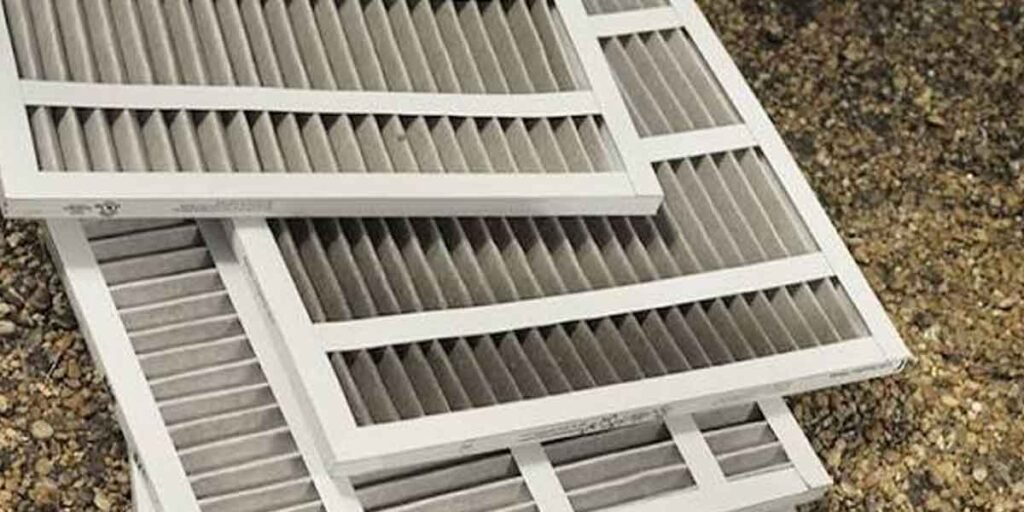
Buy the highest MERV your blower can pull without losing airflow. For most HVAC filters that means a pleated MERV 8 to MERV 11 in the deepest slot the cabinet already has, because the system judges a filter on static pressure and not on the particle number printed largest on the frame.
The rating on the box answers a question about particles in the air. The question that decides whether the blower, the coil, and the ductwork hold up is about airflow, and the two answers do not move together.
MERV, MPR, and FPR: Only One Scale Travels
MERV is the only rating you can compare between brands, because it comes from an independent test standard. MPR and FPR are brand and retailer scales that have to be translated back into it.
The number comes from ASHRAE Standard 52.2. A filter is tested in three particle ranges, 0.3 to 1.0 micrometers, 1.0 to 3.0, and 3.0 to 10.0, and its MERV is set by the worst of the three. MERV 8 has to catch at least 70 percent of the 3 to 10 micrometer band, which holds dust, lint, pollen, and mold spores. MERV 11 has to reach at least 65 percent in the 1 to 3 micrometer band, the range that carries pet dander, fine dust, and many bacteria. MERV 13 is the first common residential rating that has to do real work on the smallest band, at least 50 percent of particles between 0.3 and 1.0 micrometers, which is where smoke and most airborne virus carriers sit. Ratings of 17 through 20 describe HEPA-class media, a different product class with a different size and a different pressure cost.
Filtrete sells on MPR, its own Microparticle Performance Rating, and The Home Depot sells on FPR, a 4 to 10 color code. 3M publishes the mapping from its own scale: MPR 300 is MERV 5, MPR 600 is MERV 7, MPR 1000 and 1200 are MERV 11, MPR 1500 is MERV 12, MPR 1900 and 2200 are MERV 13, and MPR 2500 and 2800 are MERV 14.
- A Filtrete 1000 is MERV 11, not MERV 10. The number on the package is the MPR, and the two counts do not line up.
- FPR conversions disagree by a step between sources, because FPR folds in dust-holding capacity and not only particle capture.
- Both companies print a MERV equivalent somewhere on the packaging. If a filter carries no MERV figure at all, leave it on the shelf.
Know your target MERV before you reach the aisle, then compare only filters that state it on the frame.
The Static Pressure Your Blower Has Already Spent
A residential air handler is designed around roughly 0.5 inches of water column of total external static pressure, and the filter is the cheapest component in that budget to overspend.
An ASHRAE research project, RP-1299, measured airflow losses of about 4 to 11 percent when higher-efficiency filters went into residential and light-commercial test systems. MERV 11 filters cost 7 to 11 percent of the airflow in a test house, and MERV 8 filters cost 3 to 8 percent against the low-efficiency baseline. Those are system-level numbers, read at the equipment.
What the same research does not support is the shorthand most shoppers carry: that a higher MERV always means more restriction. Lawrence Berkeley National Laboratory ran the field work behind this and concluded that pleat geometry, filter depth, and face area matter enough that MERV alone cannot be used to estimate a filter’s pressure drop. The California Energy Commission reached the same place from its own filter database, finding that pressure drop varies widely across MERV 6 to 13 and is not directly tied to the rating. Two filters with the same MERV can load a blower very differently.
A 20x25x1 Filtrete MPR 1900, rated around MERV 13, starts at 0.08 inches of water column at roughly 515 CFM and 0.18 at 1,025 CFM, then climbs toward 0.5 when loaded, according to the California Energy Commission filter data published by The New York Times Wirecutter. The MPR 1000, an MERV 11 filter of the same size, shows nearly identical resistance and much weaker capture in the 0.3 to 1.0 micrometer band. Efficiency and pressure drop are separate variables, and the loaded figure is the one your blower spends most of the season fighting.
LBNL monitored ten central forced-air systems for a year, from MERV 6 up to 16. Moving a system to MERV 16 cut airflow by an average of 22 percent where the blower used a permanent split capacitor motor, and 15 percent where it used a brushless permanent magnet or ECM motor. Filter pressure roughly doubled. Ratings from MERV 10 to 13 changed energy use by less than 1 percent across a wide range of conditions. MERV 16 carried a potential energy penalty above 5 percent, and close to 20 percent in a hot climate with leaky ducts and a BPM blower.
Bypass is the failure that gets missed. The same California field work found high-efficiency filters raising airflow resistance enough to drive air around the frame, add noise at the return, and in one case pull a filter partly out of its slot within hours of installation. High-rated HVAC filters earn their place only on a low-leakage duct system, where the air has no route except through the media.
The motor decides how the problem shows up. A PSC motor, still the single-speed workhorse in most existing systems, simply delivers less air. A variable-speed ECM motor tries to hold its airflow and draws more power instead, so the first symptom is a higher bill rather than a quieter vent.
Read the blower type and the cabinet depth before choosing a rating.
Depth Buys More Than Rating
Four inches of MERV 11 usually does more for a system than one inch of MERV 13, because depth lowers pressure drop and slows the rate at which the filter loads.
LBNL’s measurements put the average pressure drop of 4-inch deep filters at 94 pascals against 110 pascals for 1-inch filters, and the deep media loaded at 5.6 pascals per million kilograms of air against 10.6 for the thin ones. Deep media present more surface area to the same airflow, so each square foot of media carries less dust and resistance climbs more slowly. Consumer Reports puts the service life of a 1-inch filter at about three months and of a 4-inch filter at about twelve, which is the same mechanism described on a calendar.
Depth also decides what physically fits, and the labels are nominal. A filter sold as 16x25x1 measures about 15.5 by 24.5 by 0.75 inches. The industry convention cuts roughly half an inch from the face dimensions and a quarter inch from the depth so the frame slides without binding. The thickness convention runs the same way: a 1-inch filter is about 0.75 inches thick, a 2-inch is about 1.75, and a 4-inch is about 3.75.
Measure the slot opening, not the filter you are removing. A loaded filter warps, and a warped one sends you back to the store with the wrong size. Take the inside dimensions where the frame seats, never the outside of the cabinet lip. If the opening lands on a true fraction, say 17.5 inches, the slot is a custom size: rounding down lets unfiltered air bypass the media, and rounding up means the frame will not seat. Do not force a thicker filter into a shallow slot.
Loading does not follow the calendar evenly either. A 1-inch filter in a house with two dogs can lose a visible share of its design airflow well before the third month, and the first sign is usually the blower note changing, not a dirty-looking frame. For most HVAC filters, the slot depth sets the loading curve before the rating enters the picture.
The Rating That Declines With Use
MERV describes a clean filter on a test bench. MERV-A describes the same filter after the electrostatic charge has been conditioned off its media, and it is the number that predicts an electret filter’s second month. Most HVAC filters sold in the allergen aisle are electret media, which is why the gap matters at the top of the rating range.
ASHRAE added that test in 52.2-2007 as Appendix J. A filter is challenged with fine potassium chloride particles until any embedded charge is neutralized, then rated again, and the result is published as MERV-A. The addition exists because media that rely on an electret charge post high numbers when new and lose efficiency once that charge goes. 3M’s own technical paper works through one example: a filter marketed as MERV 14 with a MERV-A of 13 fell from 92 percent efficiency on the smallest particle band when clean, to 84 percent after standard conditioning, 64 percent at the Appendix J minimum, and 53 percent fully discharged.
Fine-fiber media that work by interception and impaction behave differently. They do not lose efficiency as they age, so their MERV and MERV-A are typically the same figure. When a package prints both numbers, buy on the MERV-A. When it prints only MERV on media that lean on charge, plan for the lower value.
Washing is where the gap gets expensive. Patent filings for electrostatic media describe a MERV 11 filter dropping to MERV 8 or lower after a single wash, and name the cause: water dissipates the charge the rating was built on. Canada Mortgage and Housing Corporation tested residential electronic filters in place and found performance falling faster after cleaning than the manufacturers had led homeowners to expect. One house went from 75 percent particle removal to 35 percent within 48 hours. A washable filter reinstalled damp also moves moisture and its smell into the ductwork.
Which media survive a wash, the drying step most people skip, and the point where cleaning stops making sense are explained in hvac filter how to clean it and when to replace it instead.
When MERV 13 Earns Its Restriction
MERV 13 pays off when wildfire smoke, pollen season, or a diagnosed allergy is the problem and the cabinet is deep enough, or the blower variable-speed enough, to carry the extra restriction.
The EPA’s Indoor airPLUS program sets MERV 8 as the floor for new homes and recommends the highest rating the fan and the filter slot can handle, on the strength of PM2.5 health effects. Its filtration guidance treats MERV 13 as the point where at least half of the smallest particles are captured. ASHRAE 62.2, the ventilation standard, uses MERV 6 as a common minimum for residential mechanical ventilation. MERV 8 covers equipment protection for nearly every house. MERV 11 is where pet dander, fine dust, and bacteria begin to come out of the airstream. The HVAC filters shelved above MERV 13 buy smaller gains for steadily more static pressure.
Where 13 is worth its cost: a system with a 4 to 5 inch media cabinet, or a variable-speed blower, in a region with smoke events or heavy pollen. A 1-inch slot fed by a PSC blower with no static pressure reading is the wrong place to try it. The 4 to 11 percent airflow loss in the ASHRAE work and the 22 percent loss LBNL measured at the top of the scale both landed on systems whose blowers had no reserve. Lower airflow means a colder coil, longer run times, and in a hot climate, a coil that ices.
HEPA is not the next step up. The EPA states that true HEPA filters are normally not installed in residential HVAC systems, that adding one to an existing system would require professional modification, and that a typical air handler and its ductwork cannot accommodate the size and the airflow resistance. The same guidance notes that medium-efficiency filters in the MERV 7 to 13 range are likely to be almost as effective as true HEPA at cutting the indoor particles tied to health effects, and that the gains above MERV 13 are modest. For HEPA-grade filtration in an ordinary house, the workable answer is a portable unit with a true HEPA element in the room that needs it, or a purpose-built bypass system designed for the pressure.
Asthma and allergy symptoms are diagnosed and treated by clinicians. A higher-MERV filter lowers airborne particle counts, which is the full extent of what it does for a person with a respiratory condition.
Replacement intervals come from load, not from the calendar. ENERGY STAR advises checking the filter monthly during heavy-use seasons and changing it at minimum every three months, and the DOE figures behind that guidance credit routine filter changes with roughly 5 to 15 percent lower air conditioning energy use. The check that matters takes ten seconds: hold the loaded filter up to a light and see how far the gray has climbed through the pleats. I keep a spare in the utility closet and write the install month on the frame with a pencil, because the blower note changes before I remember to look.
Common Questions About HVAC Filters
What does an HVAC filter actually do?
It protects the blower, the evaporator coil, and the ductwork from dust, and it removes airborne particles from the air the system recirculates. In most houses it is the only particle filter in the system. It does not disinfect, humidify, or cool anything.
Which HVAC filters are worth buying for a home with allergies?
Match the rating to the slot: MERV 11 in a 1-inch slot, MERV 13 in a 4 to 5 inch cabinet or behind a variable-speed blower. MERV 8 is the basic floor EPA’s Indoor airPLUS program requires. Pet dander sits in the 1 to 3 micrometer band, where MERV 11 pulls ahead of basic media, and smoke particles sit below 1 micrometer, which is the band MERV 13 was designed to reach.
How much does a higher-rated filter cost to run?
Energy cost stays small until the rating jumps: LBNL measured under 1 percent at MERV 10 to 13, above 5 percent at MERV 16, and near 20 percent with leaky ducts and a BPM blower in a hot climate. The larger cost is the airflow an over-restrictive filter takes away, which shows up as longer run times, uneven room temperatures, and a coil that runs colder than it should.
Do washable filters keep their MERV rating?
Usually not. Electrostatic media lose their charge in the wash, and patent documents describe MERV 11 media falling to MERV 8 or lower after a single cleaning. A MERV-A figure on the package is the number to compare. Mechanical fine-fiber media hold their rating better, which is why some reusable filters keep working and others quietly stop.
What number is worth having before the next filter purchase?
A static pressure reading. Most residential air handlers are designed around about 0.5 inches of water column of total external static pressure, and a technician can read the actual figure in a few minutes with a manometer. If the system already sits close to that limit, deepening the filter cabinet comes before raising the MERV. Cutting a deeper media cabinet into a return drop is sheet-metal and electrical work, so that part belongs to a licensed technician.
