A duct cleaning quote is priced per system, not per house. Two companies can stand in the same hallway, look at the same return grille, and hand over numbers three times apart, because each is describing a different amount of work. The dollars follow the scope: how many air handlers, how far the runs travel, what must be opened to reach them, and what condition they are in.
Most of what decides that total is answerable before a truck shows up. The Environmental Protection Agency names five cost drivers in its residential duct guidance, and the add-ons are where estimates break.
The Five Inputs Behind Every Duct Cleaning Estimate
The EPA lists five cost drivers for a residential job: the services included, the size of the system, its accessibility, the climate the house sits in, and the level of contamination. Its guidance puts duct cleaning at $450 to $1,000 per heating and cooling system. Every other line on a quote is one of those five in a different costume.
A number quoted without anyone looking into the system is a guess wearing a labor rate. Ask which of the five moved the price, and a contractor who did the walkthrough can answer in a sentence: the second air handler in the crawlspace, the return plenum boxed shut behind drywall, forty years of debris pulled through an unsealed filter slot.
Three billing bases get used in the same market, and mixing them is how two estimates stop being comparable.
| Billing basis | Typical figure | Source of the figure | What it leaves out |
|---|---|---|---|
| Per system | $450 to $1,000 for one heating and cooling system | EPA residential duct guidance, EPA 402-K-97-002, October 1997 | Access holes cut and closed, chemical treatments |
| Per vent | About $35 per vent, in a $25 to $50 range | NerdWallet’s air duct cleaning cost page | Coils, blower, and drain pan unless named in writing |
| Per hour | $90 to $125 an hour, three to eight hours on a typical cleaning | Same NerdWallet page | Equipment, materials, and travel |
Converting between the first two takes one multiplication. A 1,400-square-foot house with twelve supply and return vents lands near $420 on the per-vent basis, which sits under the EPA’s per-system floor and close to the middle of NerdWallet’s $270 to $500 band. Neither number is wrong. They price different lists of work.
What System Count and Vent Count Do to the Total
Each air handler is its own job, so a two-system house roughly doubles the floor of the estimate. Vent count then sets the hours in that work, since every register and diffuser has to come off, be cleaned, and go back.
The arithmetic is worth doing once. NerdWallet’s labor figure runs $90 to $125 an hour for three to eight hours on a typical cleaning, which multiplies out to $270 at the low end and $1,000 at the high end. That upper figure is the same ceiling the EPA published for a single system, which says something useful about the spread between cheap and expensive quotes: it is hours and scope more than it is a decade of inflation.
Contractors who advertise hvac duct cleaning as one package are often quoting the air handler, the coils, and the duct runs together, the arrangement NADCA favors on technical grounds. Splitting them apart puts both pieces on the page, which is how you see what the low bid dropped.
The count that surprises people is not the supply registers. It is the returns. A house with one large return grille in a hallway is a shorter visit than a house of the same square footage with a return in every bedroom, and the difference arrives as labor hours instead of as a line anyone explains.
What the Work Includes, and What Counts as an Add-On
“Air duct cleaning” is a name the trade discourages, because NADCA’s position is that the whole air handler gets cleaned, and a quote limited to the runs prices part of a system. Its component list is the fair comparison: air ducts, coils, drain pan, registers, grilles, air plenum, blower motor and assembly, heat exchanger, air filter, and air cleaner.
Source removal is the method behind those components. Technicians agitate the surfaces with brushes, air whips, compressed-air nozzles, or skipper balls, then collect what they loosened under continuous negative pressure, so the material leaves the building instead of settling in a bedroom. Where no existing opening reaches a run, the crew cuts a service opening and closes it airtight afterward, and that cut-and-close work is the part NADCA calls craftsmanship as much as labor. NADCA publishes the method as ACR, the NADCA Standard, and the current edition of that document is dated 2021.
Add-Ons That Change the Scope
Four add-ons appear on real estimates, and each carries a condition worth reading before you approve it.
- Sanitizer or biocide. No product is registered by the EPA for use on fiberglass duct board or fiberglass-lined ducts, and the few registered products for bare sheet metal interiors are meant to follow mechanical cleaning. Spraying one into a running system is the practice the agency cautions against, since much of the material travels through the ducts and settles elsewhere in the house. Ask which interior surface the product is labeled for.
- Duct sealing. Sealing leaks in the duct shell is a different practice from coating the inside with an encapsulant, and the EPA treats the two separately. The first can cut heating and cooling bills. The second has no demonstrated effect on cleaning outcomes.
- Flex duct replacement. Flexible duct can be cleaned with soft-bristled brushes, and the EPA notes that replacing accessible sections is sometimes the cheaper route. On a long run behind a finished ceiling, replacement is also the honest option.
- Mold and asbestos work. NerdWallet puts mold and mildew removal at $1,223 to $3,753 and asbestos removal at $5 to $20 per square foot, both well above the cleaning itself. Asbestos-containing insulation in a duct system should not be disturbed by a cleaning crew at all.
What Money Cannot Fix in a Duct System
Wet or moldy insulation is a replacement item, not a cleaning item. The EPA, NADCA, and the insulation manufacturers give the same instruction for fiberglass duct board and fiberglass-lined ducts, and the reasoning is unflattering to anyone selling a cleaning: once that material is contaminated, cleaning does not stop regrowth, and no biocide is registered for porous duct interiors. Steam cleaning should not be used on ductwork of any kind.
Before you authorize a mold line item, settle whether the dark patch is mold. The EPA’s guidance points to a $50 sample on a strip of household tape sent to a microbiology lab, a cheap answer to a question that otherwise gets priced by the person selling the fix.
The condition that caused the growth matters more than the growth.
An estimate that carries a wet insulated run as a cleaning line is quoting work that cannot succeed at that price, because the section still has to come out. The money for that line belongs to replacement, not to cleaning.
A crew that removes the visible material from a metal duct without fixing the water source leaves you buying the same work twice, and the EPA states that plainly as a warning about recurrence.
Furnace and Duct Cleaning: Where the Scope Stops
Furnace and duct cleaning gets bundled in autumn, and the heat exchanger is why the bundle deserves a boundary. Cleaning the air side of a heat exchanger is routine work for a duct crew. The burners, the flue, and anything that decides whether carbon monoxide leaves the house belong to a technician who can test combustion, and the EPA’s seasonal advice for fuel-burning equipment is an inspection and service before each heating season.
Timing a heating duct cleaning for late autumn buys nothing on price and can cost a second visit, since a wet coil found after the system has run for a month means shutting it down again. The cooling season has just ended when the coil has dried and the system has not yet been cycling hard, and that stretch is when an inspection tells you the most about moisture.
What to Have Ready Before the Crew Arrives
Clear the path first. Attic hatches, crawlspace doors, and the closets that cover a return chase are the access points a crew needs, and time spent moving boxes bills as work. Three more jobs belong to you: pets out of the house, the system off at the thermostat and the breaker, and the water leak repaired first.
Access is the item people underestimate. A run that opens only through a cut in a finished hallway ceiling costs more than the same run reached through a hatch the builder already framed, and a crew that arrives to find that hatch behind a stack of winter coats either bills the delay or skips the branch and leaves it off the invoice quietly.
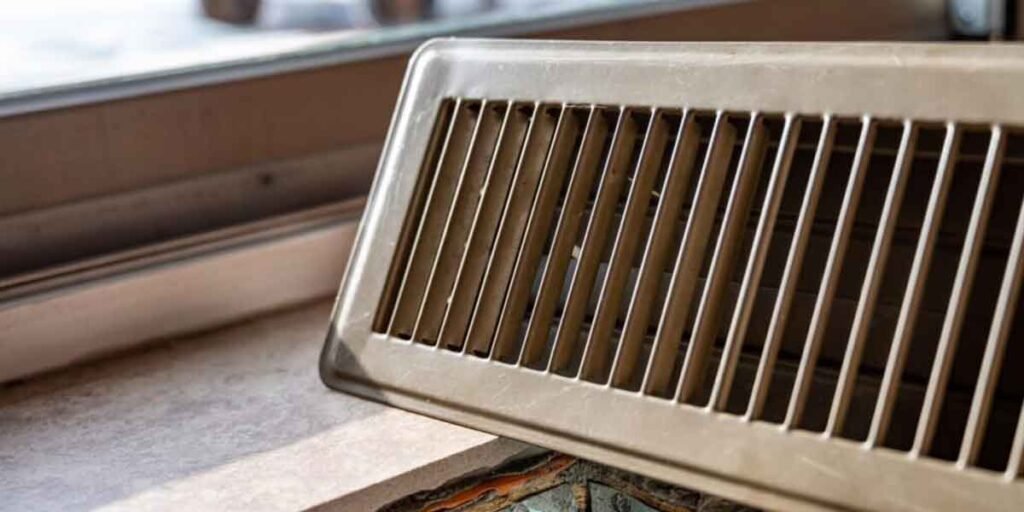
Registers and return grilles are the part you can finish yourself. Pull them, wash them, put them back. The EPA’s guidance calls a dusty return grate normal and treats it as no evidence of contamination in the duct, so cleaning those faces removes the most visible dirt in the system at no cost.
Wiping technique decides how that goes. Work in one direction with a clean face of the cloth and a fresh side before the last pass, the same sequence achieve crystal clear windows your guide to streak free cleaning describes for glass, and painted grille faces dry without streaks or lint lines.
Reading Two Estimates Side by Side
Convert both quotes to the same basis before reading the totals: turn per-vent pricing into a per-system figure, then check which components each one names. The EPA’s post-cleaning checklist works as the comparison sheet, because a written estimate can be required to answer to it.
Five items separate a quote that holds up from one that grows on the day of the visit.
- Which components are named, including both faces of the cooling coil, the drain pan, the blower blades, the return plenum, and the heat exchanger surface.
- Where the access openings will be cut and who closes them airtight, since that work decides whether the estimate covers the messy part of the visit.
- Whether a treatment is included by default or offered as an option with its own price, and which surface the product is registered for.
- What the vacuum exhausts, and whether the equipment pulls to the outdoors or runs HEPA filtration indoors.
- How the work gets verified at the end, and whether payment is tied to that verification.
Verification happens at the end of the visit, and the EPA’s checklist supplies the questions. Is the heat exchanger surface visibly clean? Are both sides of the cooling coil visibly clean? Does a flashlight pointed into the coil shine through from the other side? Are the fins straight and evenly spaced? Is the drain pan clean and draining? Are newly installed access doors attached with screws or rivets instead of tape? Do the registers sit flush again? Does the system run in both heating and cooling afterward? Written into an estimate, those questions turn a receipt into something you can check.
Two claims should end the conversation. A company describing itself as certified by the EPA is describing something that does not exist, since the agency neither sets duct cleaning standards nor certifies, endorses, or approves cleaners. A company recommending the service as routine annual maintenance is arguing against the guidance it is citing, which recommends cleaning on an as-needed basis.
Licensing is a separate question.
The EPA lists Arizona, Arkansas, California, Florida, Georgia, Michigan, and Texas as states that required a special license for air duct cleaners as of 1996, and it directs readers to state consumer protection offices for current rules. One question to that office settles it.
Keeping Dirt and Moisture Out Between Cleanings
The EPA splits prevention into two lists, and both of them spend money differently than a cleaning does. Filtration comes first: run the highest-efficiency filter the equipment manufacturer recommends, change it on a schedule that fits the cabinet and the dust load in the house, and confirm that air cannot slip past the filter through gaps around the holder. A gap there sends the dust the filter was built to catch straight to the coil.
Moisture is the second list, and the EPA calls controlling it the most effective way to prevent biological growth in ducts. Condensation on or near the cooling coil is the usual source, so a condensate pan that drains freely and insulation near the coil that stays dry deserve more attention than any treatment applied to the ducts.
Duct runs in attics and crawl spaces belong on the same list, since sealing and insulating them where the house does not condition the space keeps condensation off cold duct surfaces and keeps the system delivering the capacity it was sized for.
Duct Cleaning Cost: Answers to Common Questions
How much does duct cleaning cost on average?
Expect $270 to $500 for a typical job, with NerdWallet putting the average at $389, and $450 to $1,000 per heating and cooling system in the EPA’s guidance. The gap between those bands is billing basis, not disagreement, because one figure describes vents priced at roughly $35 each and the other prices each air handler.
Is duct cleaning really worth it?
It is worth doing when one of three EPA conditions is present: substantial visible mold on hard-surface ducts, vermin in the ducts, or debris heavy enough to block airflow or discharge from the supply registers. Without one of those, duct cleaning has never been shown to prevent health problems.
How do I know if my air ducts need cleaning?
Look for the three conditions, not for a calendar date. Visible growth on sheet metal, rodent or insect activity in the runs, and dust blowing out of supply registers are the signals worth paying for. A dusty return grille is none of them.
What are the downsides of air duct cleaning?
An inadequate vacuum collection system can release more dust and debris into the house than it removes, and careless work can damage ducts or equipment in ways that raise heating and cooling costs. The EPA also flags biocide and ozone treatments as poorly studied in ductwork, with nothing registered for fiberglass-lined interiors.
Does duct cleaning improve HVAC efficiency?
Cleaning the ducts alone has little evidence behind it. The EPA notes that some research supports cleaning the cooling coils, fans, and heat exchangers for longer equipment life and lower energy use, and those components belong in the same estimate if you are paying for a cleaning at all.
The three conditions decide the work. Where none of them is present, the least expensive correct estimate for duct cleaning is zero, and the better place for the money is a filter that gets changed on time and a coil that gets cleaned at the annual service.
