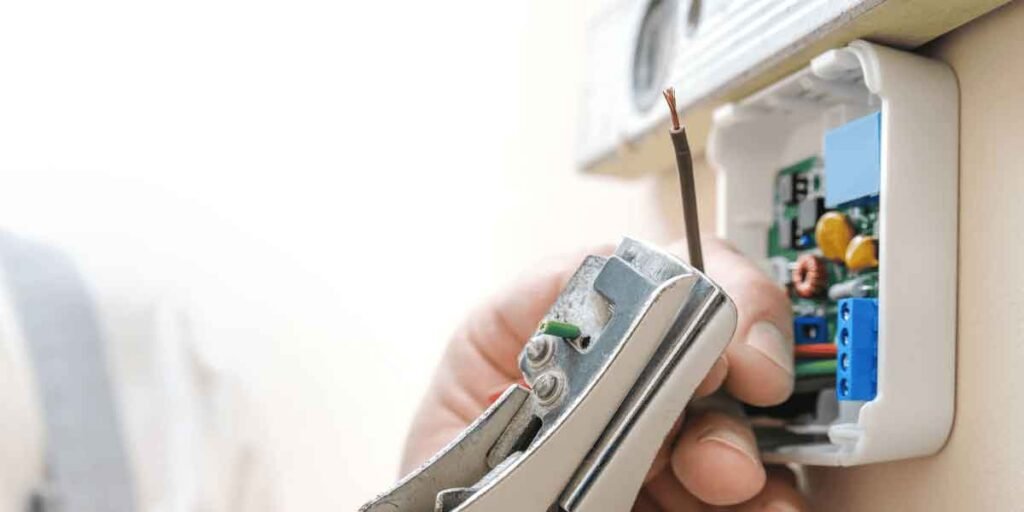
A thermostat replacement costs about $75 to $600 installed, and most same-spot swaps land between $200 and $450 once the device, the labor, and a standard low-voltage check are counted.
Two contractors can quote the same hallway job $300 apart and both be right, because each is pricing a different bundle: the device, the wiring work, the hours on site, the drywall, and whoever supplies the power wire.
Compare the line items first. The totals start meaning something after that.
Why Two Quotes for the Same Job Diverge
Published prices for thermostat replacement disagree by hundreds of dollars because they measure different bundles. Home Depot’s installation service starts at $99 with no device named, HomeWyse put the national average for an installed thermostat at $422 to $506 in May 2026, and Trane’s cost guide lists device prices from under $50 to $640.
Those three figures describe three different things. The $99 entry is labor-led with equipment unspecified. The average assumes a technician supplies the unit. The $640 ceiling is a premium smart thermostat at retail, before anyone opens a wall.
One HVAC contractor’s published cost page adds a fourth data point: $75 to $595 for the whole job, with a national average near $267 for a unit plus professional installation.
Read the four together and the market takes shape. Most homeowners pay for a device plus three hours or less of low-voltage work, and the outliers at either end are scope differences, not regional price shocks.
Ask which basis a quote uses: a flat price for the job, an hourly rate plus materials, or a rate tied to a service agreement. Bids built on different bases cannot be ranked on price alone.
The Wiring Inside the Wall Sets the Floor
Modern heating and cooling thermostats run on a 24-volt AC control circuit powered from inside the furnace or air handler. That is why the cable at the wall is thin, low-voltage, and safe to handle once the breaker is off.
How many conductors that cable carries decides the job more than any feature on the box.
A two-wire cable typically serves heat only, and on older gas fireplaces and water heaters it often carries a millivolt signal rather than 24 volts. Four or five conductors support heating, cooling, and fan control. A heat pump needs a reversing-valve conductor, labeled O or B depending on the equipment, plus a conductor for auxiliary heat. Two-stage and variable-speed equipment needs one conductor per stage.
Then comes the common wire. Consumer Reports describes the C-wire as the conductor that feeds continuous power to a thermostat’s display and Wi-Fi radio, and most connected models want one at the wall. Older heating systems often bring only two low-voltage wires to the thermostat and have no C-wire at all.
Four routes exist when that wire is missing. Ecobee and Honeywell Home sell models with a power adapter or power extender that creates the equivalent connection at the equipment, and third-party add-a-wire adapters do the same work behind the wall.
Nest and Emerson Sensi advertise models that run without a C-wire on many systems, charging an internal battery while the equipment operates. Some HVAC technicians warn that arrangement can stress older equipment.
The fourth route is a technician pulling a new conductor from the furnace to the wall, and that is where labor hours start climbing.
One boundary sits outside all of this. Line-voltage thermostats on electric baseboard heaters and direct-wired electric furnaces switch household power at 120 or 240 volts, and the switching current commonly exceeds 40 amps. A low-voltage thermostat on that circuit damages itself at best and risks a fire at worst, which puts the work in an electrician’s scope. The same caution applies in any home where the wiring at the thermostat wall is not the thin control cable.
Device Prices by Band, and Where the Dealer Channel Sits
About 42% of U.S. households still run a non-connected programmable thermostat, according to the Energy Information Administration’s 2020 residential energy consumption survey. That band is where the price ladder starts.
Retail device prices and installed totals separate into four bands. The installed column is what a homeowner actually pays.
| Band | Device price, retail | Installed total | What that buys |
|---|---|---|---|
| Manual, non-programmable | $15 to $35 | $80 to $190 | On/off control, no scheduling, single-stage equipment |
| Digital programmable thermostat | $20 to $150 | $160 to $340 | Time-of-day schedules; fits most gas, oil, and standard cooling systems |
| Wi-Fi and smart | $100 to $350 | $200 to $450 | App control, learning schedules, remote sensors, energy reports |
| Dealer-channel brands | $150 to $850 | Quote only | Carrier and Lennox units sold through contractors rather than retail shelves |
Brand pricing inside those bands spreads wider than the bands suggest. Consumer Reports lists a digital thermostat from Honeywell Home at $20 to $250, Lux at $18 to $150, Emerson thermostats sold under the Sensi name at $30 to $150, Google Nest at $130 to $250, Ecobee at $150 to $250, and Venstar at $75 to $220.
Compatibility gates the top two bands. Consumer Reports notes that the Nest Thermostat does not support ventilation systems while the Nest Learning Thermostat does, and that a house with separate heating and cooling equipment may need a thermostat for each system and each zone.
Picking a smart thermostat for AC and heat pump equipment asks more of the configuration step than of the mounting step. Not every model supports every type of HVAC system, and the reversing valve and auxiliary heat settings are where an incorrect setup gets expensive.
Add-Ons and Preparation That Change the Invoice
The lines that turn a $250 replacement into a $600 one are mostly about access and repair. Moving a thermostat to a better wall means new cable and patched drywall, published at $135 to $450, a single new C-wire conductor runs $90 to $135, and covering the gap left by a smaller replacement costs $75 to $150 in drywall and paint.
Location produces some of that work. A thermostat on an exterior wall, in a draft, or in direct sun reads the wrong temperature and cycles equipment harder, which is why Consumer Reports’ installation guidance puts it on an interior wall away from vents and sunlight.
Preparation is the part a homeowner controls, and it costs nothing:
- Switch off the breaker feeding the furnace or air handler and confirm the thermostat display is dead.
- Photograph the terminals with the wires still attached, and write down the color order.
- Record the model and serial number from the equipment nameplate.
- Note whether the system is single-stage, two-stage, or variable-speed.
- Confirm whether it is a heat pump, and whether it has auxiliary or emergency heat.
- Check Wi-Fi signal strength at the wall if app control is the goal.
- Clear the work area and keep pets away from the open panel.
Two answers send the job to a professional: a thermostat that moves or needs new cable, and a system that runs on line voltage. Everything else is a swap.
When the wiring matches and the unit stays in place, the mechanical sequence is documented in thermostat how to install it the safe five. What that sequence cannot supply is a decision on which device the system will accept, and that decision has to happen before anything is bought.
Six answers make two estimates comparable:
- Which model, and does the price include the device?
- Is the existing C-wire reused, extended, or replaced by an adapter?
- If a new conductor has to be pulled, is that work priced in?
- Is drywall patching and paint included when the new unit is smaller?
- Who configures the schedule, registers the device, and takes the old unit away?
- Is the price flat for the job, or hourly plus materials?
What the Hardware Recovers in Energy Costs
Heating and cooling consume almost half of the average American household’s annual energy bill, more than $900 a year, according to Energy Star. The savings credited to the controls are smaller than the hardware marketing implies.
Consumer Reports cites Energy Star figures of about 8% off heating and cooling bills, an average of $50 a year, for a smart thermostat adjusted through an app. Manufacturers of the same devices claim $100 or more. Both numbers rest on how far the temperature is allowed to drift while the house is empty.
That dependency is why payback differs from house to house. A household that sits empty for nine hours a day has room for a setback schedule. A home with someone in it all day, or a heat pump that recovers slowly after a deep setback, has far less room.
Utility rebates change the arithmetic again. Energy Star maintains a rebate finder for certified products, local programs change every year, and one call to the utility before choosing a model can beat any payback claim printed on a box.
Thermostat Replacement: Questions That Decide the Job
How much does a thermostat replacement cost?
A thermostat replacement typically costs $75 to $595 for the device and professional installation, with a national average near $267 and band-level totals running from $80 for a manual unit to $450 for a Wi-Fi or smart model.
The low end assumes a same-spot swap with wiring that already works. Relocating the unit, pulling a new C-wire conductor, and patching drywall add $90 to $450 in published ranges.
Can you replace a thermostat without a C-wire?
Yes, in most homes. Models sold with a power adapter or power extender, third-party add-a-wire adapters, and thermostats built to run without a common wire all avoid pulling a new conductor.
Nest and Emerson design some models to charge an internal battery while the equipment runs, an arrangement some HVAC technicians discourage on older systems.
Do you need an electrician to replace a thermostat?
An electrician is needed when household power passes through the thermostat itself, which is the case on electric baseboard heaters and direct-wired electric furnaces. Those devices handle 120 or 240 volts with currents that can exceed 40 amps.
On standard 24-volt control circuits, which cover most gas, oil, and heat-pump systems, an HVAC technician or a homeowner can do the swap.
Can you buy a new thermostat and swap it in yourself?
Buying the device first works when the existing cable has enough conductors, a C-wire is present or not required, and the thermostat position stays put. Consumer Reports warns that not all smart models support all HVAC types, so the system has to be identified before the model is chosen.
On a heat pump with auxiliary heat, or a two-stage system, the reversing valve and auxiliary heat settings decide whether the replacement runs as intended.
