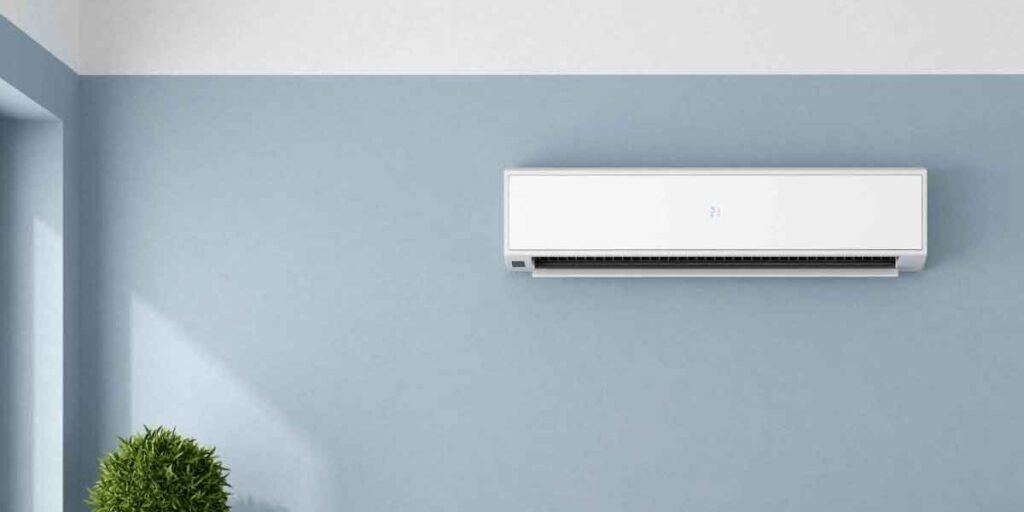
Mini split systems fit zoned loads and ductless houses. On anything wider, the same money usually goes further somewhere else — into ducts, into insulation, or into a ducted heat pump.
A single wall head cools a converted garage office, a finished attic, or a sunroom that never shared the house thermostat, and it does that job for years with no attention beyond a filter rinse. Scale the identical equipment up to five zones replacing a furnace in a drafty farmhouse and the complaints arrive in a predictable order: the February bill, the frozen condensate line, the smell from an uncleaned blower wheel, then a quote to relocate everything after a renovation moves the wall the head was mounted on. The gap between those two outcomes is a fit test, and it runs through the room, the weather, the wiring, and the paperwork.
What follows is that test.
Do Mini Split Systems Lower Energy Bills?
Often, and for a mechanical reason: ENERGY STAR puts duct losses above 30 percent of a home’s space-conditioning energy, and a ductless head delivers its air straight into the room it serves.
That 30 percent is the whole case. A ducted system can be efficient at the air handler and still lose a third of its output between the plenum and the register, through leaks, conduction, and long runs routed through a 130°F attic.
Zoning adds a second saving that has nothing to do with efficiency ratings, because a room nobody occupies does not need conditioning.
Two conditions break the arithmetic. When doors between rooms stay open through the day, a house behaves as one zone no matter how many heads hang on its walls, and the system pays for itself in appearance instead of kilowatt-hours. When a mini split is sized to carry a heating load meant for a furnace in a cold climate, the resistance element becomes the default heat source in January, and that element operates at an efficiency near 1.0.
Utility programs make the better test of a specific model than any brochure claim does, and several publish qualifying product lists tied to verified ratings for the climate zone they serve.
What the Efficiency Ratings Require
Since January 1, 2023, a split-system heat pump sold in the United States, ductless included, has to reach at least 14.3 SEER2 and 7.5 HSPF2, the numbers AHRI lists as equivalent to the old 15 SEER and 8.8 HSPF. Compliance follows the date of manufacture, so a unit built before that date can legally be sold and installed now.
The AHRI certificate is the document that matters here. Rebate administrators and program auditors will not accept a manufacturer’s own claim of equivalence, which is why the certificate number belongs in the written quote.
The heat pump version of a ductless system carries both ratings, while a cooling-only mini split ac carries SEER2 alone and no HSPF2 figure at all.
Which Homes Fit Mini Split Systems?
A mini split fits a defined room or addition with an exterior wall for the indoor head, a dedicated circuit for the outdoor unit, and a route for condensate to leave the building. A house that needs one thermostat to hold every room even is usually better served by a ducted heat pump.
The category is wider than the wall head most people picture: Mini Split Systems also include ceiling cassettes, floor consoles, and short-duct air handlers, all fed by one outdoor compressor. The fit question stays the same for all four.
Additions, converted attics and basements, garages, and older houses without ducts cover most of the successful installs, since the alternative is building a duct system into framing that was never planned for one. A second group is room-level comfort problems inside a ducted house, such as the bedroom over the garage that never cools while the rest of the floor sits at 68°F.
| House condition | Ductless fit | Why it goes that way |
|---|---|---|
| Finished attic, garage office, or addition with one exterior wall | Strong | One zone matches how the space is actually used, and no duct has to be routed |
| One room that never keeps up with the rest of the house | Strong | A second zone fixes the room without rebalancing an entire trunk line |
| Whole house, one thermostat, evenly distributed rooms | Weak | Zone savings depend on rooms you can close off |
| Historic facade or a building with rules on exterior equipment | Weak | The outdoor unit needs a slab or bracket, a wall penetration, and a drain path |
| House with sound ducts and an aging furnace | Weak | Sealed ducts and a new air handler cost less per delivered BTU |
| Cold-climate house using the system as its only heat source | Conditional | Cold-climate models hold capacity at 5°F, and the load calculation decides the rest |
Two rows in that table flip on a load calculation, the one document worth insisting on before signing anything. A contractor who will not show measured room-by-room numbers is guessing at the size, and both oversizing and undersizing land on the utility bill.
Are Mini Split Systems Good for Heating in Cold Weather?
Some are. A cold-climate ductless unit can hold full rated capacity at 5°F and keep producing heat near -13°F, and the DOE’s Cold Climate Heat Pump Challenge pushed the participating prototypes to a coefficient of performance of 2.1 to 2.4 at 5°F.
Field results are looser than the lab specification, which is worth knowing before a quote promises full heat at five degrees. PNNL’s field validation followed units at 22 sites across the United States and Canada and reported a median coefficient of performance of 1.9 in the 0°F to 5°F band, above the 1.75 threshold ENERGY STAR requires of certified cold-climate equipment but well below the challenge numbers.
Below that band, most cold-climate models keep operating. The capacity they deliver falls.
The bill spike people report in their first cold winter comes from the backup element more often than from the compressor. Auxiliary resistance heat converts electricity to heat at a ratio near 1.0, against a heat pump’s 2.0 or better in the same conditions, so a few weeks of strip heat can outweigh a whole summer of efficient cooling. Insulation and air sealing move that ratio more than a change of brands does.
Oversizing does not fix it either. A unit sized past the load short-cycles, and short cycles waste the inverter’s advantage.
What a Defrost Cycle Looks Like From the Couch
Every few hours in humid cold, a heat pump reverses briefly to melt frost off the outdoor coil. The indoor fan stops, the reversing valve thumps, and steam rises off the cabinet; a Grassroots Motorsports thread about living with a wall head describes that noise change as the most surprising part of the first winter.
A defrost cycle is normal operation, and a unit that skips it ices the outdoor coil and loses capacity.
What Maintenance Do Mini Split Systems Need?
Reusable mesh filters need a wash every two to four weeks in heavy use, the coil and blower clean belongs to a technician, and EIA’s equipment cost study uses a 15.3-year average life for residential ductless heat pumps.
The filter is the one task that stays with the owner. It slides out of the front panel, rinses under lukewarm water, and goes back only after it dries completely, because a damp filter grows mold.
Everything behind the filter needs partial disassembly. The blower wheel collects a felted layer that no rinse reaches, the evaporator coil grows biofilm the mesh never catches, and the drain pan holds standing water between cycles. Pressure-washing those coils bends the fins, so the deep clean belongs to a technician.
Water, not refrigerant, causes most service calls on these systems.
I have watched a condensate line freeze where it left a garage wall in February and shut a wall head down for three days with the charge intact and the compressor fine. The tubing was narrow, the pitch was nearly flat, and the outdoor run was uninsulated; the repair took an afternoon.
Owner write-ups cluster by model line rather than by brand, which is how a specific fan bearing or flare joint becomes known before the first winter. A collection of mini split systems reviews shows those clusters faster than a spec sheet does.
Lifespan tracks the cleaning routine more closely than it tracks the label. EIA assumes 15.3 years for a residential ductless heat pump in its equipment cost study, manufacturers publish ranges from 10 to 20 years, and Trane’s guidance stretches from 10 to 30. A unit whose blower never gets cleaned lands at the bottom of whichever range its paperwork claims.
What You Are Not Allowed to Do Yourself
The EPA states plainly that installing an R-410A mini split requires Section 608 technician certification, because connecting the line set, pulling a vacuum, and releasing the factory charge all count as refrigerant handling.
The agency’s own question-and-answer page addresses the DIY case directly, and the trigger is that the circuit gets opened. Flaring a line, attaching gauges, cutting the tubing, or adding charge all qualify, which puts a conventional installation out of reach for anyone without certification.
Pre-charged quick-connect sets change the legal picture without changing the physics. The refrigerant stays sealed in the line set behind valves, the circuit is never opened to the atmosphere, and kits designed on that principle, such as the MRCOOL DIY line, are built for installation by the person who owns the house. The manual still specifies torque values that determine whether the joint holds for fifteen years.
Certification is a federal requirement, while licenses, permits, and warranty terms are local ones with their own consequences.
A conventional install also needs a dedicated circuit sized from two nameplate figures, the minimum circuit ampacity and the maximum overcurrent protection, and anything larger than a small single-zone head typically calls for 208/230 volts. The disconnecting means has to sit within sight of the equipment and be readily accessible, which the National Electrical Code defines as no more than 50 feet away, and the 2023 edition adds a tool or lock requirement for enclosure covers that unqualified people can reach. Most jurisdictions issue a mechanical permit and an electrical permit for the work, and whether a resident may pull those permits varies by state.
Warranty language is the quiet cost of going it alone. Several manufacturers tie coverage to installation by a licensed contractor, and a registered DIY kit is the exception.
What Changed in 2026: Refrigerant Rules and the Tax Credit
Two dated changes outweigh any specification sheet. The EPA’s May 2026 final rule lifted the January 1, 2026 installation deadline for pre-2025 R-410A equipment, and the federal 25C tax credit ended for property placed in service after December 31, 2025.
New residential equipment has been off R-410A since January 1, 2025, when the EPA’s Technology Transitions Rule capped refrigerant global warming potential at 700. Ductless lines moved to R-32, with a global warming potential of 675, while most ducted equipment adopted R-454B at 466. The May 21, 2026 rule, effective July 27, 2026, lets equipment manufactured or imported before the 2025 cutoff be installed until that stock is gone, and it does not permit new systems assembled from post-2025 parts.
The statutory phasedown target, an 85 percent cut by 2036, is untouched, and states can move faster; New York’s Part 494 keeps its own January 1, 2026 date and bans virgin R-410A.
Both replacement refrigerants are A2L, mildly flammable, which brings room-size rules that few buyers see before a quote. Above roughly 3.91 pounds of R-454B charge in a circuit, UL 60335-2-40 and the EPA’s SNAP conditions require a minimum room area marking on the indoor unit, and a small bedroom served by a large multi-zone outdoor unit can fail that test. Exact figures come from the unit’s own manual, since the threshold shifts with refrigerant and circuit.
The flame symbol has to appear on indoor and outdoor units at a height of at least 30 millimeters, so the marking stays visible after installation.
The tax credit story is messier than the marketing around it. The IRS states in its August 2025 fact sheet that the 25C credit, including the heat pump portion worth up to $2,000, is not allowed for property placed in service after December 31, 2025, and product pages still advertising a 30 percent credit through 2032 are describing the statute, not the current guidance. A group of House members wrote to the IRS in September 2025 arguing that the credit remains law through 2032, so the status is disputed rather than settled. A tax professional is the right resource before counting on either outcome.
Utility and state rebate programs sit outside that dispute, and they are worth checking before a model is chosen.
Frequently Asked Questions
What is the average lifespan of a mini split?
About 15 years by the planning numbers, with a wide spread in practice. EIA’s equipment cost study assumes 15.3 years for a residential ductless heat pump, manufacturers publish 10 to 20, and Trane’s guidance reaches 30. Cleaning the blower and coil on schedule separates the top of that range from the bottom.
Where should you not install a mini split?
Skip it in a room with no exterior wall for the head or no gravity route for condensate, in a space without a code-compliant circuit, and in a small bedroom whose calculated refrigerant charge exceeds the room area allowance. Historic facades and buildings with exterior equipment rules are the other hard stop, because the outdoor unit needs a mounting surface that someone else approves.
Why is my electric bill so high with mini splits?
The backup heat element is the usual culprit. Resistance strips convert electricity to heat at an efficiency near 1.0 while the heat pump manages 2.0 or better, so a cold snap raises consumption even when the equipment works correctly. Clogged filters, a zone left holding temperature in an empty room, and a unit undersized for its load each add to the total.
Are ductless mini-split heat pumps good for heating?
Cold-climate models are, and standard models are not always. Units built to cold-climate specifications hold full rated capacity at 5°F and produce heat near -13°F, while PNNL’s field study measured a median coefficient of performance of 1.9 in the 0°F to 5°F band across 22 sites. A house depending on the system as its only heat source needs a load calculation and a documented capacity figure at design temperature.
Do mini split systems need a permit?
Usually yes, on the mechanical side and the electrical side both. Most building departments treat a new mini split installation as permitted work, and the dedicated circuit typically requires an electrical permit of its own. Who may pull those permits depends on state law and on whether the property is owner-occupied.
A room-by-room problem with a wall, a circuit, and a drain behind it is what makes these systems worth their upkeep. Without that problem, money put into a load calculation and duct repair comes off the winter bill faster than a wall head will.
