About kiolopobgofit supplement, the useful answer is that the name does not identify one product. In current use it covers a wellness philosophy built on short daily habits, a branded supplement with no manufacturer named anywhere, and a pronunciation exercise. No label record or product registration was found under it.
That is not a trick of wording. The phrase is a search term that has collected unrelated pages under itself, and the pages disagree about what kiolopobgofit even is. Anyone weighing a bottle sold under the name needs the disagreement separated first, because the answer changes with whichever account of the kiolopobgofit supplement the seller happens to be using.
What About Kiolopobgofit Supplement Refers To
About kiolopobgofit supplement, the most detailed public description calls it a modern wellness philosophy that blends mindfulness, mental performance and low-stress daily habits.
That description comes from a 540-word page dated 11 June 2025 on difitlifestyle.com, a fitness site. Reading it through, the wellness-philosophy framing is explicit: the author calls the term a modern wellness philosophy, not a set program or a branded system, and says its origin is uncertain.
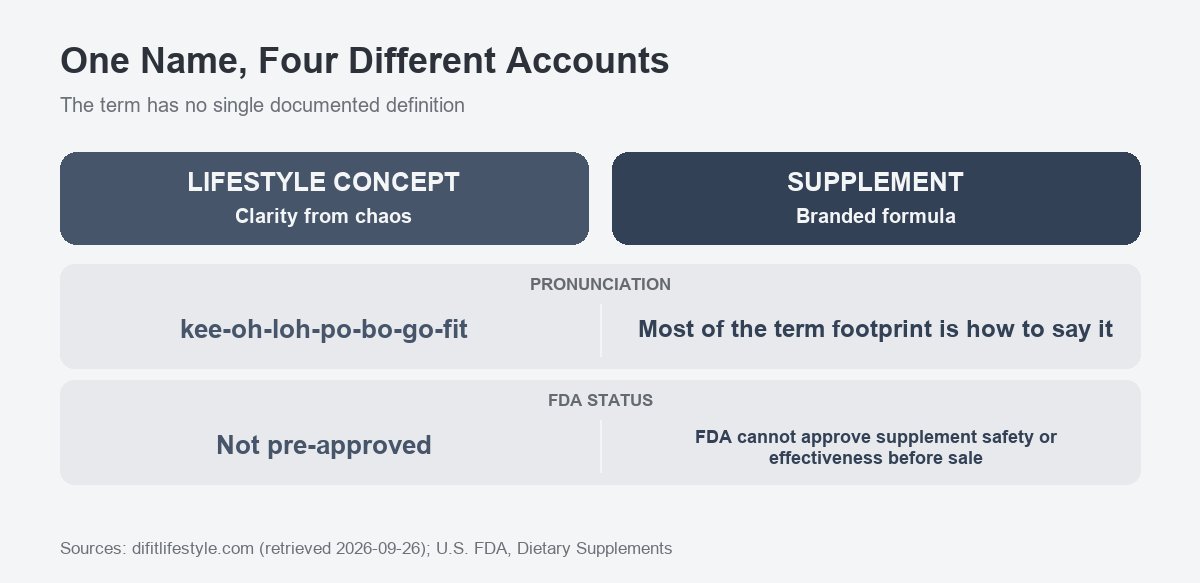
Its suggested reading of the word is a blend of kinetic, focus, body, growth and fitness, which the author sums up as clarity from chaos. Small habits carry the idea, such as two to three minutes of light movement, one to two minutes of meditation, and short stretches without a screen.
One more paragraph follows, about a Kiolopobgofit-branded supplement, and that is where most of the confusion starts. Readers who go looking for information about kiolopobgofit supplement now find two unrelated subjects sharing a single name.
Four Accounts of the Same Name
Four descriptions of kiolopobgofit are circulating, and they do not describe the same thing. Each one is built on different material, which is why the ingredient lists disagree from page to page.
Five pages currently rank for the term, and all five were read in full, yet not one of them cites a study, a regulator or a named maker for its ingredient list.
| Reader situation | What the source says kiolopobgofit is | Ingredients given | What can be checked |
|---|---|---|---|
| Saw the word in a forum and wants a definition | A lifestyle philosophy, not a branded system | None, because no product is described | The page and its date |
| Looking at a bottle with this name on it | A branded supplement sold as a cognitive enhancer | Ginkgo biloba, L-theanine, B vitamins, ashwagandha | Whether the label names a maker |
| Trying to pronounce the word out loud | A coined term with a worked-out pronunciation | None | Nothing beyond the spelling |
| Comparing pages before buying | A general wellness formula covering energy, focus and immunity | Three further lists, none matching the others | Why the lists conflict |
Ingredient lists are where the disagreement becomes visible. Three lists in the research set name ashwagandha, and two add green tea extract. One adds CoQ10 and spirulina, while another builds the formula from B-complex vitamins, vitamin D, magnesium and zinc. A published product identity does not produce lists that differ that widely.
One page attributes the formula to a team of biochemists and nutrition experts. No team, company or country of manufacture is named on that page, and no other page fills the gap. The name travels between pages that share nothing else, and the maker never travels with it.
Why No Manufacturer Name Appears
Two public registers were searched, and kiolopobgofit does not appear in either one. No label carries the term in the NIH Dietary Supplement Label Database, and a search of the USPTO trademark register found no federal registration.
An empty result in those two places is not proof of anything by itself. Plenty of lawful small products are too new or too small to sit in a label database, and unregistered names are common in commerce. What the empty result does establish is narrower and still useful, because nobody is publicly claiming the name as their brand in the two places where a real seller normally would.
Every claim attached to the name carries less weight as a result. A dosage instruction, a side-effect list or a results timeline cannot be traced to a manufacturer, because no manufacturer is on the record. Such claims stand alone, without a party accountable for them.
What the FDA Rule Means for a Named Product
American regulators do not pre-approve dietary supplements. In the agency’s own words, “FDA is not authorized to approve dietary supplements for safety and effectiveness before they are marketed,” and firms can often put a product on the market without notifying the agency at all.
The Dietary Supplement Health and Education Act of 1994 sets the sequence the FDA describes. Manufacturers and distributors are responsible for evaluating the safety and labeling of their products before marketing, and the FDA acts against adulterated or misbranded products after they reach the market, which means a supplement can be lawful, on a shelf, and still never have been reviewed by a regulator. A page describing kiolopobgofit as a formula on sale therefore says nothing about what was checked before the sale. The FDA consumer guidance on dietary supplements sets out the rule and closes with a plain instruction: talk to a doctor, pharmacist or other healthcare professional before deciding to buy or use one.
Checking a Product Sold Under the Name
Anyone weighing a purchase sold under this name can run two checks in a few minutes, and both are free. Search the NIH label database for the product name and then the USPTO trademark register for the brand, because a hit in either place gives a maker, an address and a filing date.
If both searches come back empty, treat every claim about the product as having come from the seller, because nothing else supports it, and expect the seller to be the only party with any interest in what the label says.
An empty result is no reason to assume harm. It is a reason to expect no accountability if something goes wrong, and standard supplement advice assumes a documented product to evaluate.
Nothing of the kind exists here. A buyer gets a name that four pages define differently, a claimed benefit, and a decision to make without a party standing behind either one, which leaves working out how much to trust the seller as the only available defense.
What Cannot Be Verified About Kiolopobgofit
Several specifics cannot be established from the public record. No manufacturer, no registered trademark, no entry in the label database, no clinical trial naming the formula, and no dosage figure attributed to anyone.
Claims that do circulate carry no traceable source. One page states that ashwagandha trials reduced stress markers in more than 70 percent of participants, and another promises noticeable energy improvements within seven days. Neither page names the trial, the sample or the year, and the claims remain unverified here.
None of this makes the word worthless. A short daily habit of two minutes of breathing and less screen time is sound advice whether or not it has a name. What the word cannot do is carry the authority of a product identity it has never had.
Nothing described under this name is a treatment for any condition. A reader who takes prescription medication, is pregnant or breastfeeding, or manages a chronic illness should treat any supplement carrying the name as something to clear with a clinician first.
