Apps like Tinder but free are not hard to find. Tinder, OkCupid, Hinge, Bumble, Badoo and Plenty of Fish all run a free tier that lets a new account swipe, match and open a conversation.
The list is long enough that the real choice comes down to something narrower than the list.
Each of the six publishes the features it sells in its own help centre, and reading those six lists side by side shows where the walls sit. They cluster on two actions: seeing who already liked a profile, and reaching more people per day than the free allowance permits.
Matching and messaging stay open.
What Apps Like Tinder but Free Keep Open
A download price tells a reader almost nothing here, because the download is free across the whole set. What separates the six is the point where the free version stops doing the work the account was created for. On some apps that point never arrives. On others it arrives the first time someone worth messaging likes back and stays invisible.
The liked-you queue is the clearest version of the wall. Tinder Gold, OkCupid Premium, Hinge+, Bumble Premium and Badoo Premium all sell a view of people who have already shown interest.
On a free account that interest sits unopened until the account holder likes back on a guess.
Volume is the second wall, and it lands hardest on readers in thin markets. Tinder Plus, OkCupid’s paid tiers and Bumble Boost all lift or remove a daily cap on how many people an account can reach.
Once the cap is spent, a new profile is finished for the day.
The pattern makes commercial sense, which is why it repeats. Messaging is the function that keeps a pool of users large enough to be worth searching, and charging for it would shrink the pool on which every other paid feature depends. Position and information can be metered without touching that loop, so that is where the six operators put their price, and the six tier lists read as variations on one idea instead of six separate designs. The reading is an inference from the six help pages rather than a statement any of the six makes.
The Free Tier, App by App
The six rows below come from each app’s own help pages, not from a roundup.
| App | What the free tier allows | What the paywall holds |
|---|---|---|
| Tinder | Swiping, matching and chatting; the help centre says the free version gives an account the ability to match, chat and connect | Unlimited daily Likes, unlimited Rewinds, Passport Mode, an ad-free view and Incognito on Plus; a view of who already liked the profile on Gold; faster delivery of likes on Platinum |
| OkCupid | Likes and Intros, matches and messaging, which OkCupid calls completely free and free forever | Unlimited Likes, since the free tier caps Likes per day; a view of who liked first; Incognito |
| Hinge | The regular version, which Hinge calls absolutely free | All incoming Likes at once and advanced preferences on Hinge+ or HingeX; Boosts and Roses sold separately |
| Bumble | The core app; Bumble states that paid features are optional and that the app works without them | Unlimited likes, five SuperSwipes and one Spotlight a week, 72-hour match extensions, rematch of expired connections and unlimited Backtrack on Boost; see-who-liked-you, advanced filters, Incognito Mode and Travel Mode on Premium |
| Badoo | Discover and Encounters, plus chat with people who matched back | A view of who likes the profile, priority on sent messages, one crush a day, ad removal, undo on an accidental left swipe, unlimited filters and private browsing on Premium |
| Plenty of Fish | Messaging and the standard profile on a product POF itself markets as free dating | Whether emails were read or deleted, every Extended Profile, the date and time a profile was viewed, 16 photo uploads and first position in Meet Me on an upgraded membership |
Five of the six operators sell some version of the same view, the people who already liked the account. Three sell more daily reach. Two name ad removal, and the other four help pages say nothing about advertising either way. Those counts describe the six help pages read for this comparison, not the category, so a seventh operator could shift them.
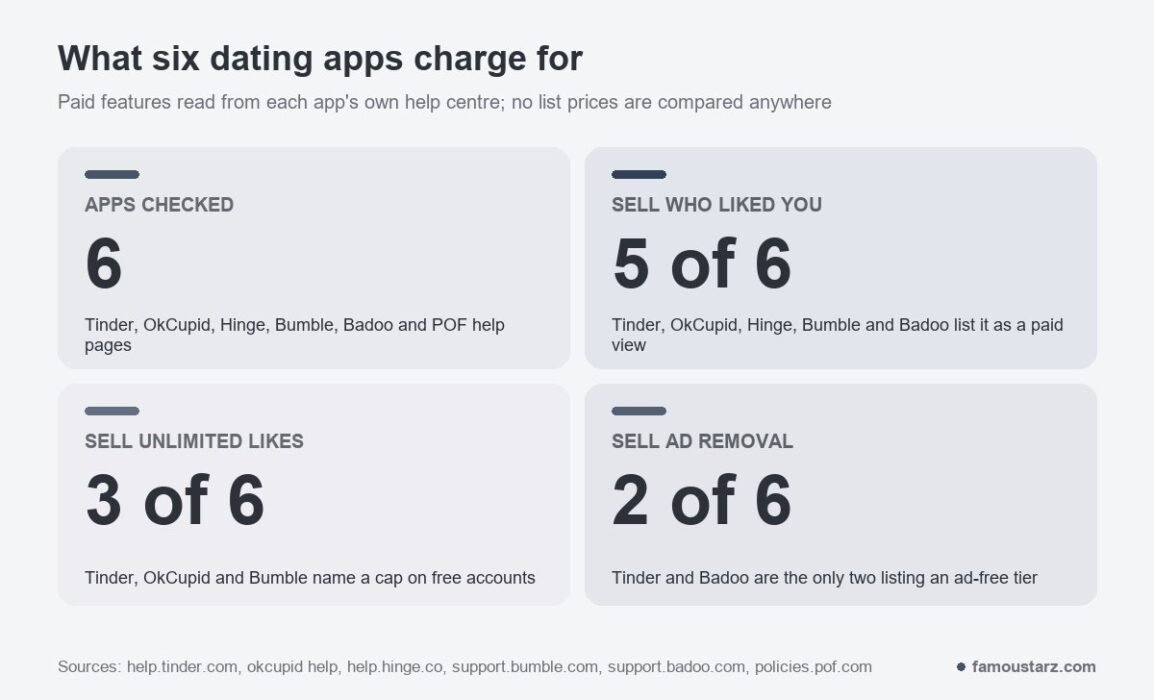
Prices are left out on purpose. Bumble’s help centre states that pricing appears in the app and varies with the subscription tier, the duration and the size of the package, so a figure quoted anywhere else describes one store in one country on one day.
One absence matters. Matched conversations are not listed as a paid feature on any of the six help pages. The only chat item sold anywhere in the set is Badoo’s credit purchase for a conversation with no match behind it, which is a different situation from two people who have already agreed to talk.
How the Paid Side Is Packaged
The paid side is not a single product, and its shape decides what a reader has to buy to get one thing done. Five of the six sell recurring subscriptions, three of those also sell single-use items, and Badoo runs a credit balance.
A reader who wants one visible day has a cheaper route on those three than a month of anything, because the difference between them sits in how each company meters an allowance.
OkCupid separates its tiers by weekly allowances, not by access. Premium includes three SuperLikes a week and Premium Plus includes fifteen, with both sitting above a Basic tier that OkCupid has withdrawn from new purchases. Incognito is sold as its own mode, and most of OkCupid’s Stacks are free while the rest open with a seven-day pass.
Bumble and Badoo take the metered route in different directions. Bumble sells SuperSwipe and Spotlight as consumables in packs alongside Boost and Premium, so attention can be bought per use. Badoo runs a credit balance on top of its plans, and the balance can be set to refill on its own once it drops below 200 credits.
Hinge’s plans renew weekly, monthly or over three and six months. Tinder footnotes its own tier list to say that some Plus subscribers may still see ads while the company tests, and that the monthly Boost does not come with a weekly plan. Both conditions sit in a footnote instead of the feature list.
For anyone weighing a single purchase, the allowance structure matters more than the feature list. A weekly SuperLike allowance resets whether or not it is used, which makes a three-month plan a poor fit for someone who opens the app twice a month. The same metering appears outside dating, where an allowance arrives as credits instead of a tier. A guide to 840 free credits on one image tool describes a sign-up bonus stacked with a seven-day check-in streak, which is the same shape as a weekly SuperLike allowance.
Is There a Free Version of Tinder?
Yes. Tinder’s help centre says the free version gives an account the ability to match, chat and connect, and that Plus, Gold and Platinum add features instead of replacing it. The restrictions sit on daily Likes, on visibility and on the liked-you queue.
The paid tiers are specific about what they add. Plus carries unlimited daily Likes, unlimited Rewinds, Passport Mode, an ad-free view and Incognito. Gold adds a view of who already liked the profile, weekly Super Likes and a Boost each month. Platinum adds faster delivery of likes. None of the three is required to reply to a match.
For an account that runs out of Likes before the evening is over, the daily allowance is the binding constraint. Messaging is not.
Is OkCupid 100% Free?
OkCupid states that accounts are entirely free, forever, and that messaging is free once two people have liked each other. The qualification is that a free account has a daily limit on the Likes it can send, one free SuperLike a week, and no view of who liked first.
The paid tiers are OkCupid Basic, Premium, Premium Plus and Incognito, and OkCupid marks Basic as no longer available for new purchases. Unlimited Likes are the feature most free accounts end up wanting, because the daily allowance is what stops the sending. OkCupid answers the free-account question on its help page and lists the tier allowances in a second article.
Is There a Dating App That Is 100% Free?
Free in the sense of matching and messaging, yes. Free in the sense of removing every limit, no. All six apps in the ledger give away profiles, matches and conversations, and all six also sell something, most often a view of who liked the profile or a larger daily allowance.
The disagreement in the wild is about the definition, not about the apps, and it surfaces whenever one reader counts a feature they never needed as a broken promise while another counts the same feature as a bargain. Someone weighing apps like Tinder but free is really weighing two questions: who can be written to, and who can be seen.
“Every app was cross checked for hidden paid features. ‘Free to download’ does not mean free. Tinder, Bumble, Hinge, OkCupid, POF, Badoo, Hily, Grindr, Match, and TruMingle are all excluded – each locks core features behind paywalls.” [excerpt — 2708 characters in full]
— r/OnlineDatingApps (9 upvotes)
The thread rules out Tinder, Bumble, Hinge, OkCupid, POF and Badoo on the same ground, so the complaint is about the category. A second reader in the same subreddit reported no such problem with the app they use.
“I’m just getting back into dating and only use FB dating. Doesn’t seem to be a problem there and it’s free.”
— r/OnlineDating (18 upvotes)
The line to draw is the reader’s own use. A free tier suits someone who gets a handful of matches a week and wants to write to them. It does not suit someone who needs to reach hundreds of profiles, or who wants an open queue of everyone who liked first, and those two needs are exactly what the six operators charge for.
OkCupid’s wording also deserves a close read, because the promise covers the account and not the features. The company says its accounts are free forever, which is a durable commitment to the entry point, and then sells allowances on top. Any app making a comparable promise should be checked for what the promise names.
What Is the 3-3-3 Rule on Tinder?
The 3-3-3 rule is not a Tinder feature and not a Tinder policy. Tinder’s help centre does not describe it. It is a dating rule that spread through TikTok, asking for a fresh assessment of the connection after three dates, again at three weeks and again at three months.
The checkpoints are spaced to catch different things. Bustle traced the rule to a TikTok creator who framed the first three dates as a test of whether two people enjoy each other’s company. The three-week mark became a question about how the other person feels to be around. The three-month mark became the point to decide whether the relationship has a name. A therapist quoted in the same piece suggested adjusting those intervals to fit the couple instead of following them literally.
Nothing in it depends on a product, which is why no app sells it as a setting. A couple who met on Tinder, on Hinge or at a bus stop can run the same three checks.
One app mechanic does run on a clock, and it belongs to Bumble and not to Tinder, since Bumble sells a 72-hour extension on a match through Boost and a match there can lapse before a conversation starts. Tinder publishes no equivalent expiry in its help centre, so the three-week checkpoint has to be a decision the couple makes, not one the app forces.
Three Checks Before Signing Up for a Free Tier
Three checks answer most of the question, and each one takes a few minutes in an app’s own help centre before an account is created.
- Search the help centre for the app’s own name for the liked-you queue. An article filed under subscriptions means the queue is a paid view.
- Look for a daily number. A page that mentions a limit on Likes, messages or discovery has just published the free tier’s real ceiling.
- Confirm what a match opens. On all six apps a matched conversation is open to both accounts, and a chat with no match behind it is where a credit can be needed.
The weakest signal is a help page that lists paid features and never mentions a free limit, because the ceiling then surfaces only after the allowance runs out. That is the normal case across this set: Tinder, Hinge, Bumble and Badoo publish no number for the free allowance at all, and OkCupid says only that free accounts have a daily limit on Likes. The free ceiling on these apps is undocumented by design, and a reader who needs a working number will have to find it by counting.
Frequently Asked Questions
Do apps like Tinder but free still show who liked you?
Usually not. Five of the six apps in the ledger sell that view, and OkCupid keeps only mutual Likes free. The queue of people who liked first is the feature most likely to stay closed.
Are free dating apps free to download but paid to use?
Partly. The download and the core loop are free on all six, and the paid part is an upgrade to visibility or to volume. Badoo is the one app in the set where a credit can open a conversation with no match behind it.
Which of these apps names the fewest paid features?
Hinge and Plenty of Fish name the fewest. Hinge’s paid tiers add a view of incoming Likes and advanced preferences, and POF’s upgraded membership adds read receipts, Extended Profiles, profile-view history, more photo slots and first position in Meet Me. Neither help page mentions a daily limit on how many people an account can reach.
