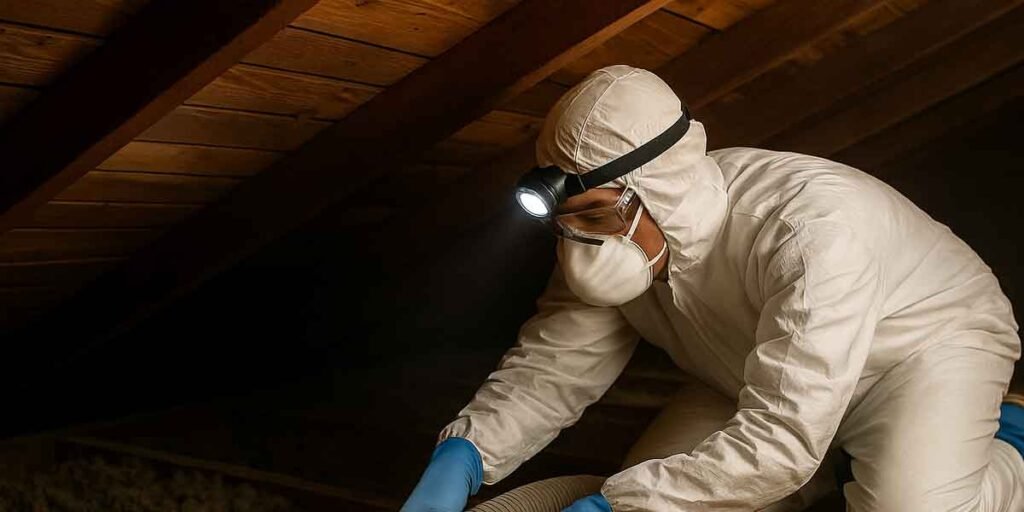
Strip attic insulation that is wet, fouled, or hazardous.
The condition of the old layer answers that question. The material answers a harder one, because a bed of gray pebbles in an older attic is not a homeowner project at all, and no R-value target turns it into one.
Water comes first, then contamination, then the identity of the old material, then the wiring running beneath it. The R-value goal sits at the end of that line, since every check in front of it changes how much of the goal is reachable.
What Forces a Full Removal, and What Only Looks Like One
Three conditions make removal mandatory: a layer that got soaked and stayed soaked, animal waste mixed into the fill, and any material a homeowner cannot legally handle. Thin, patchy, compacted fill does not qualify, and can be covered once the ceiling plane is sealed.
Water damage and the moisture source
The EPA’s mold guidance sets the order for this work: fix the water or moisture problem, then clean up what it grew. Attic insulation that has taken on water is part of the problem. Cellulose and fiberglass both hold damp against framing, and neither dries out in a closed attic.
Water traces back to a short list of repeat offenders: a roof leak at a valley or pipe boot, a bathroom or kitchen exhaust fan venting straight into the attic, a masonry chimney seeping at the roofline, condensation on ductwork moving through hot summer air. Much of it is legible before any test. Rusted staple heads, dark bands on rafters near the ridge, and a stain that repeats on every third rafter mark a leak that has been running for seasons.
Surface mold on framing is a cleaning problem for the homeowner when the patch is roughly 3 feet by 3 feet or less. Anything larger, or any growth that returns after cleaning, points at water nobody has found yet, not at a cleaning product that failed.
Pest contamination
Urine and droppings change the math even when the fill still looks fluffy. The CDC directs people to avoid dry sweeping or vacuuming rodent waste, because both methods lift contaminated dust into the air you are breathing. The sequence runs: ventilate the space for at least half an hour, saturate the waste with disinfectant, let it soak about five minutes, then lift it with the fill into doubled bags while wearing gloves and an N95 or better respirator.
Cleanup is also the wrong first step. Trapping and sealing the entry points comes first, and health departments suggest waiting roughly five days past the last sign of activity before anyone touches the contaminated material. Raccoons and bats change the project again, since their waste carries its own handling requirements and usually belongs to wildlife and abatement crews instead of an insulation installer.
Thin, patchy, compacted fill
Compaction is the most misread condition in an attic. A batt that has been walked on, or loose fill under a stack of stored boxes, loses thickness and some R-value, but the material itself is still sound. Nothing has to come out.
A flashlight gives you the read. Sweep the beam across the joists: a clean gray stripe riding over the wood means the fill still covers the top plate, while a chalky line at the joist edge marks how deep it once ran. Even distribution matters more than total depth, because a bare strip along the eaves costs more heating energy than an extra two inches in the middle saves.
Blowing new attic insulation over dry, settled fill of the same family is routine. Blowing cellulose over old fiberglass is done every day; blowing over fiberglass that has been wet is not, which is why the water check comes before the material conversation.
Vermiculite and Asbestos: Where Removal Stops Being a Homeowner Job
If the fill looks like small gray, gold, or silver pebbles, treat it as asbestos until a laboratory says otherwise, and do not remove it. The EPA advises that attic insulation made of vermiculite be left undisturbed and that any renovation which would disturb it be handed to a professional asbestos contractor.
Vermiculite is a mica-like mineral that expands when heated, and it was poured into attics and walls as a lightweight fill, mostly in homes built before the 1980s. The EPA’s concern is where it came from. A mine near Libby, Montana supplied more than 70 percent of the vermiculite sold in the United States between 1919 and 1990, and that deposit also held asbestos. Zonolite is the brand name most often attached to it. Because the contamination was never uniform, the agency tells homeowners to assume any vermiculite insulation contains asbestos, and to skip the lab test as a reason to relax.
The EPA’s own precautions are specific enough to follow without a consultant:
- Leave the material in place.
- Do not store boxes or other items in an attic with exposed vermiculite, since retrieving them disturbs the fill.
- Keep children out of that attic.
- Do not attempt removal yourself, and bring in a professional asbestos contractor for remodeling that would disturb it.
- Limit trips into the attic and keep them short.
- Skip the dust mask. Common masks do not filter asbestos fibers, and a household vacuum spreads them rather than collecting them.
The agency also notes that undisturbed insulation is unlikely to release fibers, which makes “leave it alone” a real answer instead of a dodge. Insulate elsewhere in the house, keep the path to the hatch short, and treat any future attic remodel as an abatement question first.
When a removal becomes a regulated asbestos job
Federal notification thresholds come from the asbestos NESHAP, 40 CFR 61.145(b): 160 square feet of regulated asbestos-containing material on components other than pipe, 260 linear feet on pipe, or 35 cubic feet of material already off components. Cross any of those and written notice goes to the state or the EPA at least ten working days before work begins.
A building with four or fewer dwelling units falls outside the federal definition of a facility, so the federal rule does not reach most single-family attics. State rules do, and many of them set their own thresholds, notification forms, and contractor licensing for abatement. The practical upshot: a vermiculite attic is a call to the state asbestos program before anyone climbs up there, not a dumpster order.
Cover or Replace: Sorting the Cases in Order
Work down the list. The first condition that matches decides the project.
- Past or present water. Remove the affected fill, repair the leak or the venting, then talk about new material.
- Rodent or other animal waste. Remove the contaminated fill, disinfect the framing, and close the entry points before anything new goes down.
- Pebble-like fill in an older attic. Stop, follow the EPA precautions above, and bring in a licensed asbestos contractor.
- Knob-and-tube wiring under the fill. Call an electrician first. Concealed knob-and-tube conductors may not be enveloped by loose, rolled, or foamed insulation under NEC 394.12(5), a restriction in the code since 1987, and several states permit it only with a licensed electrician’s certification plus noncombustible insulation.
- Dry, clean, and only too thin. Cover it, after sealing.
- Dry, clean, but compacted or uneven. Rake the old fill loose or pull the worst stretches, then cover.
The fill’s age on its own, the color of the kraft facing on old batts, and the number on the original R-value sticker decide nothing.
If It Comes Out: What the Removal Actually Involves
Removing attic insulation is less about strength than about containment and heat. Two things wreck the day: traffic between the attic and the living space, and a work space forty degrees hotter than the yard.
Protect yourself and the house
- Seal the hatch or stairwell with plastic and tape. If a fan is available, blow air out a window so dust travels away from the rooms below.
- Wear a disposable coverall, gloves, eye protection, and a respirator suited to the particles you are disturbing. A P100 cartridge covers fiberglass and cellulose dust.
- Lay walk boards across the joists. Balancing between joists to avoid compacting fill is how ceilings get damaged from the wrong side.
- Start early and take water breaks. An attic in July runs far past the outdoor temperature.
- Use a HEPA vacuum with a fine-dust filter. A shop vac without one pushes the fines you just bagged straight back into the air.
Bagging, and what the open window is for
Contractor bags, doubled, filled no more than half way so they can be lifted through the hatch. Most states treat clean household insulation as ordinary construction debris, while anything identified as asbestos falls under a separate waste stream with its own paperwork. Check with the state program before the truck is loaded.
The stripped attic is also the only moment the whole ceiling plane is visible, and that is the real value of the removal day. This is when air sealing gets done, when junction boxes and duct runs get photographed for later, and when a recessed light can be swapped for a sealed fixture without cutting the drywall. Returning the same fill would waste the one chance to fix what sat under it.
Seal, Baffle, Then Blow: The Order That Protects the New Layer
Sealed first, baffled second, blown third. ENERGY STAR puts it bluntly: attic insulation delivers its rated value only when air is not moving through or around it. Leaks at top plates, chases, and hatch frames get handled before new material goes down.
Seal by gap size
DOE’s weatherization job aids tie the sealant to the size of the opening, which keeps you from caulking a three-inch chase:
- A quarter inch or less: caulk.
- A quarter inch to two inches: one-component spray foam or mastic.
- Two to three inches: two-component foam.
- Three inches or wider: rigid infill that will not sag, plus support for spans past two feet, set before any insulation.
The targets DOE names cover top plates, chases, dropped soffits, recessed lights, plumbing vent pipes, exhaust fans, and duct penetrations. Most of them sit under whatever fill was already there, which is the argument for doing this part while the cavity is empty.
Baffles, lights, and the hatch
Three details get skipped, and each one undoes new material:
- Soffit vents. Fill that buries the eave vents turns a vented attic into a trapped one. Rafter baffles hold a channel open and keep fill out of it.
- Recessed lights. A fixture not rated for insulation contact keeps a three-inch gap, wires and ballast included. The better fix is a gasketed ICAT fixture or a sealed box built over the fixture from the attic side.
- The hatch or pull-down stair. Weatherstrip the frame, insulate the lid, and build a dam around the opening that rises past the finished depth of the fill.
The R-value target follows, and it depends on location. ENERGY STAR points to the 2021 International Energy Conservation Code: attics in climate zones 4 through 8 want R49 to R60, with R60 for a bare attic and R49 where three to four inches of attic insulation are already in place. Depth is not a number to import from a forum, since every bag carries its own R-value per inch and the settled depth that hits your target follows from that figure.
Choosing the product comes last, because the checks above have already narrowed the field. A shallow joist bay, a cathedral ceiling, and a floor that has to stay walkable each point somewhere different. At that point the lineup in best attic insulation for your home sorts by what each option fits, which is the order this decision actually runs in.
Questions Homeowners Ask About Attic Insulation Removal
Is it worth removing old attic insulation?
Only when the layer is wet, contaminated, or a material that requires abatement. Dry, clean attic insulation that is merely thin is worth keeping beneath a new layer, since removal adds disposal and labor without changing the R-value.
Can you lay new insulation over old insulation?
Yes, when the old fill is dry, free of waste, and evenly spread. Seal the ceiling plane, rake compacted stretches loose, and leave the eave baffles clear; the added layer then builds on the R-value already in place.
What is the 7 and 7 rule for attics?
It describes conversion space rather than insulation: roughly 7 feet of headroom over 7 feet of width in an unfinished attic. No code or energy program ties a 7-and-7 figure to R-values or depth.
How much does attic insulation removal and replacement cost?
Volume and hazard drive the number: how deep the fill runs, whether the waste is regulated, disposal fees, and how much air sealing happens while the ceiling is open. Bids worth comparing separate removal, disposal, air sealing, and material, because those four move independently.
Do you have to remove old insulation before spray foam?
For foam sprayed onto the attic floor, yes. Both open-cell and closed-cell products need a clean substrate to bond to. For foam sprayed on the underside of the roof deck to pull the attic inside the envelope, the old floor fill can often stay.
