No published TTweakHotel code can be found on the brand’s own site. I read its homepage and six of the pages that use the phrase, and none of them prints a code string, a validity window, or an instruction for entering one at checkout.
That leaves a discount code TTweakHotel in an odd position. It reads like a coupon in the writing around it and behaves like a claim in the record, because no page names the party that issued it.
A code becomes real only when the owner of the discount publishes it, and nothing else can make it real.
What TTweakHotel Is
TTweakHotel is a travel discount site that presents itself as a hotel savings platform. Its homepage describes promotional pricing, curated deals and seasonal reductions, and it points to a wider group of services under the TravelTweaks name: airline codes, a map tool, and a support line.
The support line is a fair sample of how the material reads. The page refers to a TravelTweaks phone number for travelers who need help, and prints no number anywhere on it.
Detail at that level is what attaches the brand name to the phrase. A site that markets the whole category of travel discounting under its own name makes that name shorthand for the category, and a request for a code follows from the shorthand. Reading about a discount and confirming one are separate tasks, and only the second needs the issuer to publish.
What Its Own Pages Publish
The check that settles the question is small enough to repeat. On 27 September 2026 I opened the homepage, the six posts whose titles or text carry the phrase, both sitemaps and the fixed pages, and looked through the visible text of each for a code-shaped string.
Seven pages carry the phrase, and none of them holds a code. The only uppercase strings containing digits across that text are CSS color values read out of the page markup. When I listed the post sitemap, it gave 31 published items, and 21 of those slugs are built from the brand name plus a discount, offer or code word. Three fixed pages exist, and the hotel address the site’s own menu points at answers 404.
The limit of the check belongs in the same breath. My scan covers visible text on those pages and the sitemaps, so a code printed inside an image or held behind a sign-up form would not appear in it.
An inventory that thin leaves a reader with nothing to enter. Two pages that discuss the phrase are worth reading closely for what they do instead. One page on punpeak.com prints SAVE20 and SAVE50 in a table as illustrations of the format, with no issuer, no window and no terms attached. A page on traveltweakshotels.org states that it does not issue, hold or distribute any TTweakHotel code at all. Neither page offers a working code, so both leave a reader with nothing to type in.
What the Brand Does Publish
What the brand publishes is description rather than terms. Percentage reductions, fixed-rate offers and seasonal campaigns appear throughout the homepage, with no figures attached and no booking window named, which is why none of it can be checked against a checkout screen. The post sitemap also carries material with no connection to travel, including an article on an AI music generator and one on a plumber in Arizona.
Five Checks Before Using a Discount Code TTweakHotel
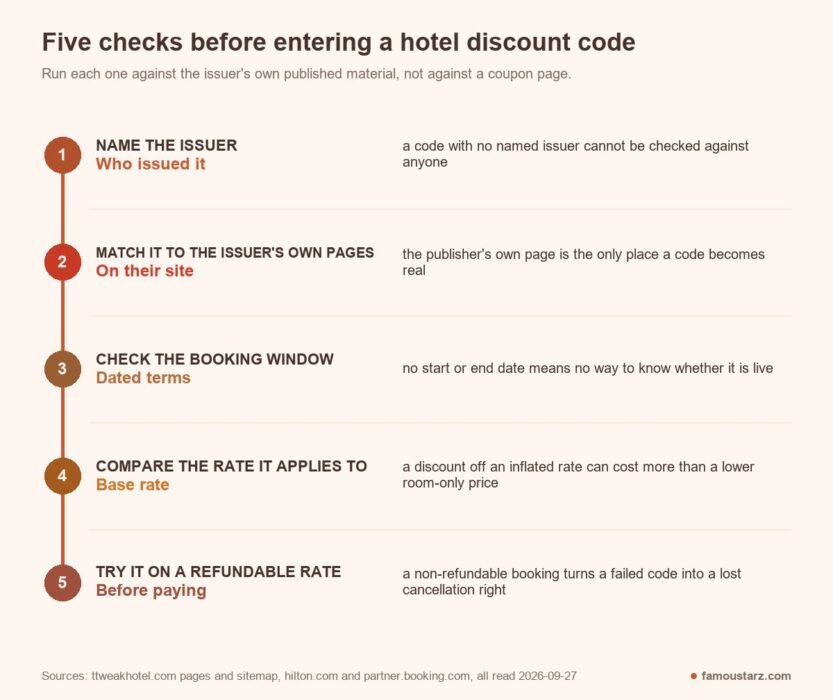
Five checks separate a hotel code that exists from a string that merely looks like one, and all five run in about a minute.
- Name the issuer. A code with no named issuer cannot be checked against anything, and the line of inquiry stops there.
- Find it on the issuer’s own pages. If the party that owns the discount does not carry the code, no other page can make it valid.
- Check the booking window. A code with no start or end date has no way to be known as live.
- Compare the rate it applies to. A percentage taken off an inflated rate can cost more than a plain room-only price.
- Test it on a refundable rate. A failed code on a non-refundable booking turns a small saving into a lost cancellation right.
Two of the five carry most of the weight. The issuer check removes the invented strings in a single step, because a fabricated code never has a company behind it.
The rate check is the one readers skip, and it decides whether the discount is real money. Price the same room without the code first, then with it, on the same dates. The window check is quicker, since a code issued for a fixed period will say so and silence about dates is the tell that nobody issued it.
I would run the issuer check first in every case. Looking through a brand’s own pages takes seconds, and a promotion appears wherever the brand actually runs it, whether that is a page, a newsletter sign-up or a partner listing.
What Actually Lowers a Hotel Bill
The two figures I trust here come from the companies that set the terms, since each one arrives with an owner and a rule. Hilton’s price match guarantee promises that when a lower qualifying rate turns up on another site after a direct booking, Hilton matches it and takes a further 25% off the room rate.
The claim has to be filed inside 24 hours, and the rate has to be for the same hotel, dates, room type and booking terms.
Loyalty tiers work the same way at a smaller size. Booking.com’s partner documentation states that a property joining Genius agrees to give returning travelers 10% off its least expensive and most popular room types, and that the 15% and 20% tiers may be suspended on up to 60 dates a year. The same page describes the travelers the programme targets as people who spend 15% more, book up to twice as far ahead, and leave 29% more reviews.
How the Three Compare
Set the three options against a booking that is already chosen and the order is not close. A code is worth whatever an unaccountable page says it is worth. A price match is worth the gap between two rates plus a quarter of the room rate, and a loyalty tier is worth a fixed percentage at the properties that carry it.
The difference between them is who carries the promise. A chain’s price match is a written commitment applied to its own bookings, and a loyalty tier is a standing agreement with the properties that join it. A code posted by a site that does not issue it carries no promise at all, which is why a comparison of headline percentages alone settles nothing.
When a Code Is Not Worth Chasing
Four situations turn the hunt into a worse use of time than changing the booking. Each one is a question about the offer itself, and each can be answered before payment.
Two of the four are about the rate itself. The first is a discount taken off a rate that was raised to carry it, which is why the price without the code matters more than the price with it. The second is a code that works only on a non-refundable booking, where the saving and the cancellation right are traded against each other.
The other two are about the terms. A property can also switch off its participation, since Booking.com’s own terms let it suspend the 15% and 20% Genius tiers on up to 60 dates a year. A minimum stay or minimum spend can push the trip past what the reader intended to pay.
Guessing is the one free move in this space, and it has a precondition. The trick travelers pass around is to take a code they have seen and alter the number inside it.
“When online shopping try adding 5, 10, 15, 20 after the following in the apply code section WELCOME TEAM GET HELLO STAFF SAVE If you can be bothered going through the process you’d be surprised how often one of these works”
— r/AussieFrugal, August 2026 (475 upvotes)
The trick works often enough to keep the habit alive, and it only has a starting point where a business already publishes a base code with a number in it. A brand that publishes none offers nothing to vary. That is where this phrase stands.
Frequently Asked Questions
Is there a discount code TTweakHotel that works at the moment?
No code is published on the brand’s own site, so nothing can be confirmed as working. A discount that nobody issues stays a claim.
Where would a code come from if one existed?
From the party that owns the discount. That means the brand’s own pages, an email sent to subscribers, or a partner the brand names in writing. A coupon page cannot create one.
How can a hotel code be checked before paying?
Name the issuer, find the code on that issuer’s own pages, check the booking window, compare the rate it applies to, and test it on a refundable booking.
What lowers a hotel bill when no code can be confirmed?
A direct-booking price match or a loyalty tier. Hilton matches a lower qualifying rate and adds 25% off within a 24-hour claim window, and Booking.com’s Genius programme starts at 10% off a property’s least expensive and most popular room types.
