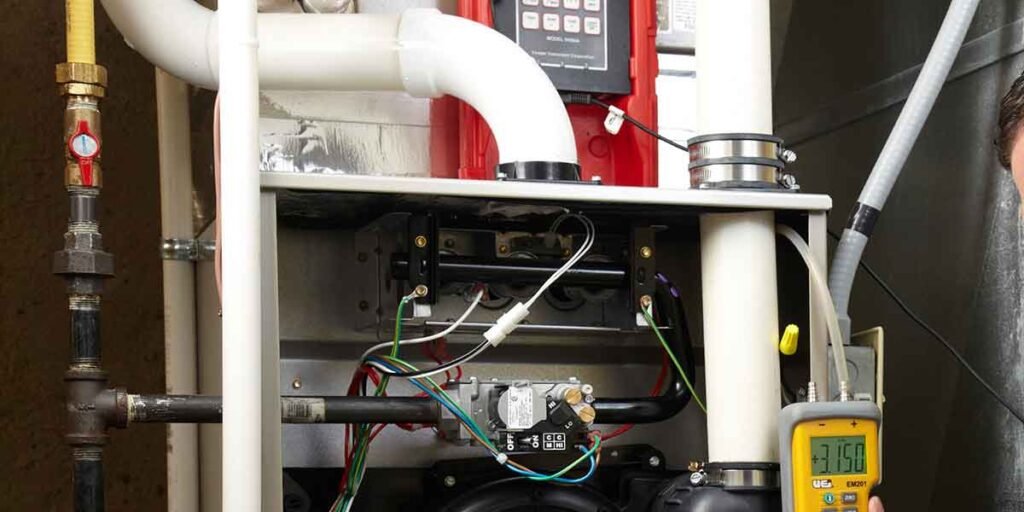
The legal line turns on your state and your fuel, and for a furnace replacement it exists before anyone argues about skill.
Massachusetts requires a license for gas fitting, so only a credentialed plumber or gas fitter can pull the permit for a furnace change-out. New Jersey exempts the owner-occupant of a single-family home from that requirement, with two carve-outs. Minnesota wants a mechanical permit everywhere but answers the who question city by city. Same equipment, three different answers.
Furnace Replacement divides into two questions that rarely share an answer: what the law lets you do, and what you can prove once the work is finished. Most estimates arrive with neither one written down.
The Permit Rule Comes Before Any Price
A furnace replacement is permitted work nearly everywhere. The mechanical provisions that states adopt from the International Residential Code require a permit to install, alter, or replace heating equipment, and a same-size swap is not exempt just because the old footprint stays.
Who may hold that permit is the variable that saves or costs the most money. Massachusetts sets the ceiling: under MGL c. 142, § 3, plumbing and gas fitting work belongs to the licensed trades, and the state Board of Examiners of Plumbers and Gas Fitters puts it plainly, only a licensed master or journeyman plumber or gas fitter pulls the permit from the local inspector. Homeowners there can take out a building permit for structural work; the gas side stays closed. Boston’s gas permit application has to be filed by the licensed contractor, who also has to be on site for the inspection.
New Jersey sits at the other end. N.J.A.C. 5:23-2.15(b)2.i bars unlicensed plumbing, electrical, and HVAC work, then carves out the owner-occupant of a single-family dwelling, and N.J.S.A. 45:16A-9 repeats the exemption in the licensing statute. Two limits survive the exemption. Refrigerant work still belongs to a state-licensed HVAC contractor, and the chimney verification form that accompanies a fuel-burning appliance replacement has to be signed by a professional, not the owner. If the house is a two-family, the exemption disappears.
Minnesota has no statewide mechanical contractor license, only a bond requirement, and the permit comes from the city. Many cities allow an owner to pull it; Minneapolis excludes gas-fired heating equipment from its owner permit allowance, and St. Cloud requires a licensed contractor to complete the heating test record even when the homeowner holds the permit. Rental property and multi-unit buildings go to the trades in every version of these rules.
Skipping the permit is the expensive option that does not look expensive at the time. Unpermitted mechanical work surfaces at resale, at an insurance claim, and at the next inspection, and the fix is usually a tear-out and a re-inspection rather than a paperwork fee.
What a Homeowner Can Legitimately Take On
The work splits cleanly along the interfaces where fuel, combustion, and refrigerant live. Everything that requires breaking one of those three open belongs to someone credentialed; the rest is mostly labor.
| Work item | Who does it | Why the line sits there |
|---|---|---|
| Permit application | Owner where the city allows it, otherwise the contractor | Puts the install under inspection |
| Removing the old unit and clearing the space | Owner | Gas and power are already shut off |
| Sizing and equipment selection | Contractor, or owner with a load calculation | Oversized equipment shortens its own life |
| Gas piping, leak test, and connection | Licensed gas fitter or HVAC contractor | Statute, plus the consequences of a leak |
| Venting and terminations | Contractor | Condensing units need their own pipe and slope |
| Dedicated 240-volt circuit and panel capacity | Electrician | Electric heat draws far more current than gas |
| Start-up, on-rate, and combustion verification | Contractor with instruments | Needs a combustion analyzer and training |
| Refrigerant recovery, evacuation, and charging | EPA-certified technician | Federal sales restriction on refrigerant |
| Final inspection and permit close-out | Local inspector | The record the next buyer will read |
A paid look at the systems nobody sees earns its fee. The benefits of professional plumbing inspections come from catching corroded supply lines and failing drains before a wall has to be opened, and gas piping rewards the same skepticism. A furnace replacement regularly exposes a flue sized for the old appliance, a gas line too small for the new input rating, or a return duct that was never sealed, and those findings matter more to the final bill than the unit price does.
Equipment access is the quiet obstacle. Distribution for major brands commonly runs through credentialed trade accounts, which is why the same model number is easy to find in a contractor’s quote and hard to find at retail. Warranty coverage follows the same path: Carrier’s Consumer Choice Warranty offers ten years on parts, or five years on parts plus three on labor, for eligible equipment registered on time, and registration depends on a documented installation.
The Numbers That Prove a Furnace Replacement Was Set Up Right
A furnace replacement that lights, heats, and holds the thermostat at 70 degrees can still be running outside its rated conditions. ANSI/ACCA 5 QI-2015, the quality installation standard that EPA’s ENERGY STAR program points to for HVAC work, defines the measurements that separate a finished install from a hopeful one.
Section 4.5 covers on-rate for fuel-fired equipment. On gas, the firing rate has to land inside 5 percent of the nameplate input, measured either by combustion analysis or by clocking the gas meter, and the temperature rise has to fall inside the range printed on the unit’s rating plate. On oil, the nozzle’s gallon-per-hour rating and spray angle have to match the burner’s spec, the pump pressure has to be set to the manufacturer’s number, and the temperature rise gets measured the same way.
Section 4.1 covers airflow, and it is the part homeowners never hear about. Airflow through the blower has to sit inside the equipment maker’s rated CFM range, measured with every accessory in place, and measured external static pressure has to stay inside the maker’s limit. The pressure ceiling is not a guess: the standard allows no more than 25 percent or 0.10 inches of water column above design, whichever is larger.
Combustion analysis supplies the rest: carbon monoxide, oxygen, stack temperature, and draft, read against the manufacturer’s numbers rather than a generic target. A wrench and a flashlight will not produce those figures. A combustion analyzer does, and it needs annual calibration to be worth trusting.
Ask for the sheet. A contractor working to this standard can hand over the recorded firing rate, temperature rise, static pressure, and combustion readings, and a homeowner comparing two bids for the same furnace replacement learns more from those numbers than from the equipment list.
What Stays, and What Has to Match
Replacement decisions get complicated by the parts of the system that stay behind. Ductwork, the coil, the electrical service, and the vent path all keep their old ratings, and the new furnace has to work within them.
Replacing the AC at the Same Time
A furnace replacement can keep the existing air conditioner, provided the new blower can move the airflow that coil was rated for. Carrier’s guidance for its own equipment says a furnace can be paired with an existing AC when the two are compatible and a technician confirms whether a matched system is needed for rated efficiency. The compatibility question is a blower curve against a coil rating, not a brand question.
The AC side also runs into federal law. EPA’s refrigerant sales restriction, at 40 CFR Part 82 Subpart F, took effect at the end of 1994 and was extended in 2004 to blends containing class I or class II substances, which is why a homeowner cannot legally buy the refrigerant for a system evacuation and recharge. Recovery, evacuation, and charging require Section 608 certification. Any quote that bundles a coil replacement carries work no owner can finish.
Electric and Oil Furnaces Cost Out Differently
Electric furnaces avoid venting entirely and still need a dedicated 240-volt circuit, which turns a replacement into an electrical project when the panel has no spare capacity. Carrier’s published 2026 cost table puts electric furnace replacement at $2,000 to $7,000 installed, against $3,800 to $10,000 for natural gas and $6,750 to $10,000 for oil. Those are one manufacturer’s figures for installed work, not a market average, and the spread between them mostly tracks equipment and labor complexity.
Oil equipment carries its own commissioning burden. Nozzle size, spray angle, and pump pressure all get verified against the burner spec, and poorly set oil burners are a leading source of soot and carbon monoxide complaints. An oil furnace also needs annual service in a way a gas furnace does not.
Manufactured Homes Have Their Own Rulebook
Mobile home furnace replacement answers to HUD’s Manufactured Home Construction and Safety Standards, not just the local mechanical code. Section 3280.709 requires complete separation of the combustion system from the home’s interior air, achieved either by a direct-vent appliance or by an enclosure with no door or removable panel opening into the living space. Ductwork falls under 3280.715, which requires UL 181 Class 0 or Class 1 connectors, a metal supply plenum extending at least three feet from the heat exchanger, and R-8 insulation with a vapor barrier on ducts exposed to outside air.
Two practical consequences follow. The replacement unit has to be listed and labeled for manufactured housing, and a unit that is listed still has to be installed to its listing rather than treated as a drop-in. The existing roof jack and duct start collar can be reused when they are the right type, the right size, and in good condition.
Timing: Two Rules in Motion
Two federal changes have been moving at once, and both change what a furnace replacement buys. One governs money and the other governs equipment, and neither is settled.
The Section 25C energy efficient home improvement credit changed status. The IRS stated in Fact Sheet 2025-05 that no credit is allowed for property placed in service after the end of 2025, a reading that followed the 2025 budget law’s accelerated termination. Members of the House Ways and Means Committee wrote to the IRS in September 2025 arguing the statute’s expiration date was never amended and remains 2032. Until that dispute resolves, a payback calculation that assumes a $600 credit is an assumption, not a figure.
The efficiency standard is in the same state of limbo. The Department of Energy finalized furnace standards in December 2023 requiring 95 percent AFUE for non-weatherized and mobile home gas furnaces manufactured from late 2028, a level that only condensing equipment reaches. Industry groups challenged it, and the Supreme Court sent the rule back to the D.C. Circuit in June 2026 after the government changed position; the agency has been weighing a delay toward 2030.
Read the fine print on that rule and the waiting strategy loses its appeal. The standard applies to manufacture, not installation, and DOE wrote no sell-through or installation deadline into it. A non-condensing furnace made before the compliance date stays legal to install whenever it is installed, so waiting does not buy a better unit. What waiting does change is supply, as non-condensing models thin out, and what a condensing furnace demands of the house: PVC or CPVC venting through a side wall, a condensate drain or pump, and the end of a shared chimney.
FAQ
Can you replace a furnace by yourself?
In some states, yes, and in others the gas connection alone ends the project for a homeowner. New Jersey and much of Minnesota allow an owner-occupant to hold the permit; Massachusetts does not, and Minneapolis excludes gas-fired heating equipment even where its broader owner permit rule would apply.
Anyone assessing the question should separate the work into three bands. Removal and site preparation are ordinary carpentry. Gas piping, venting, and start-up require credentials almost everywhere. Refrigerant work requires federal certification in every state. A homeowner in a permissive state can legitimately own the first band and hire out the other two.
How much should furnace replacement cost?
Carrier’s published 2026 figures run from $3,800 to $14,200 installed across fuel types, with electric at the low end and propane at the high end. Labor for a straightforward change-out is a fraction of that range; venting upgrades, duct repairs, and electrical work are what pull a bid toward the top.
Two line items deserve a direct question. Ask what the quote includes for commissioning, since the ACCA measurements are the only record that the unit was set up to its rating plate. Ask separately about permit fees and inspection, because those costs exist whether or not they appear in the estimate.
Is installing a furnace difficult?
The physical side of a furnace replacement is heavy but familiar to anyone who has handled sheet metal and threaded gas pipe. The difficult part is verification, because a furnace that runs is not evidence of a furnace set up correctly.
Firing rate, temperature rise, static pressure, and combustion readings are the four measurements that decide whether the install meets its rating. Reaching them requires a combustion analyzer, a manometer, and the training to interpret what the instruments report when a duct system is undersized.
Do the furnace and AC have to be replaced together?
No. A furnace replacement and an air conditioner replacement do not have to happen in the same visit, but the two systems share airflow. A new furnace has to move the CFM its paired coil was rated for, and a mismatched pair costs efficiency that the furnace’s own rating does not reflect.
Replacing both at once is a scheduling convenience rather than a requirement, and it usually follows an AC that is near the end of its service life. The refrigerant side of that work cannot be completed by a homeowner under federal rules, so a combined project always includes at least one credentialed trade.
