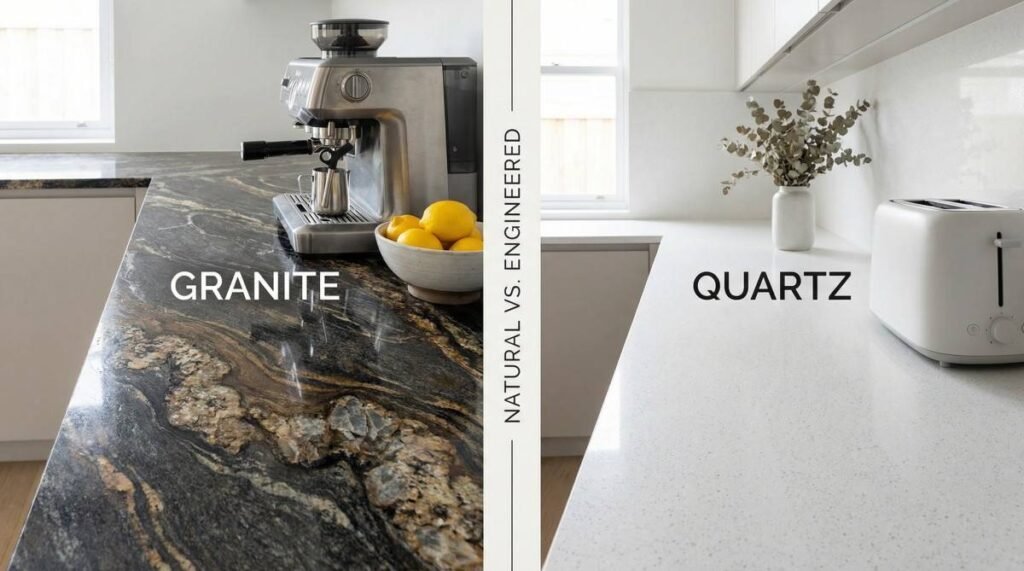
Choosing between granite and quartz countertops involves understanding their distinct maintenance requirements, with quartz generally offering easier upkeep due to its non-porous nature, while granite demands regular sealing to prevent staining and bacterial growth.
Both materials are popular choices for home improvement projects, valued for their durability and aesthetic appeal in kitchens and bathrooms says Jackson Property Management experts. However, their inherent properties dictate different care routines. Granite, a natural stone, possesses microscopic pores that can absorb liquids, necessitating periodic sealing to maintain its resistance to stains and bacteria. In contrast, quartz countertops are engineered from natural quartz crystals combined with resins, resulting in a non-porous surface that resists stains and does not require sealing. This fundamental difference significantly impacts the long-term maintenance effort and overall ease of care for each material.
Granite and quartz countertops exhibit varying degrees of durability and scratch resistance, with quartz generally proving more resistant to scratches and chips due to its engineered composition, while granite, though very hard, can be susceptible to damage from sharp objects or heavy impacts if not properly cared for.
Granite, a natural igneous rock, is renowned for its hardness and resistance to heat. Its crystalline structure makes it highly durable, capable of withstanding daily kitchen activities. However, it is not entirely impervious to damage. Sharp knives or heavy dropped objects can potentially chip or scratch the surface. While minor scratches can sometimes be buffed out, deeper damage may require professional repair. The natural variations in granite also mean that some slabs may be harder or more brittle than others.
Quartz, being an engineered stone, is composed of approximately 90-95% ground quartz and 5-10% polymer resins, pigments, and other additives. This composition makes it exceptionally hard and non-porous, contributing to its superior resistance to scratches, chips, and cracks compared to natural stone. The resins in quartz also provide a degree of flexibility, making it less prone to chipping than granite. This inherent toughness means quartz countertops generally require less vigilance against accidental damage in a busy kitchen environment.
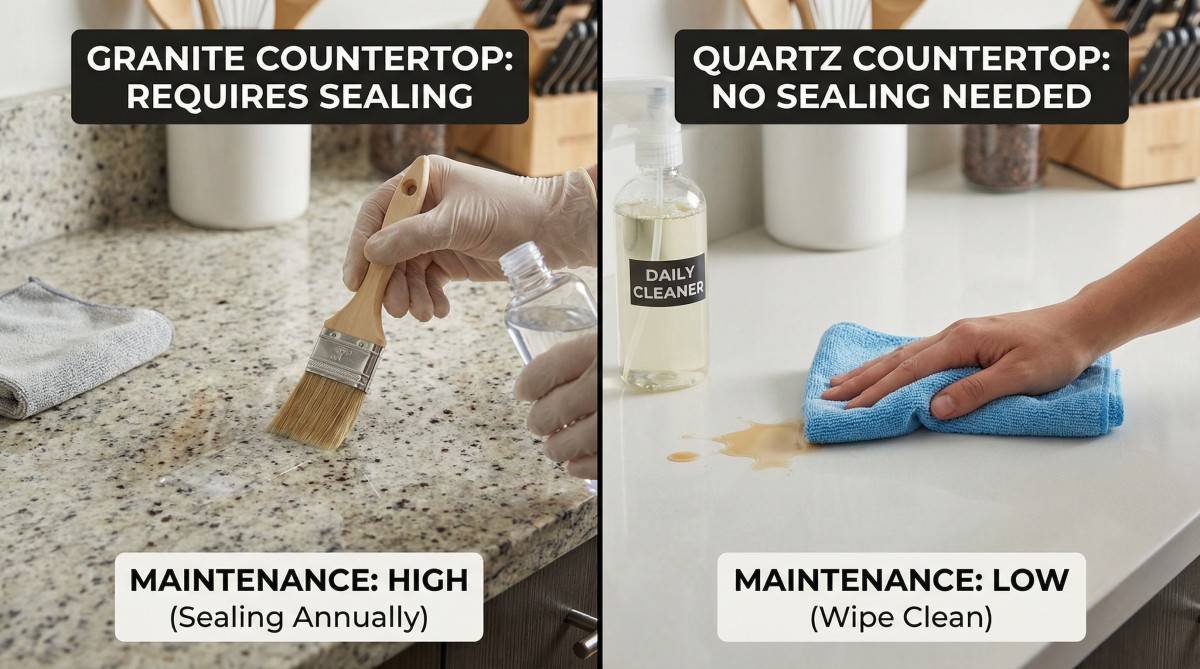
Quartz countertops offer superior stain resistance and do not require sealing due to their non-porous surface, whereas granite, a porous natural stone, necessitates regular sealing to prevent the absorption of liquids and subsequent staining, making quartz generally easier to maintain in terms of stain prevention.
The primary difference in maintenance between granite and quartz lies in their porosity. Granite is a naturally porous material, meaning it has tiny microscopic holes that can absorb liquids. If spills, especially acidic or oily substances, are left on an unsealed granite surface, they can penetrate the stone and cause permanent stains. To combat this, granite countertops require periodic sealing, typically once every 1-3 years, depending on the type of granite and sealant used. This sealing process creates a barrier that prevents liquids from seeping into the stone, thus protecting it from stains and bacterial growth.
In contrast, quartz countertops are engineered to be non-porous. The resins used in their manufacturing fill any potential voids, creating a solid, impermeable surface. This non-porous quality makes quartz highly resistant to stains from common kitchen culprits like coffee, wine, oil, and food dyes. Because liquids cannot penetrate the surface, quartz does not require sealing, which significantly reduces its maintenance demands. This inherent stain resistance is a major advantage for homeowners seeking a low-maintenance countertop option.
Cleaning granite and quartz countertops differs significantly, with quartz requiring only mild soap and water for daily cleaning due to its non-porous surface, while granite benefits from pH-neutral cleaners to protect its sealant and prevent damage, making quartz generally simpler to sanitize.
Daily cleaning for quartz countertops is straightforward and requires minimal effort. A soft cloth, warm water, and a mild dish soap are typically sufficient to wipe away spills and maintain a hygienic surface. Because quartz is non-porous, it does not harbor bacteria or viruses within its surface, making it an excellent choice for food preparation areas. Harsh abrasive cleaners, strong chemicals, or scouring pads should be avoided as they can dull the surface or damage the resin binders over time.
Granite cleaning also involves mild soap and water for routine spills. However, it is crucial to use pH-neutral cleaners specifically designed for natural stone to avoid degrading the sealant. Acidic or alkaline cleaners can strip away the protective layer, leaving the granite vulnerable to stains and etching. Regular wiping with a damp cloth and gentle cleanser is recommended. For deeper cleaning or disinfection, specialized granite cleaners are available that are safe for sealed surfaces. Prompt cleanup of spills is essential to prevent liquids from penetrating the sealant and staining the stone.
Granite exhibits superior natural heat resistance compared to quartz, which can be susceptible to thermal shock and damage from extreme heat due to its resin content, making granite a more forgiving option for direct contact with hot cookware.
Granite is formed under intense heat and pressure deep within the Earth, making it inherently resistant to high temperatures. Hot pots and pans can typically be placed directly on a granite countertop without causing damage, though using trivets is always recommended as a best practice to protect the surface and prolong its lifespan. Extreme thermal shock, such as placing a very hot pan on a cold granite surface, can potentially cause cracking, but this is rare. Its natural composition allows it to dissipate heat effectively without compromising its structural integrity or appearance.
Quartz countertops, while durable, are not as heat resistant as granite. The resin binders in quartz can be damaged by direct exposure to high temperatures, leading to discoloration, warping, or cracking. Placing hot cookware directly on a quartz surface can melt the resin, leaving a permanent burn mark or a dull spot. Therefore, it is essential to always use trivets or hot pads when placing hot items on quartz countertops. While daily use and ambient heat are not an issue, direct and prolonged contact with extreme heat should be avoided to maintain the countertop’s pristine condition.
The long-term appearance and maintenance costs of granite and quartz countertops differ, with granite potentially incurring costs for resealing and professional repairs, while quartz generally maintains its appearance with minimal ongoing expense due to its engineered durability and stain resistance.
Over time, granite countertops may require occasional professional resealing, which adds to the overall maintenance cost. While DIY sealants are available, professional application ensures thorough protection. Additionally, if granite chips or cracks, repairs can be more complex and costly due often requiring specialized tools and expertise to match the natural stone’s unique patterns. The natural variations in granite also mean that its appearance can subtly change over decades, developing a patina that some homeowners appreciate, while others may prefer a consistent look.
Quartz, on the other hand, typically has lower long-term maintenance costs. Since it does not require sealing, there are no recurring expenses for sealants or professional application. Its uniform composition and resistance to chipping and staining mean that repairs are less frequently needed. When repairs are necessary, they are often simpler due to the consistent nature of the material. The engineered consistency of quartz ensures that its appearance remains virtually unchanged over many years, offering a predictable aesthetic that appeals to those who prefer a uniform and modern look without significant upkeep.
Frequently Asked Questions
Is granite or quartz more durable?
Both granite and quartz are highly durable, but in different ways. Granite is extremely hard and heat resistant, while quartz is more resistant to chipping, scratching, and staining due to its engineered composition. For overall resistance to daily wear and tear, quartz often has an edge.
Does granite need to be sealed regularly?
Yes, granite is a porous natural stone and requires regular sealing, typically once every 1-3 years, to prevent liquids from penetrating its surface and causing stains or harboring bacteria. The frequency depends on the type of granite and the sealant used.
Can I place hot pots directly on quartz countertops?
It is not recommended to place hot pots or pans directly on quartz countertops. The resin binders in quartz can be damaged by high temperatures, leading to discoloration, warping, or cracking. Always use trivets or hot pads to protect quartz surfaces from heat.
Which countertop is better for resale value?
Both granite and quartz countertops are highly desirable and can add significant resale value to a home. The choice often comes down to personal preference and the overall aesthetic of the home. Modern buyers appreciate the low maintenance of quartz, while others prefer the natural beauty and uniqueness of granite.
What is the best way to clean granite and quartz?
For quartz, a soft cloth, warm water, and mild dish soap are sufficient for daily cleaning. For granite, use a pH-neutral cleaner specifically designed for natural stone to avoid damaging the sealant. Always wipe up spills promptly for both materials.
Conclusion
The choice between granite and quartz countertops ultimately depends on individual priorities regarding aesthetics, maintenance commitment, and budget. Quartz generally offers a lower maintenance solution due to its non-porous, engineered surface, making it highly resistant to stains and scratches without the need for sealing. This makes it an attractive option for busy households seeking convenience and consistent appearance. Granite, while requiring more diligent care with regular sealing and careful cleaning, provides a unique natural beauty and superior heat resistance that many homeowners find appealing. Understanding these distinctions allows for an informed decision, ensuring the chosen countertop material aligns with lifestyle needs and long-term expectations for durability and upkeep.
