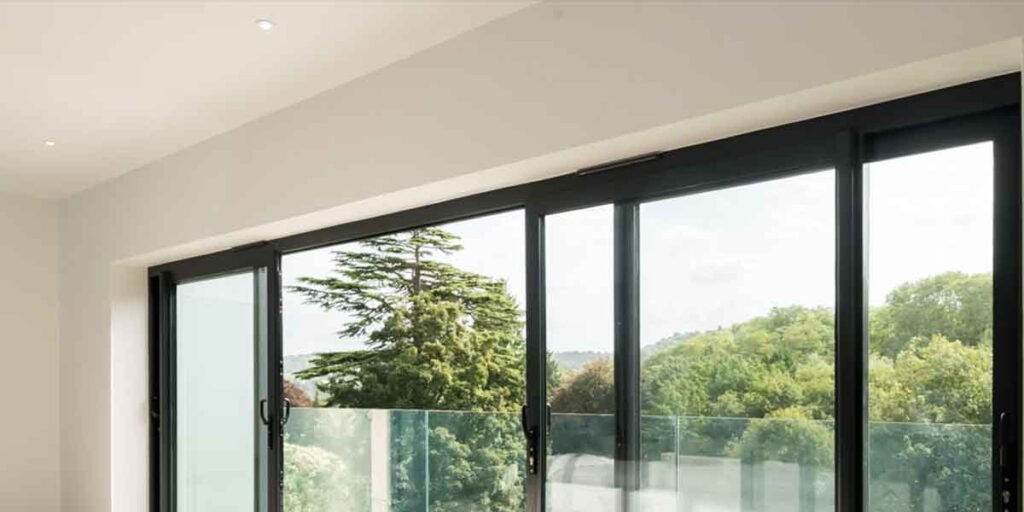
Pay for glass, seals, and rollers on patio doors, then treat the rest of the quote as optional. That order is what separates a good price from a cheap one.
Panel count, glass package, and frame material set the spread on patio doors, where a single product family runs from roughly $512 to $14,286 and Lowe’s puts the typical figure at $2,186. Three variables explain most of that distance: how many panels the opening needs, how the glass is built, and what the frame is made of.
Buying in 2026 adds one more. The federal credit that effectively discounted qualifying exterior doors by $250 each closed on December 31, 2025, so any comparison built last year has to be rebuilt without it.
Three things multiply the price of patio doors
Panel count, rough-opening width, and the glass package account for most of the distance between two doors that look identical in a showroom. Labor changes the total, but it rarely reorders doors that those three variables already separated by thousands of dollars.
A single 36 in prehung fiberglass unit with half-lite glass and mini blinds lists at $399.00 at Door Clearance Center, and the full-lite version of that door lists at $499.00. A pair of 8 ft panels takes the same retailer to $698.00. A 192 in by 96 in iron triple reaches $13,998.00.
Width does most of that work. Stock openings cluster at 60 in, 72 in, and 96 in wide by 80 in high. Footprints from 108 in to 144 in exist largely as special orders, and a special order changes who pays for the extra frame, the freight, and the remake if the tag was wrong.
Glass is the second multiplier. A Low-E fiberglass double lists at $779.00 against $698.00 for the clear-glass version at the same source, which makes coated glass the cheapest upgrade in the category. The frame is where money starts moving fast, with knotty alder and mahogany doubles listed at $1,299.00 and $1,898.00.
Installation quotes price those three variables plus disposal and trim, and competing bids rarely line up on the extras. Disposal and trim are the entries that move most between bidders on a patio doors cost estimate.
Which upgrades earn their cost
Safety glazing and the roller-and-sill assembly are the two places to spend without hesitation. Low-E glass with argon earns its price in most climate zones. Triple glazing, custom width, and decorative hardware can usually be declined.
| Upgrade | What it changes | Verdict |
|---|---|---|
| Safety glazing (tempered or laminated) | Federal compliance for the opening | Mandatory |
| Low-E coating with argon | Heat loss and solar heat gain | Worth it almost everywhere |
| Triple glazing | U-factor below what a door needs | Rarely pays |
| Fiberglass or wood-clad frame | Stability, paintability, warranty length | Severe sun and salt exposure |
| Upgraded rollers and multi-point lock | Air leakage, panel travel, security | Cheapest insurance on a slider |
| Blinds sealed between panes | Cleaning and privacy | Taste, not performance |
| Custom width or height | Fit to a non-stock opening | Only when the opening demands it |
Safety glazing is a legal baseline, not an upgrade.
Federal rules at 16 CFR 1201 list sliding glass doors of the patio type as Category II products, the higher impact class. That rating is verified with a 100 lb bag dropped 48 in, which is equivalent to an ANSI Z97.1 Class A rating, so a door that cannot document it is not a cheaper door for the same opening.
Low-E with argon pays first because it moves two numbers that Energy Star grades separately: U-factor for heat loss, and solar heat gain coefficient for how much sun the glass admits. The warmer climate zones cap solar heat gain at 0.25 for a fully glazed door. A glass package tuned for a northern exposure can miss the limit that applies where the door is installed.
Triple glazing is the upgrade to question. Windows in the coldest zone have to reach U ≤ 0.22, which in practice means a third pane. A fully glazed door only has to reach U ≤ 0.30, a number that a high-performance double-pane unit meets across most of the country, and the third pane still costs like an upgrade and adds weight to the rollers.
Rollers, the sill, and the lock are the cheapest items on the list and the ones that decide how the door feels in year eight. Energy Star holds sliding doors to air leakage of 0.3 cfm/ft² or less under ASTM E283; a panel that rattles in its track or needs a shoulder to close is describing that number in plain language.
Where a cheap patio door costs more later
A low sticker price usually comes out of frame wall thickness, single-point locking, and the rollers. Those parts fail first, and a failed perimeter seal or a flattened roller can cost more to correct than the original price difference.
Sliders fail in a predictable order. The fixed panel’s seal stops sealing, the roller flattens, the track collects grit, and the insulated glass unit fogs once its perimeter seal goes.
Swapping one sliding panel or a fogged glass unit is a reasonable homeowner project while the track, sill, and frame are sound. Replacing the whole assembly is not: an 8 ft sliding door is heavy enough that most manufacturers call for two installers, the rough opening has to be re-flashed, and any change to the opening width reaches framing and the header.
Hire a licensed contractor when the opening has to change size, when the framing above it cannot be identified, when the door opens onto a deck or grade that drains toward the house, or when the local code office requires a permit for exterior door replacement. Structural framing, weather flashing, and inspection sign-off are poor candidates for a first attempt, and a slow leak at the sill stays hidden longer than an owner expects.
The 25C credit closed on December 31, 2025
The IRS states the 25C Energy Efficient Home Improvement Credit is not allowed for property placed in service after December 31, 2025, per Fact Sheet FS-2025-05. Qualified exterior doors once cut $250 each from a tax bill, up to $500.
Those rules paid 30% of the cost, capped at $250 per door and $500 total, with labor excluded, inside a $1,200 annual envelope for building envelope work. The FAQ issued with news release IR-2025-86 on August 21, 2025 states the credit will not be allowed for anything placed in service after December 31, 2025.
A group of House Ways and Means members disputed that reading in a September 11, 2025 letter to the IRS, arguing the statutory expiration remained 2032. The published IRS position is what a filer has to work with, and a tax professional is the right person to confirm how a given 2026 purchase is treated. That dispute is also why a quote from last autumn no longer reflects what a door costs after tax.
State and utility programs keep their own ledgers, and they still exist in parts of the country. Their approved product lists and pre-approval steps are worth checking before an order is placed. A door already in production is expensive to redirect.
Checking a price against Energy Star’s door tiers
Energy Star Version 7.0, effective October 23, 2023, grades doors by how much glass they contain: opaque doors at U ≤ 0.17, half-lite or less at U ≤ 0.25, and more than half-lite, which covers a fully glazed slider, at U ≤ 0.30.
The tier matters more than the name on the box. A fully glazed sliding door falls in the more-than-half-lite group, the loosest of the three door tiers. Its solar heat gain limit splits by climate, at 0.40 or less in the northern zones and 0.25 or less in the southern ones, so a glass package designed for a Minnesota elevation can fail the limit that applies in Arizona.
The NFRC label carries the numbers a code official or a utility program will ask for: U-factor rated under NFRC 100, solar heat gain under NFRC 200, air leakage under testing per ASTM E283. A listing page with a photo and a price and none of those ratings gives a buyer nothing to compare.
Questions buyers ask before they pay
Does a higher price mean a better patio door?
Not by itself. Price follows panel count, glass package, and frame material closely, and those variables decide how the door performs and how long it lasts. Two doors with the same ratings can differ by hundreds of dollars for reasons that never reach the glass.
Is any federal credit available for patio doors in 2026?
None for doors installed in 2026. The IRS states the 25C credit does not apply to property placed in service after December 31, 2025. State and utility programs run on separate rules and are worth checking before an order.
What U-factor should a new patio door have?
Energy Star’s more-than-half-lite tier, which covers fully glazed sliders, tops out at U ≤ 0.30, and the half-lite-or-less tier tops out at U ≤ 0.25. Matching the applicable tier matters more than chasing the lowest rating on the market.
Is tempered glass required in a patio door?
Safety glazing is required. Federal rules at 16 CFR 1201 place sliding glass doors of the patio type in Category II, the higher impact class, which is equivalent to ANSI Z97.1 Class A.
Can one sliding panel be replaced without buying a whole door?
Often, yes. While the track, sill, and frame are sound, a fogged glass unit or a single panel costs a fraction of a new assembly. Once the track is worn or water has reached the sill, a partial replacement buys a year or two.
Write the glass package, the air-leakage rating, and the rough opening size beside any price you are quoted, and put the warranty terms underneath them.
