Termites treatment cost actually arrives as three separate bills, and only one of them is the treatment.
Termites cost money in three places, and the treatment is only one of them. Finding the problem, killing the colony, and keeping a warranty valid are three different invoices, and the third one comes back every year. The first number a homeowner sees rarely matches what the year finally costs.
Two things decide most of the total: what was actually found, and what unit the estimate is written in. Everything else is detail.
What Termites Treatment Cost Covers, and the Two Bills It Leaves Out
Termites treatment cost normally bundles an inspection, one application, and a first-year warranty. Structural carpentry and nearly all homeowners insurance sit outside the bundle, and both arrive later.
The inspection is the smallest line and often the least examined. Angi’s most recent cost data puts a wood-destroying organism inspection near $150, with pest inspections generally between $125 and $450, while a formal report prepared for a lender or a title transfer tends to run $100 to $300. A free walkthrough and a written report are not the same product, and the difference matters when a sale depends on the paperwork.
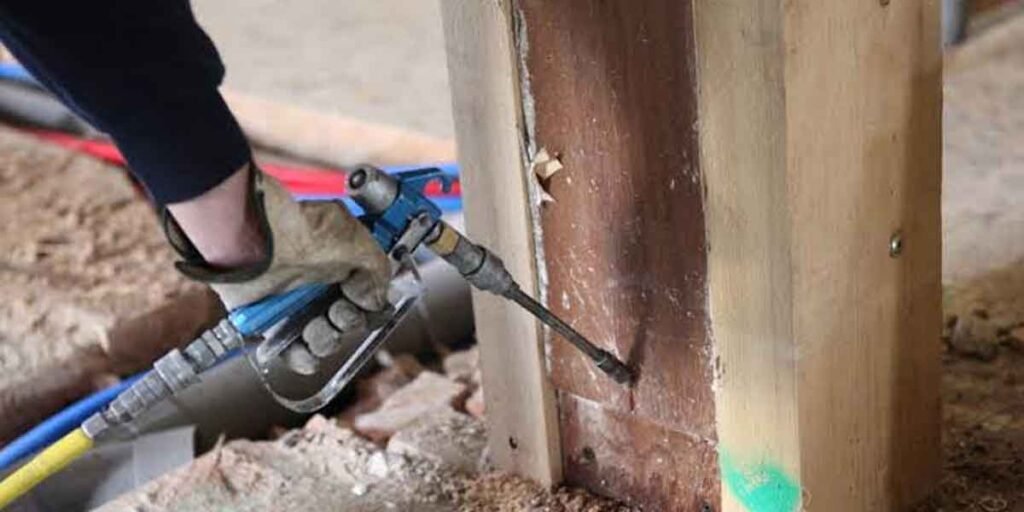
The application is the line homeowners recognize. Thumbtack, pricing from its own booked jobs, reports a single treatment between $380 and $1,268, with most jobs near $694. Contractor pages advertise lower starting numbers because they quote per linear foot instead of per house.
Then the second bill arrives. Replacing a sill plate, sistering a joist, or patching a stud wall is carpentry, and no pest control estimate includes it. The National Pest Management Association puts termite damage at $6.8 billion a year in the United States, a figure the association raised from the $5 billion that still circulates on contractor pages after adjusting the older number for inflation.
Insurance absorbs none of that. The Insurance Information Institute lists pest infestation among the maintenance failures standard policies exclude, and a National Association of Insurance Commissioners survey found that 31% of homeowners assumed infestation damage was covered.
The Evidence You Have Sets Which Band You Are Priced Into
A swarm on a stump at the property line is an observation. Shed wings on an interior windowsill mean an active infestation. The distance between those two findings is usually a four-figure gap, and the finding, not the pest control company, decides which side of it you are standing on.
Winged reproductives, called swarmers or alates, are the termites homeowners actually catch sight of. Purdue Extension’s identification sheet draws the line against winged ants: termite swarmers carry four wings of equal length, a broad waist, and straight bead-like antennae, while flying ants have pinched waists, elbowed antennae, and hind wings shorter than the front pair. After the flight, swarmers break off their wings, which is why a small pile of identical wings near a window, a sliding door, or a light fixture is worth a photograph before anyone reaches for the vacuum.
Timing narrows it further. Subterranean termites swarm in spring on warm days after rain, and a study by Furman and Gold reported in PCT, the pest control trade magazine, found that 90% of subterranean swarms took place within three days of a rain event. A swarm outdoors and far from the foundation usually came from a stump, a woodpile, or garden timbers, and the honest response is a note to watch the area. Activity indoors, or within roughly ten feet of the foundation, is the finding that earns an inspection.
Three bands follow from what turns up.
- Observation only: outdoor swarm, no interior wings, no shelter tubes. An inspection is the reasonable spend, and treatment is not yet on the table.
- Active infestation: interior swarmers or shed wings, mud tubes on foundation walls or piers, wood that sounds hollow along the grain. Soil treatment, baiting, or a spot application gets priced from here.
- Structural involvement: sagging floors, soft trim, visible tunneling near wiring or gas appliances. Pest work and carpentry both get priced, and the carpentry is the larger bill.
Reading the band wrong costs money in both directions. Treating a band-one property buys nothing that lasts, and buying band-one services for a band-two problem leaves a colony working while the repair estimate grows.
How Much Does Termites Treatment Cost per Square Foot
Square footage prices the inspection and some spot work, not a soil treatment. Soil termiticides are sold by the linear foot of foundation perimeter, so the unit on the estimate tells you more about the number than the number does.
Per-foot pricing is where the multiplication happens. Econ-O-Bug, a South Carolina operator that publishes its ranges, quotes soil treatment from $3 to $12 per linear foot. A rectangular 1,200-square-foot single-story house measuring about 30 by 40 feet carries 140 linear feet of perimeter, so the same house lands between roughly $420 and $1,680 before add-ons, depending on which end of that range the local market sits at. An attached garage or a stepped footprint pushes the perimeter higher.
Other lines scale differently. Inspections scale with the size and accessibility of the structure, localized wood repair scales with the square footage of material involved, and bait installations are usually priced as a package with monitoring built in. A homeowner comparing a per-foot application, a per-square-foot repair allowance, and a flat annual monitoring fee is comparing three different products.
The Yearly Side of the Bill
Liquid soil treatments are paid for once and inspected afterward. Bait systems are paid for up front and then visited on a schedule. That difference in shape, more than the sticker price, decides which method is cheaper across ten years and which is cheaper in the first month.
How long a soil barrier holds is a regulatory floor rather than a promise. EPA tells manufacturers to demonstrate efficacy of at least five years for soil termiticides, and NC State Extension points out that this minimum is not a guarantee: properly applied products commonly run five to ten years, and failures in the first year usually trace to a gap in the barrier instead of a chemical breakdown.
What shortens the window is physical. Digging near the treated perimeter, new landscaping, a poured patio, and a persistent crawlspace moisture problem all cut into barrier life, and label language generally forbids re-treating on a calendar schedule without evidence of renewed activity or a disturbed barrier. The annual share of termites treatment cost, in other words, is mostly monitoring, not product.
A monthly payment plan spreads the same monitoring work across twelve bills without changing the annual total.
Warranties carry their own arithmetic. Most household treatments include a first-year protection warranty, and state rules set longer floors in a few places, Arizona among them, where companies are expected to answer reoccurrences for up to three years. Renewal is where coverage quietly disappears: a contract that requires a paid annual inspection lapses when the inspection is skipped, and a lapsed warranty covers nothing in year four.
What You Can Legally Do Yourself, and Where the Line Sits
Retail sprays kill termites you can see. A soil barrier, a bait installation designed around a colony, and structural fumigation are licensed work nearly everywhere, and the product label, not the checkout page, decides what you may lawfully apply.
EPA’s guidance on “for use only by” label statements describes the gap. The agency cannot block the sale of a general-use product, so a professional termiticide can usually be ordered online by anyone, while the label limits application to people licensed or registered by a state. Buying a jug and having the legal right to open it are separate questions, and the label is the document that gets enforced.
Fumigation is the unambiguous case. Sulfuryl fluoride, the only fumigant registered for residential structures, is classified as a restricted-use pesticide, which EPA states may be applied only by a certified applicator or by someone under a certified applicator’s direct supervision. A private applicator certificate, the type used for farm pesticides, does not cover termiticide work, which falls under commercial structural categories in state programs.
The practical line runs through the middle of the job. Moisture correction, drainage, removing wood-to-soil contact, and clearing a crawlspace are yours, and doing them can lower the treatment price. Injecting a foundation, trenching and rodding a perimeter, fumigating a structure, and anything tied to wiring or gas appliances belong to licensed trades. Stop at the soil and at the gas line.
When the question moves from what the work costs to how it is carried out, the termites how to get rid of them a realistic guide covers the sequence from inspection through follow-up.
Prep Work That Comes Out of Your Own Pocket
Every hour a crew spends clearing a crawlspace or moving stored furniture is billable time. Clearing stored items, getting firewood and garden timbers off the soil line, and drying out a crawlspace are the three tasks that most often change a final invoice, because each has to be finished before an application can start.
Moisture is the part homeowners underestimate. Damp crawlspace soil and a disconnected downspout feed a colony, and the common pattern is that the treatment gets scheduled while the water problem stays. Fixing drainage first costs less than paying for a second application after the barrier fails early.
Scheduling adds its own pressure. Spring is swarm season across most of the country and inspection calendars fill up, so a property sitting in the observation band can afford to wait for a slower month, while a confirmed interior infestation should be inspected as soon as a crew has an opening.
One warning belongs here. Digging, tilling, or replanting inside the treated strip after the work is done can open a path through the barrier and void the warranty, which is the opposite of what the money was spent to buy.
Questions That Change the Number Before You Compare Bids
Two estimates for the same house can differ for reasons that have nothing to do with price. These five answers settle most of it.
- Is the figure per linear foot, per square foot, or flat for this house?
- Does it include the inspection and a written report, or is that billed separately?
- Is drainage or moisture correction included, or listed as an exclusion?
- How long is the warranty, and what annual inspection or renewal keeps it valid?
- Does the warranty cover repair as well as re-treatment?
The last two answers are what separate contracts that look identical on price. Repair coverage is far rarer than re-treatment coverage, so a warranty that re-treats but does not repair leaves the carpentry bill sitting with the owner.
Frequently Asked Questions
What does termites treatment cost include, and when is it worth paying?
Termites treatment cost covers the inspection, one application, and a first-year warranty, and it is worth paying once activity is confirmed inside the structure. Damage compounds while a colony stays active, and the insurance exclusion means the repair bill is not shared with an insurer. Paying for treatment early is the cheaper half of that trade.
How do I get rid of termites permanently?
Nothing removes the possibility of termites returning, because the colony that matters over a decade is the one outside the barrier. Soil termiticides are registered against a five-year performance floor and commonly hold five to ten years, so the durable approach is treatment plus the monitoring that keeps the warranty alive.
Is it expensive to get rid of termites?
A single treatment runs from roughly $380 to $1,268 for most houses on Thumbtack’s booked-job data, with the inspection adding about $150. The larger number in the decision is the repair bill that a slow response produces, since insurance does not cover it.
What is a termite’s worst enemy?
In a house, dry soil and a break between wood and soil do more than any predator. University of Kentucky Extension guidance puts exterior wood at least six inches above grade, Georgia’s structural pest control rules require eighteen inches of clearance inside a crawl space, and Mississippi State Extension lists a missing soil-to-wood gap among the conditions that invite a colony.
How often does the bill repeat?
Bait systems repeat annually, because the colony is monitored instead of sprayed, and the renewal inspection keeps the warranty valid. A liquid soil application is paid for once and inspected yearly, with re-application driven by evidence of new activity or a disturbed barrier instead of a calendar.
Keep the written inspection report and the warranty language, whatever the invoice says. A lender will ask for the report at resale, and the warranty terms, not the total, decide who pays in year three.
