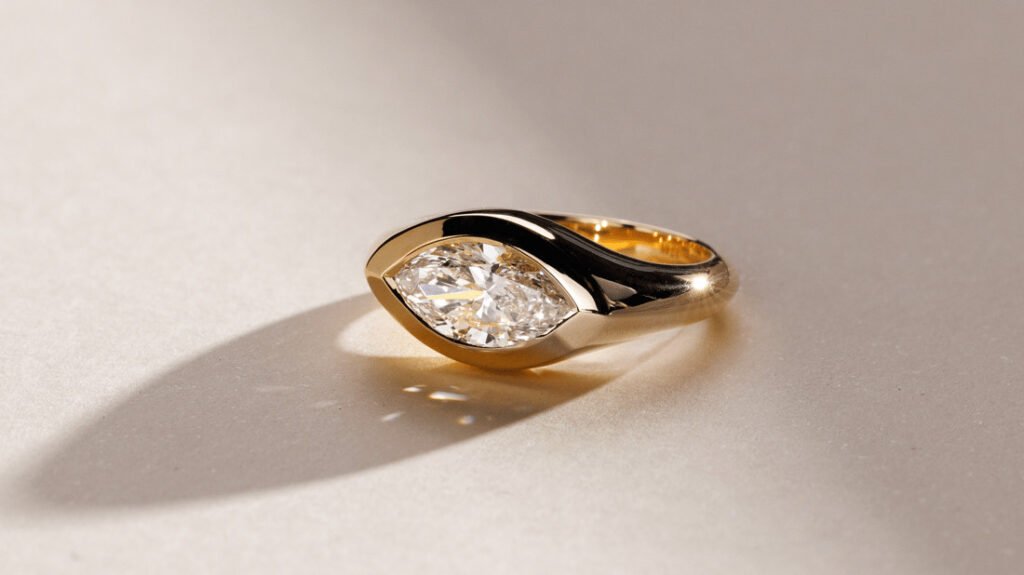
Scroll through any red carpet gallery lately and you’ll spot the same silhouette popping up again and again: a long, pointed diamond that looks almost like a boat, or maybe a football, depending who you ask. That’s the marquise cut, and it’s quietly become the ring shape of the moment.
It’s not a new invention, though. The story goes that King Louis XV of France commissioned the shape back in the 1700s, wanting a diamond that echoed the smile of his mistress, Madame de Pompadour. Whether that’s fully true or just good marketing from three centuries ago, the shape stuck around for a reason.
The Finger-Flattering Factor
Stylists and jewellers will tell you the same thing: marquise cuts make fingers look longer and slimmer than almost any other shape. The elongated silhouette draws the eye up and down rather than across, which is exactly why so many celebrities with a love of dramatic hand poses (think award show close-ups, Instagram flat lays) gravitate toward it. A round or cushion cut sits neatly on the finger. A marquise commands it.
There’s also a size illusion at play. Because the surface area is stretched out rather than clustered, a marquise-cut diamond can look noticeably bigger than a round or princess cut of the same carat weight. For anyone chasing that “wow” moment without the matching price tag, that’s a genuinely useful trick.
Why Lab-Grown Is Changing the Game
Here’s where things get interesting for anyone actually shopping, rather than just admiring from afar. Marquise cuts have historically been tricky to source in mined diamonds because the pointed tips are prone to chipping and the rough stone needs to be cut with real precision, which pushes up cost and limits supply. Lab-grown diamonds have sidestepped a lot of that problem. Because the growing process is more controlled, cutters have more consistent material to work with, and buyers get access to sharper points and cleaner symmetry without hunting for years to find the right stone.
That’s part of why brands specialising in this space have leaned hard into the shape. Cullen Jewellery Marquise Lab-Grown Diamond Rings are a good example of where the trend has landed commercially: elongated stones with crisp points, set in designs that still feel classic rather than trend-chasing, at a price point that doesn’t require a second mortgage. It’s a shape that used to feel reserved for old Hollywood glamour, and now it’s genuinely accessible.
Not Every Hand Suits It (And That’s Fine)
Worth saying plainly: marquise isn’t a universal flattering shape the way, say, an oval often is. Shorter fingers can sometimes look overwhelmed by the length if the ring isn’t sized and set thoughtfully. A good jeweller will talk you through proportion before you commit, not just show you the shiniest option in the case.
The Celebrity Effect Isn’t Slowing Down
Once a handful of high-profile engagements feature the same cut, the ripple effect through search trends and bridal boards is almost instant. That’s exactly what’s happened here. Marquise went from “vintage curiosity” to “most-requested shape” in the space of a couple of red carpet seasons, and jewellers are still catching up to the demand.
If there’s one takeaway, it’s this: the shape photographs beautifully, wears bigger than its carat weight suggests, and finally has the lab-grown supply to match the hype. That combination is rare, and it’s exactly why it’s sticking around longer than most engagement ring trends do.
