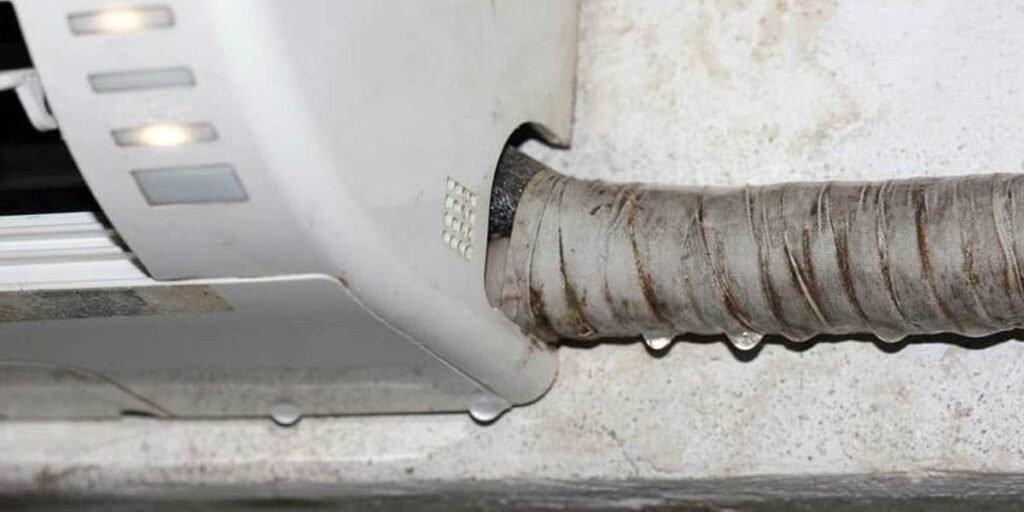
If you are asking, “Why is my Toshiba air conditioner leaking water?”, start with the drain path. On most Toshiba portable units, water leaks come from a full internal tray, a loose drain plug, a kinked drain hose, a clogged condensate channel, or a unit that is not sitting level. On window and wall-style units, the usual suspects are poor tilt, a blocked drain channel, a dirty filter, or ice melting off the coil.
The messy part is that Toshiba sells several different air conditioner styles, and they do not handle water in the same way. A portable Toshiba AC may collect condensate in an internal tray and show a P1-style water-full warning. A window unit usually has to drain outdoors. A wall split or mini-split relies on a condensate drain line that must slope correctly. Treating all three as the same problem is how people end up mopping the floor twice.
| Where the water appears | Most likely cause | First thing to check |
|---|---|---|
| Under the back of a Toshiba portable AC | Loose lower drain plug or full collection tray | Unplug the unit, drain the tray, and reseat the cap firmly |
| From the front or air outlet | Standing water inside, dirty filter, or iced coil melting | Clean the filter and let ice melt before restarting |
| From a drain hose connection | Kinked hose, uphill hose run, or hose end sitting in water | Make the hose run continuously downward to an open drain |
| Inside below a window AC | Unit tilted the wrong way or blocked rear drain channel | Confirm the outdoor side sits slightly lower than the indoor side |
| Down the wall below a split unit | Clogged condensate line or bad slope through the wall | Stop the unit and have the drain line cleared or re-pitched |
The Quick Answer: It Is Usually Drainage, Not A Broken Compressor
A Toshiba air conditioner leaks water when condensate cannot leave the machine the way the design expects. That can mean the tray is full, the plug is loose, the hose is wrong, or the drain channel is blocked.
Air conditioners remove moisture as they cool. Warm indoor air passes over a cold evaporator coil, water condenses on that coil, and the unit has to route that water somewhere. The U.S. Department of Energy notes that humid weather makes condensate drainage especially important, because clogged drains and poor drainage can cause water problems in air conditioners.
For Toshiba portable models such as RAC-PD series units, the first clue is often the location of the leak. Water under the lower rear corner points to the lower drain plug or the collection tray. Water near the exhaust or air outlet points more toward internal splash, poor leveling, high humidity, or ice melt. Water around a hose means the hose path deserves attention before anything expensive gets blamed.
Before You Touch Anything, Do This First
Turn the Toshiba unit off, unplug it, move electronics and rugs away from the water, and do not restart the AC until you know whether the leak came from normal condensate or an electrical-risk location.
Water around a plugged-in appliance is not the place to improvise. If the outlet, cord, plug, control panel, or extension cord got wet, stop there and let everything dry fully before power is restored. If a breaker tripped, if you smell burning plastic, or if the unit was tipped while running, treat it as a service call.
For a portable Toshiba AC, put a shallow pan or towel behind the unit before opening any drain plug. The small annoyance nobody mentions: the plug can look harmless until several cups of water come out fast and run under the baseboard.
Identify Which Toshiba Air Conditioner You Have
The correct fix depends on the Toshiba design. Portable, window, and split-style air conditioners all make condensate, but the drain hardware and failure points are different.
| Toshiba type | How water normally leaves | Leak pattern that fits |
|---|---|---|
| Portable air conditioner | Internal tray, lower drain plug, upper drain outlet in dry mode, or drain hose on some models | Water under the unit, P1 or water-full behavior, dripping from a rear cap |
| Window air conditioner | Condensate drains or is slung toward the outdoor side | Water runs inside when the unit is tilted inward or the outdoor channel is blocked |
| Wall split or mini-split | Gravity drain line or condensate pump | Water runs down the wall, often after cleaning, pump failure, or a clogged line |
The model label usually sits on the side or rear panel. If you have a Toshiba RAC-PD1011CRU or similar portable model, the manual layout shows drain outlets at the rear and a water collection tray that must be accessible. The Toshiba RAC-PD1011CRU manual also lists a water-full troubleshooting step: turn the unit off, drain the collection tray, and restart it.
If A Toshiba Portable AC Is Leaking Water
For Toshiba portable air conditioners, check the lower drain plug, the collection tray, hose position, filter, and whether the unit is level. Portable units are the most likely Toshiba models to leak indoors because all the water management happens inside the room.
Check The Lower Drain Plug And Cap
A loose lower drain cap can leak even when the AC is otherwise working normally. The cap may feel attached, but if the rubber seal is twisted, cracked, missing, or cross-threaded, water can seep out whenever the tray fills.
- Turn off and unplug the unit.
- Place a shallow pan behind the lower drain.
- Remove the lower cap and plug slowly.
- Let the tray drain completely.
- Inspect the rubber plug and cap for cracks, flattening, or dirt on the sealing surface.
- Push the plug fully back in and tighten the cap by hand.
If the leak stops after reseating the cap, the machine may not be broken at all. It was simply unable to hold water in the tray. If the cap will not tighten or the rubber plug feels loose, replace that part before assuming a pump, coil, or refrigerant problem.
Check The Continuous Drain Hose
A drain hose has to flow downhill. If the hose rises above the drain outlet, kinks behind the unit, or ends under water in a bucket, condensate can back up and escape from the Toshiba cabinet.
This is the point that shows up again and again in user complaints. One Reddit HVAC advice thread about a Toshiba portable unit described constant draining and leaking from the bottom; a commenter asked whether the drain plug was sealed and whether the hose sat higher than the outlet. That is not glamorous advice, but it is exactly where many portable AC leaks begin.
“Is the drain blocked?”
– r/AirConditioners, 2025
If you are draining into a bucket, keep the hose end above the waterline. If the bucket fills and covers the hose outlet, the hose can stop draining cleanly. For gravity drainage, the boring rule is the right one: short, downward, no dips, no loops.
If You See P1 Or A Water-Full Warning
A P1-style warning usually means the internal water collection tray is full. Drain the tray first. If the code returns quickly, the unit may be making more condensate than the self-evaporation system can handle, especially in humid weather.
High humidity changes the behavior of portable air conditioners. A unit that rarely needs draining in dry weather can need frequent draining during humid days, rainy weeks, basement use, or dry mode. That does not automatically mean the Toshiba is defective. It means the unit is removing more moisture than it can evaporate through the exhaust stream.
If A Toshiba Window AC Is Leaking Indoors
A Toshiba window air conditioner usually leaks indoors because the unit is tilted inward, the outdoor drain path is blocked, or the filter and coil are dirty enough to disrupt normal condensate flow.
Window units often rely on gravity and outdoor-side drainage. If the indoor side is lower, water follows the easiest path back into the room. If the outdoor side is dirty, clogged with debris, or packed with wet dust, water can pool until it spills where it should not.
- Turn off the AC and remove the front filter.
- Clean the filter and let it dry before reinstalling it.
- Check whether the outdoor side sits slightly lower than the indoor side.
- Look for leaves, sludge, or dust blocking the rear drain channel.
- Restart the unit and watch where the first water appears.
Do not drill new holes into the base pan unless the manual specifically allows it. Some window AC units use water in the pan to help cool the condenser coil. Random drilling can make the unit louder, less efficient, or easier for insects and rain to enter.
If A Toshiba Wall Or Mini-Split Unit Is Dripping Inside
A wall-mounted Toshiba air conditioner drips indoors when the condensate drain line is clogged, sagging, pitched the wrong way, disconnected, or overwhelmed by a failed condensate pump.
Split systems are less forgiving than portable units because the drain line often runs through a wall. If the indoor head was recently cleaned and the leak started soon after, the drain pan or drain hose may have been disturbed. If the leak happens only after long cooling cycles, slime or dust buildup inside the line is more likely.
A homeowner can safely check the filter and visible drain outlet. Clearing a hidden drain line through the wall is usually better left to an HVAC technician, especially if the line needs nitrogen, a wet vacuum, or pump testing. Water inside a wall cavity can become a mold and drywall problem faster than people expect.
Do Not Ignore The Filter And Frozen Coil
A dirty filter can make a Toshiba AC leak by reducing airflow across the evaporator coil. If the coil gets too cold and freezes, the ice can melt later and overwhelm the drain tray.
When the filter is clogged, the unit still tries to cool, but less warm air reaches the coil. That can drop coil temperature too far. The leak may show up after the AC has been running for a while, or after you turn it off and the ice melts all at once.
| Symptom | What it suggests | What to do |
|---|---|---|
| Weak airflow plus water | Dirty filter or blocked intake | Clean the filter, clear curtains or furniture from intakes |
| Ice on the coil or cold air suddenly stops | Frozen evaporator coil | Turn cooling off, run fan only if available, let ice melt |
| Water appears after shutdown | Ice melt or overfilled tray | Drain the tray and inspect airflow before restarting |
| Leak returns after filter cleaning | Drain clog, low refrigerant, or service issue | Call a technician rather than repeatedly running the unit wet |
Low refrigerant can also contribute to coil freezing, but do not top off refrigerant as a DIY fix. If refrigerant is low, the system has a leak or another fault that needs licensed service. The practical homeowner move is to document the symptoms, clean the filter, let ice melt, and stop short of opening sealed refrigeration parts.
A Five-Minute Diagnostic That Usually Finds The Leak
The fastest way to diagnose a Toshiba AC water leak is to locate the first wet spot, match it to the drain hardware, and test one simple fix at a time.
- Dry the floor and cabinet. You need to see where new water starts, not where old water spread.
- Run the unit for five minutes while watching the rear and bottom. Do not leave it unattended.
- If water appears at a cap, reseat or replace the cap. A bad seal can mimic a major leak.
- If water appears from the front, stop and check airflow. Clean the filter and look for ice.
- If water backs up from a hose, simplify the hose run. Keep it short, open, and downhill.
- If the unit shuts off with a water warning, drain the tray fully. Then note how quickly it fills again.
- If the leak returns immediately, stop using cooling mode. The next step is service, not more towels.
Use a flashlight, not a guess. On portable Toshiba units, the rear lower area can hide the actual source because the base spreads water before it reaches the floor. A dry paper towel placed under the drain cap for one minute is often more useful than staring at the puddle.
When To Call A Technician
Call an HVAC technician when water keeps returning after the tray is drained, the filter is clean, the hose runs downhill, and the plug seals correctly. Persistent leaks usually mean a blocked internal channel, pump issue, coil problem, or installation fault.
- The unit trips a breaker or gets any electrical component wet.
- Ice forms repeatedly after the filter is clean.
- The leak comes from inside a wall-mounted indoor head.
- The drain cap or plug is missing, cracked, or will not seal.
- The Toshiba unit is still under warranty.
- You suspect low refrigerant or a sealed-system fault.
For a newer unit, check the warranty path before paying for a deep repair. A portable AC that leaked from the first week may have a missing plug, shipping damage, a badly seated internal tube, or a manufacturing defect. Keep the model number, serial number, photos of the leak, and a short timeline.
Prevention Habits That Actually Matter
Preventing another leak is mostly about airflow, drainage, and placement. Keep the filter clean, keep drain caps tight, make hose runs downhill, and avoid running a portable unit on a soft or sloped surface.
| Maintenance habit | Why it matters | How often |
|---|---|---|
| Clean the washable filter | Protects airflow and reduces coil icing risk | Every 2 to 4 weeks during heavy use |
| Check the lower drain cap | Prevents slow seepage from the collection tray | After every manual drain |
| Inspect the hose slope | Stops water from backing into the cabinet | Whenever the unit is moved |
| Keep the unit level | Helps condensate reach the intended drain path | At setup and after moving |
| Watch humidity changes | High humidity creates more condensate | During storms, basement use, or dry mode |
One more small habit helps: after draining a portable unit, wipe the plug area before closing it. Grit on the rubber seal can create a tiny channel for water. It is a small detail, but small leaks often start with exactly that kind of dirt.
FAQ
Why is my Toshiba portable air conditioner leaking from the bottom?
A Toshiba portable air conditioner usually leaks from the bottom because the lower drain plug is loose, the internal tray is full, or the unit is not level. Drain the tray, inspect the cap and rubber plug, then restart the unit only after the area is dry.
Why is my Toshiba air conditioner leaking water after I drained it?
Why is my Toshiba air conditioner leaking water after draining? The plug may not be sealing, the hose may be backing up, the unit may be tilted, or the coil may be melting ice into the tray faster than it can drain.
Should water come out of a Toshiba portable AC?
Some water is normal because the AC removes humidity from indoor air. It should leave through the intended drain outlet, tray, or hose. Water leaking across the floor, out the front, or around a loose cap is not normal operation.
What does P1 mean on a Toshiba air conditioner?
On many Toshiba portable air conditioners, P1 means the water collection tray is full and needs to be drained. Turn off the unit, unplug it, drain the tray through the lower drain, reseal the plug, and restart it.
Can I run my Toshiba AC while it is leaking water?
No, do not keep running a Toshiba AC while water is leaking indoors. Stop the unit, unplug it, dry the area, and find the leak source first. Running it wet can damage flooring, electronics, and the air conditioner itself.
Why does my Toshiba AC leak only in dry mode?
Dry mode removes more moisture from the air, so the tray or drain hose may fill faster than in cooling mode. Check whether your model requires a continuous drain hose in dry mode and make sure the hose slopes downward.
Why is my Toshiba window air conditioner leaking inside?
A Toshiba window air conditioner leaks inside when it is tilted toward the room, the outdoor drain channel is blocked, or airflow is restricted by a dirty filter. Correct the tilt, clean the filter, and clear the outdoor side before running it again.
The Practical Takeaway
Why is my Toshiba air conditioner leaking water? In most homes, the honest answer is still water routing before major mechanical failure. Start with the plug, tray, hose, filter, level, and drain path. If those are right and water still returns, stop trying to outwork the leak with towels. At that point, the cheaper move is usually a proper service check before the floor, wall, or unit takes the real damage.
