A Midea AC that runs but does not cool almost always points to one of eight specific issues, and most owners can solve five of them without a technician. The unit may still hum, the fan may still spin, and the remote may show “Cool” mode, yet the air coming out is room temperature or barely chilled, observes Georgetown Property Management.
The fix depends on which part is failing. Thermostat misread, dirty filter, blocked condenser, refrigerant loss, compressor wear, fan motor failure, wiring fault, or a wrong mode setting. Each has a distinct symptom pattern. This guide matches the symptom to the cause, then walks through the exact fix for every Midea air conditioner type, including the U-shaped inverter, portable units, and standard window models.
Quick Diagnostic: Match Your Symptom to the Likely Cause
Before opening anything, use the table below to narrow down which of the eight common causes matches what your Midea AC is actually doing. This skips the trial-and-error step that costs most homeowners a service call.
| What You Notice | Most Likely Cause | DIY-Fixable? |
|---|---|---|
| Unit runs, air feels room-temperature | Wrong mode (Fan instead of Cool) or refrigerant low | Mode: yes / Refrigerant: no |
| Cools, then warms up after 20 minutes | Dirty filter or iced evaporator coil | Yes |
| Outdoor unit hot, weak airflow inside | Dirty condenser coils | Yes (surface) / No (deep clean) |
| Loud humming, no cold air | Compressor failing or starting capacitor dead | No |
| Indoor fan silent or weak | Blower motor or capacitor failure | No |
| Thermostat reads odd numbers | Thermistor (temp sensor) drift | Reset first, then call tech |
| Display blinks E1, E2, E3, P1, P4 | Error code from sensor or board | Depends on code (see below) |
| Sporadic cooling: cold one hour, warm the next | Inverter board glitch or thermistor placement | Reset first, then call tech |
8 Reasons Your Midea AC Is Not Cooling
These eight causes account for nearly every Midea cooling complaint reported in service logs and homeowner forums. Five are self-fixable in under 30 minutes. The other three need a licensed HVAC technician.
1. Wrong Mode or Temperature Setting
The simplest cause and the most common one. Midea remotes have a Cool, Fan, Dry, Heat, and Auto mode. If the unit was bumped into Fan mode, it blows room-temperature air without engaging the compressor.
Press the Mode button until the snowflake icon appears. Set the target temperature at least 2°C below the current room temperature. On Midea U-shaped units, the compressor will not start until the set point is below the room reading.
2. Dirty or Clogged Air Filter
A filter caked in dust restricts airflow across the evaporator coil, which drops cooling capacity by up to 15% within the first month and can drop it 30%+ after three months of neglect. Energy Star recommends cleaning or replacing residential AC filters every 30 to 90 days during peak cooling season.
Slide the front panel open, pull the mesh filter out, rinse it under cool tap water, and let it air-dry fully before reinstalling. Wet filters seeded inside the housing breed mold and trigger refrigerant icing within days.
3. Low Refrigerant (Gas Leak)
Refrigerant does not get consumed during normal operation. If your Midea AC needs a “top-up” after a few years, there is a leak somewhere in the copper line set, evaporator, or condenser coil. Topping off without finding the leak only delays the repeat failure.
Signs include ice forming on the indoor copper line, a hissing sound near connections, and the outdoor unit running constantly without cooling. The fix requires a licensed technician with EPA Section 608 certification. Refrigerant handling is regulated. Expect $200 to $600 for leak detection and recharge.
4. Dirty Condenser Coils (Outdoor or Rear Unit)
The condenser sits outside (split systems) or at the back of the unit (window and U-shape). When fins are coated in pollen, grass clippings, or dryer-lint drift, the unit cannot dump heat outside. The compressor runs hotter, cooling drops, and the safety cutoff may shut the system down on hot afternoons.
Power off at the breaker. Brush the fins gently with a soft-bristle brush in the direction of the fins, never across them. A garden hose at low pressure rinses pollen-clogged coils. Bent fins can be combed back with a $10 fin comb. Deep grime needs professional coil cleaner.
5. Failing Compressor or Capacitor
The compressor pressurizes the refrigerant. When it fails, cooling stops entirely. A symptom progression: short cycling (turns on, runs 60 seconds, shuts off), loud humming without start-up, then full failure. Often the actual problem is a dead start capacitor: a $30 part the compressor needs to spin up.
This is technician territory. Compressor replacement on a 5-year-old Midea costs $800 to $1,500, often more than a new unit. Capacitor replacement is $150 to $300. Always get a second opinion if a tech recommends compressor replacement on a unit under 8 years old.
6. Thermostat or Thermistor Drift
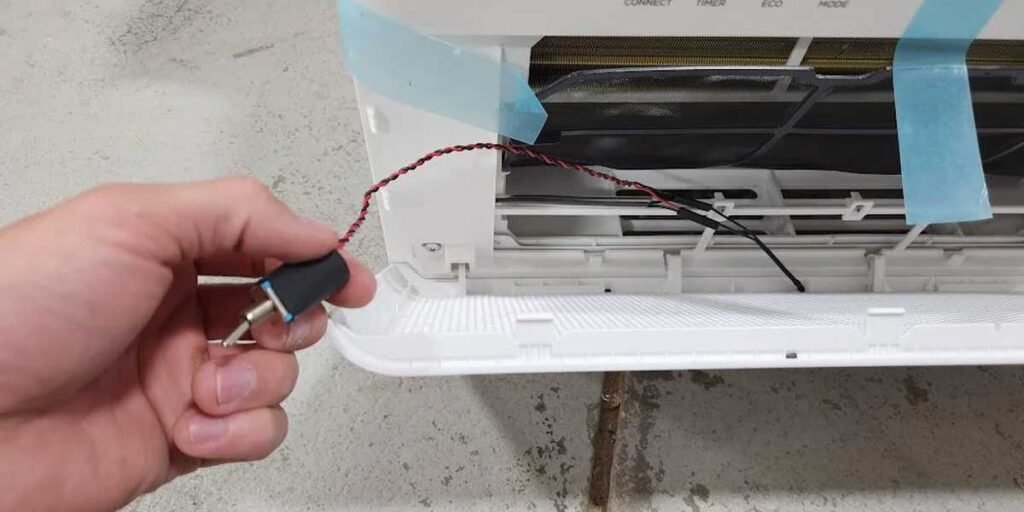
Midea AC units rely on a small thermistor (temperature sensor) near the evaporator coil to read room conditions. If it falls out of position or drifts, the unit thinks the room is already cool and refuses to engage the compressor. Symptoms include the display reading 18°C when the room is clearly 28°C.
A full reset (see Reset section below) clears most thermistor glitches. If the wrong reading persists, the sensor needs replacement: a $80 to $150 job for a technician, since the thermistor sits inside the indoor unit casing.
7. Indoor Blower or Condenser Fan Motor Failure
If the indoor fan spins weakly or not at all, cold air never reaches the room even when the compressor works fine. If the outdoor fan stops, the unit overheats and cuts out within minutes. Both motors typically last 8-12 years; capacitors fail earlier.
Listen for the fan during operation. A clicking sound at startup often points to a failing capacitor rather than the motor itself. Capacitor swaps cost $150 to $250. Full motor replacement runs $300 to $600 including labor.
8. Power Supply or Wiring Faults
Brownouts, loose terminal connections, or a tripped GFCI can cause a Midea AC to power on but skip the cooling cycle. Some Midea U-shape and portable models will display a blinking light pattern instead of an error code when voltage is unstable.
Check that the outlet delivers full voltage (a $15 plug-in tester confirms this). For hardwired units, the breaker may be sized too small for the unit’s startup draw: a 15A breaker on a unit specced for 20A trips on every compressor start. This requires an electrician, not an HVAC tech.
Midea-Specific Issues by Unit Type
The U-shape, portable, and standard window units share core components but each fails in distinctive ways. Matching the symptom to your specific model class shortens the diagnosis and avoids the trial-and-error fixes that drain a Saturday afternoon.
Midea U-Shape Inverter (MAW08V1QWT and Similar)
The U-shape’s inverter board is the most common failure point reported by owners. Symptoms include the unit cooling fine for 30-60 minutes, then warming, then cooling again — what one r/AirConditioners user called “sporadic cooling.” A firmware reset (unplug for 5 minutes, then re-power) clears the issue about 60% of the time. Persistent sporadic cooling means the inverter board needs warranty service.
“For those with a Midea brand U-shaped inverter AC — not cooling enough? Sporadically cold sometimes, not others? Some tips I’ve discovered over the summer: make sure the saddle drain hole isn’t blocked, check the thermistor wire seating, and try the unplug-5-minutes reset before calling support.”
Midea Portable AC (MAP Series)
Portable units depend on the exhaust hose to vent hot air outside. A kinked or undersized hose traps heat inside the unit, which then dumps it back into the room. Single-hose portables also create negative pressure that pulls in warm air from outside through any gap, dropping efficiency by up to 40%.
Check the hose for kinks. The window kit seal must be tight: gaps as small as a finger-width leak enough warm air to make the unit feel useless on humid days. Empty the condensate tank if the unit has one; some models stop cooling when the tank is full.
Midea Window AC Units
Standard window units fail most often at the front-panel filter and rear condenser. The filter clog is identical to the issue covered above. The rear condenser, however, gets neglected because it faces outside. Leaf debris, spider webs, and pollen build up over a single season and choke airflow.
Remove the unit from the window once per cooling season, vacuum the rear fins, and rinse with low-pressure water. This single 15-minute task prevents about 70% of mid-season cooling complaints reported to Midea support.
How to Reset Your Midea AC and Decode Error Codes
A full reset clears the inverter board’s memory and resolves about half of all “not cooling” complaints that have no obvious mechanical cause. The error code list below maps the most common Midea fault codes to their meaning.
The Complete Midea Reset Sequence
This works for U-shape, portable, window, and most split-system Midea units. Follow each step in order; skipping the wait period defeats the reset.
- Turn off the AC using the remote, then press and hold the power button on the unit itself for 10 seconds.
- Unplug the unit from the wall (or flip the breaker for hardwired models).
- Wait a full 5 minutes. The board needs this time to fully discharge capacitors.
- Plug back in. Wait 60 seconds before pressing any button: the board runs a self-test.
- Set Mode to Cool and temperature to 22°C. Listen for the compressor click within 3 minutes.
Common Midea Error Codes
| Code | Meaning | What to Do |
|---|---|---|
| E1 / EC | Indoor temperature sensor fault | Reset; if persists, sensor replacement |
| E2 / EH | Evaporator coil sensor fault | Reset; if persists, technician needed |
| E3 / EA | Outdoor/condenser sensor fault | Check outdoor unit wiring |
| E4 | Communication error between boards | Reset; check ribbon cable seating |
| P1 | Low voltage protection | Electrician: voltage drop diagnosis |
| P4 / P5 | Inverter compressor drive fault | Warranty service if under 5 years |
| F0 | Refrigerant leak detected | Stop unit, call HVAC technician |
When to Stop DIY and Call a Technician
Four causes are confidently DIY: wrong mode, dirty filter, dirty condenser surface, and full reset. Four require a licensed technician: refrigerant work, compressor or capacitor replacement, thermistor replacement, and motor swap. The rule of thumb: if the fix involves opening a sealed refrigerant line, replacing an electrical component, or touching the compressor, hire a pro.
One Reddit homeowner shared a cautionary tale after paying $30,000 for an AC system replacement that failed in two months. The lesson echoed across 138 comments: always get at least three quotes for any repair over $500, and ask each contractor to show you the failed part before they replace it. A Midea AC quote of $4,000 for what should be a $300 capacitor swap is not unusual from less ethical operators.
For an aging Midea unit (8+ years), the math often favors replacement. A new 8,000 BTU Midea U-shape runs roughly $399 retail. A compressor replacement on the old one runs $800 to $1,500. The new unit also delivers 30%+ better efficiency under current ENERGY STAR ratings.
Frequently Asked Questions
Why is my Midea AC running but not blowing cold air?
The unit is likely in Fan mode instead of Cool mode, or the air filter is fully clogged. Check the remote for the snowflake icon and pull the filter for inspection. If both are correct and air still feels room-temperature, the refrigerant may be low, a job for a licensed HVAC technician.
Where is the reset button on a Midea AC?
Most Midea AC units do not have a dedicated reset button. The reset is performed by unplugging the unit (or flipping the breaker) for a full 5 minutes, then powering back on. Some U-shape models accept a 10-second hold on the unit’s physical power button as a soft reset.
How often should I service my Midea air conditioner?
Clean the air filter every 30 to 90 days during heavy use. Have a licensed technician inspect the full system once per year, ideally in spring before peak cooling demand. Outdoor condenser coils benefit from a quick visual check and brush-off at the start of every season.
What does low refrigerant feel like on a Midea AC?
The unit runs continuously but cooling is weak, and you may see ice forming on the indoor copper line or the outside connection. A hissing sound near the line set confirms a leak. Refrigerant does not deplete through normal use, so a low charge always indicates a leak that needs professional repair.
Can I fix a Midea AC not cooling issue myself?
Yes for filter cleaning, mode correction, condenser brush-off, and full reset: these resolve roughly 60% of all not-cooling complaints. No for refrigerant work, compressor or capacitor replacement, and thermistor swap. DIY refrigerant work is also illegal in the US without EPA Section 608 certification.
When should I replace my Midea AC instead of repairing it?
If the unit is older than 8 years and the repair quote exceeds 50% of a new unit’s price, replacement is the better long-term value. A new Midea unit also qualifies for current ENERGY STAR efficiency tax credits in many states, which a repair does not.
Bottom Line
A Midea AC that runs but does not cool is rarely a complete unit failure. Five of the eight common causes — wrong mode, dirty filter, condenser grime, full reset, and basic wiring checks — can be diagnosed and fixed in under 30 minutes without tools. The remaining three causes need a licensed technician, but knowing the symptom pattern lets you describe the problem accurately and avoid being upsold on parts you do not need. Run the quick diagnostic table first, then work through the eight causes in order. Most “broken” Midea units are back to cooling within a single afternoon.
