DIY vs professional tree removal comes down to the space around the tree. If a trunk or a limb can reach anything you would have to pay to replace, the cutting belongs to a crew with rigging, insurance, and a second person on the ground.
Tree size only matters after that. A 30-foot tree in an open field is a weekend of work. The same tree over a driveway is a crane job, and the difference has nothing to do with how tall it grew.
Most of the expensive mistakes start the same way: the tree gets measured and the space around it does not.
The Fall Zone Decides the Job, Not the Tree’s Height
A tree is a do-it-yourself candidate only when its entire fall zone is clear. Arboricultural practice sets that zone at 1.5 times the tree’s height as the minimum distance for workers handling ropes, and 2 times the height for everyone else on site. That second number is what a 30-foot tree beside a house fails to clear.
The figures come from ANSI Z133, the consensus safety standard for tree care operations. The version of it quoted in a Tennessee OSHA fatality investigation holds ground workers handling taglines outside the striking distance, “preferably 1.5 times the height of the tree away, or further when practicable.” Workers with no role in the felling stay back at twice the height.
A 60-foot oak therefore needs roughly 90 feet of empty ground for the rope handler and 120 feet of clearance for anyone else. Ninety feet of empty ground.
Most suburban lots do not have it, so professional tree removal on a small lot usually means climbing and lowering in sections instead of dropping in one piece.
Measuring a Fall Zone Without a Tape Measure
Height is the awkward number, and the low-tech method is a shadow. When your own shadow is the same length as you are tall, the tree’s shadow matches the tree’s height, so you can pace the shadow and have a working figure in under a minute.
Then walk the targets instead of the tree: house, garage, fence, driveway, parked cars, shed, septic field, play equipment, and the service drop where power enters the house.
Anything inside the zone changes the answer. A 25-foot ornamental with 25 feet of open ground all around it is manageable for a fit homeowner with a sharp saw and a clear head.
Conditions that clean are uncommon on a lot with a fence, a driveway, and a house on it.
The Retreat Path Is Part of the Cut
Nearly every felling fatality happens near the stump, in the first seconds after the hinge gives. OSHA’s logging guidance is to plan two escape paths before the saw starts, angled about 45 degrees away from the line opposite the intended fall, cleared of tripping hazards, and never directly behind the trunk.
The operator who steps straight back is standing where the butt can kick out or the trunk can slide.
Clearing two paths in a small yard usually means moving a wheelbarrow, a coiled hose, and whatever the kids left out on the grass, then doing it again because the first path ended up on the wrong side of the lean. None of that is difficult. It is only easy to skip, and it is the step that separates a tree on the ground from an afternoon in an emergency room.
Structural Failure Signs a Full Crown Hides
A green, fully leafed crown says nothing about whether the trunk can hold it. Forest Service hazard-tree training points to the signals that do: fruiting bodies of decay fungi on the trunk or at the root flare, open cracks, cavities, a lean greater than 10 degrees from vertical, and soil lifting around the roots.
So why does everyone stare at the crown? Because it is the part that changes with the seasons.
The Forest Service definition of a hazard tree requires two things at once: a defect that makes failure likely, and a target that failure would strike. With no target, the framework does not call the tree a hazard at all. Beside a driveway, a bedroom window, or a parking spot, the same tree qualifies.
Decay fungi enter through wounds, broken branch stubs, and old fire scars, and they cannot work through intact bark. A conk on a living tree means rot is already inside it. The signal homeowners walk past is at the ground line. A mound of soil on the side away from a lean, or a fresh crack opening in the soil near the base, points to a root plate that has started to move.
Missing mushrooms prove nothing. Fruiting bodies can be small, buried in leaf litter, or on the far side of the trunk.
Why Defect Plus Target Ends the Argument
Homeowners argue about vigour and arborists argue about structure, which is why those conversations go sideways. Crown vigour measures growth. Structural soundness depends on stem wood, branch attachments, and anchoring roots, and only the second list decides whether a tree can fall on something.
Once a defect shows up on a tree that overhangs a roof or a parking spot, the inspection itself has passed out of reach of a look from the lawn. Sounding a trunk or climbing to examine a cavity is trained work.
Four Stop Lines That End the Do-It-Yourself Option
Four conditions end the homeowner option: work within 10 feet of an energized line, a dead or structurally compromised tree, any task that needs climbing or lowering limbs on rope, and a tree covered by a local ordinance.
None of the four depends on price, strength, or confidence. Each one removes the option, so the useful question about a tree is which of them applies.
| Condition | What stays with the homeowner | Who takes over |
|---|---|---|
| Ground-level limb, clean cut, nothing overhead | Pruning and disposal | Nobody |
| Tree under about 20 feet with an empty fall zone and a sound trunk | The cut, the debris, the risk | The homeowner, with a sharp saw and two clear paths |
| Any part of the work within 10 feet of a power line | Making the call | The utility’s line-clearance crew |
| Dead, leaning past 10 degrees, split, hollow, or overhanging a structure | Keeping people out of the area | A trained crew with rigging and insurance |
The 10-Foot Line Around Power Lines
OSHA defines line-clearance tree trimming as pruning, trimming, or removing trees within 10 feet of electric supply lines and equipment, and the minimum approach distance grows by 4 inches for every 10 kilovolts above 50 kV.
Inside that band, the work assumes insulated tools, verified voltage, and often a second qualified trimmer within voice contact.
A homeowner holding an aluminum pole saw is not a qualified trimmer.
Start with the utility. Many will inspect a tree that threatens their conductors and handle the limbs themselves, and the call costs nothing either way.
Climbing, Rigging, and Lowering in Sections
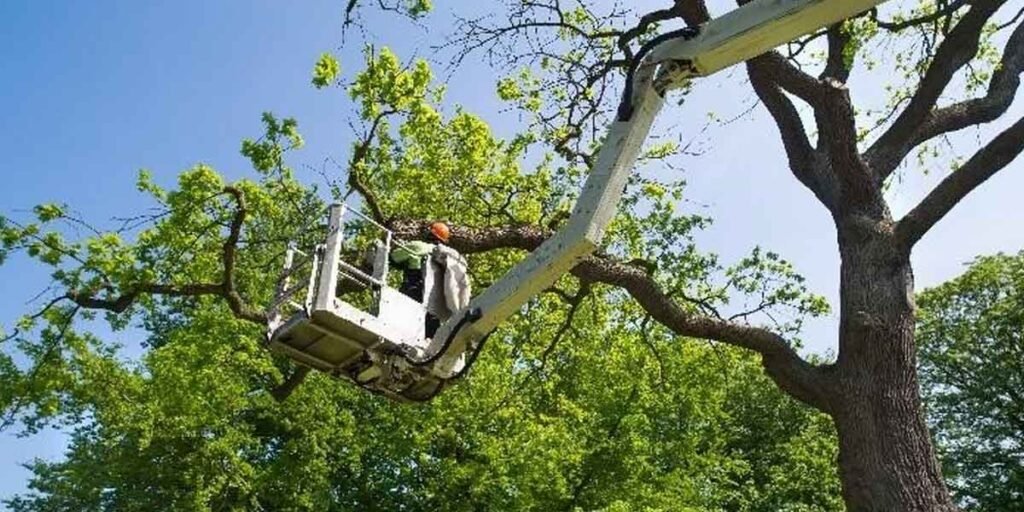
Tree removal methods fall into two families. Felling drops the tree in one piece into a clear zone. Sectional removal takes the tree apart from the top, with a climber cutting and lowering each piece on rope to a ground worker. A crane is the third option when the pieces are heavy enough that rope work alone gets slow or unsafe.
The target list picks the method. Felling is fast and cheap and only possible where the drop zone is empty. Sectional removal is why a tree over a roof can come down without a hole in it, and it is also why that work arrives with a crew, a rope bag, and a ground worker who never looks up without stepping first.
Permits and Ordinances
Tree rules are usually written locally, which means a removal can be routine on one side of a street and require an approval on the other. Municipal ordinances commonly cover protected species and trunk-size classes, street trees, and trees in shoreland or wetland buffers. Homeowner associations add a review layer of their own.
One call to the municipal tree warden or planning office settles it. Ask whether the address falls under a tree ordinance and whether the species or trunk size triggers a permit, then ask any contractor for license and insurance paperwork before the crew arrives.
What the DIY Route Costs Besides Tools
Equipment is the cheapest part of do-it-yourself tree removal. Disposal, days of labor, and the liability that stays with the homeowner when a trunk lands somewhere expensive are the costs that decide the comparison.
A felled tree is not gone when it hits the ground. Wood has to be bucked into lengths, moved, and either burned, given away, or hauled, and municipal yard-waste sites come with size limits, fees, and short weekend hours. Green hardwood is heavy in a way that surprises people who have only handled firewood. A section nobody can lift is also a section no wheelbarrow will take, so moving it turns into a chain of small decisions made on a hot afternoon.
Liability When a Tree Lands Wrong
Liability follows who caused the fall. When a tree drops on its own, most states require proof that the owner knew or should have known about a defective condition, and the American Bar Association’s survey of tree law puts the standard at a defect that is visible, apparent, and patent.
Cutting changes the analysis. A homeowner whose tree lands on a neighbor’s roof is judged on negligence in the manner of the cut, and insurers describe the resulting claim against the person holding the saw in exactly those terms.
A proposed strict-liability statute that would have made tree owners responsible for damage regardless of fault, Florida’s 2025 Fallen Tree Act, died in committee that spring and never took effect. The negligence framework is what still applies.
Hiring moves the exposure instead of deleting it.
Ask for a certificate of insurance showing general liability and workers’ compensation coverage, because an uninsured crew member injured in your yard is a problem that can follow the property owner.
None of this is legal advice for a specific parcel, and state rules differ enough that a dispute over a fallen tree belongs with a lawyer who works in that state.
The Injury Numbers Behind the Warnings
The Bureau of Labor Statistics counted 80 fatalities among tree trimmers and pruners in 2023 and 102 among landscaping and groundskeeping workers. Trees, logs, and limbs led the list of causes.
A NIOSH review of 93 fatality investigation reports covering 95 deaths between 1987 and 2023 found electrocution from power lines at 18.3 percent, falls from trees at 16.1 percent, chipper and machinery incidents at 12.9 percent, and being struck by a tree section or branch at 10.8 percent.
The detail that matters most to a homeowner sits in the same review: more than two-thirds of the fatally injured workers had been on the job a year or less. Inexperience drives the risk, and someone attempting a first removal is at the far end of that scale.
Chainsaw injuries are the other half of tree removal risk. An estimated 23,000 to 29,000 people reach U.S. emergency departments each year with chainsaw wounds, most of them lacerations to hands and legs, according to a 2025 analysis of Consumer Product Safety Commission surveillance data.
Diagnose Before You Cut: Drains, Roots, and Standing Water
A blocked drain is usually a pipe problem wearing a tree costume. Roots get in through existing cracks and loose joints, and they do not break into sound pipe, so tree removal treats the symptom while the defect stays in the ground.
The EPA’s study of root control in sewers identified defective joints as the main entry point for both infiltration and roots. University extension material on the same question adds the mechanism: root hairs a few cells wide need nothing more than a microscopic opening at a joint to get started.
Some municipalities write that conclusion into policy. A city sewer root-intrusion policy in California states that intrusion is typically a symptom of a defect in the lateral, that it is not grounds for removing a tree, and that removing one tree does not solve the problem because roots from nearby vegetation find the same break.
When the symptom is a slow drain, a gurgling toilet, or a damp patch over the lateral, the useful first move is a camera inspection of the pipe.
The same pattern covers a basement that floods after storms. Drainage and sump capacity explain it, and adding or servicing a water removal pump fixes something that tree removal never touches.
Timing matters as much as the diagnosis. A camera pass before the work and again a few weeks after it shows whether the pipe was already cracked or whether the ground moved once the roots stopped holding it, which is one of the benefits of professional plumbing inspections that homeowners rarely collect unless they ask.
What Happens Underground After the Tree Is Gone
Roots left behind do not disappear. New Mexico State University’s extension service answered the question directly in a long-running garden column: with no leaves to make food, the roots stop growing and can only shrink, then decompose, and decomposition leaves tunnels and voids where the roots used to be.
Proximity turns that into a cost. A University of Vermont extension response to a homeowner’s sinkhole described buried decomposing stump and root material leaving a void that soil settles into, and advised treating it as a priority when it sits within a few feet of a foundation, a sewer lateral, or a utility line.
Tree removal can therefore expose a pipe problem instead of solving it. Soil that roots were holding shifts, a cracked lateral loses support, and the camera inspection that looked optional before the work becomes worth scheduling within weeks of it.
Repeat drain blockage removal is the signal that nothing has been diagnosed. Clearing the same line every year or two treats a defect a camera pass would have found the first time.
What Changes Either Way on the Ground
Both choices change the ground under the tree. A retained or replacement tree needs slow, deep watering through its first two seasons, while a removed stump leaves a decay pocket and a root system that keeps settling for years.
Watering is where most replacement trees are lost. A hose held at the trunk for two minutes wets the surface and little else, while tree watering bags release their contents over hours so the water reaches the root ball instead of running off down the slope.
Irrigation follows the same logic. A DIY drip irrigation line run along the drip line, the outer edge of the canopy where most fine roots sit, delivers water slowly enough to soak in. Emitters pressed against the trunk keep bark wet for hours, which is the opposite of what a trunk wants.
Keep the first two summers boring: fill the bag, walk away, repeat weekly through dry spells, and let the surface soil dry between waterings.
After the Tree Is Removed
Stumps are either ground below grade or dug out, and both leave a hole to backfill and compact. Root systems still in the ground will not hold soil the way living roots did.
Replanting belongs on the same map as the tree removal. Keep the new trunk clear of the sewer lateral, the water service, and the foundation, and match the species to the space available rather than to whatever looked good in the nursery.
DIY vs Professional Tree Removal: Questions Before the Saw Comes Out
What is the difference between an arborist and a tree trimmer?
An arborist is trained in tree biology, structural assessment, and plant health care, while a tree trimmer is a worker who cuts branches, and neither title carries legal weight on its own. Assessment is the real divide between them.
An arborist decides what a tree needs, and a trimmer carries out that plan with a saw.
What is the difference between an arborist and a certified arborist?
A certified arborist holds a credential from the International Society of Arboriculture, and the word certified refers to that exam and renewal cycle, not to a government license. The ISA program is voluntary and accredited to the ISO/IEC 17024 personnel-certification standard, and it asks for about three years of full-time field experience plus continuing education to stay current.
How tall is too tall to remove a tree yourself?
Height alone does not set the limit, because the space around the tree matters more. Once the fall zone needs more clear ground than the property has, the work shifts to sectional removal on rope, and a realistic ceiling for a first attempt is a small, sound tree with an empty drop zone and no ladder involved.
Does removing a tree fix a blocked drain?
Tree removal almost never fixes a blocked drain, because the crack or open joint that let the roots in stays where it was. Relining or repairing the lateral is the durable repair, and the removal itself can leave voids that let the pipe settle.
Do I need a permit for tree removal in my yard?
Permits depend on local ordinance, and many municipalities require approval for protected species, large trunks, street trees, and trees in shoreland or wetland buffers. A call to the tree warden or planning office confirms whether the address is covered before any cutting starts.
The homeowner’s share of tree removal ends at the fall-zone boundary. Inside it, with a sound trunk and both retreat paths cleared, the work is yours. Outside it, the useful next step is reading a contractor’s insurance certificate before anyone arrives.
