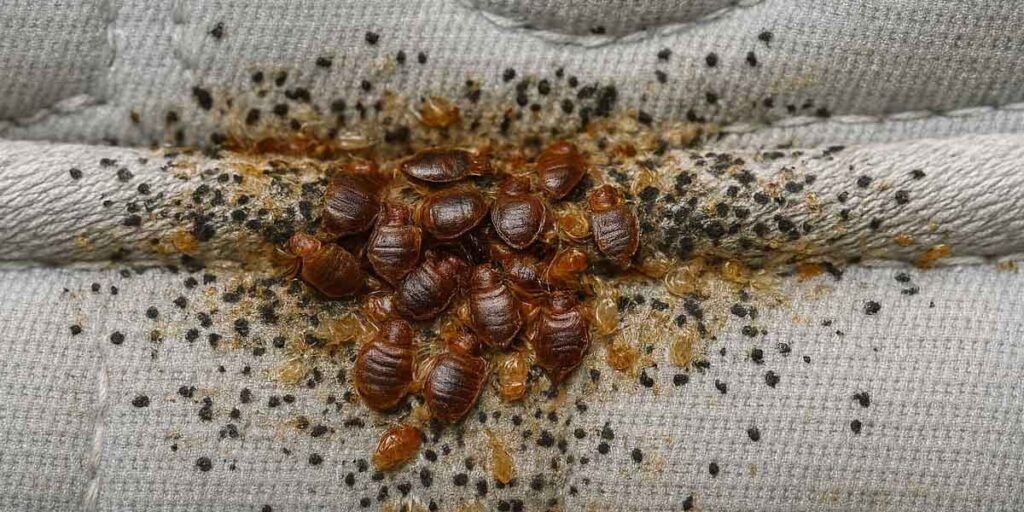
Bed bugs take weeks of repeated work, not one treatment. That is the honest shape of the job, and those weeks are mostly preparation and checking.
Most household attempts do not fail at the store shelf. They fail in the order the work gets done: the room was never cleared, only the mattress got treated, and the checks stopped the week the bites eased.
Preparation, contact work, then a weekly count under each bed leg. The count is the part that gets skipped.
Confirming Bed Bugs Before Anything Gets Treated
Bed bugs are reddish-brown, wingless, and 1 mm to 7 mm long, per the CDC, and they hide in seams and crevices within a few feet of where people sleep. Confirmation rests on a live insect, shed skins, or dark fecal spots, not on bites.
A flashlight pass covers more ground than any spray. Work the mattress seams and piping, the corners of the box spring, the joints of the bed frame, the back face of the headboard, and the baseboards and outlet plates within about 20 feet of where anyone rests, the range Illinois DPH uses as the inspection zone.
Bites settle nothing on their own. Reactions range from nothing at all to inflamed welts in a line, and marks can take days to appear. Some people never react, which is how one person in a household ends up covered in welts while the person beside them has none.
Size, Shape, and the Number That Comes Up Most
Adults average about 5 mm, and nymphs hatch near 1.5 mm, translucent enough to read as a smudge instead of an insect. The CDC’s 1 mm to 7 mm span covers the whole life cycle: five nymphal stages, each one needing a blood meal before it molts. A room holding adults holds juveniles, and those are the insects a quick look misses.
Bat Bugs: The Look-Alike That Changes the Plan
Bat bugs share the genus Cimex with bed bugs and look identical to the naked eye, so the separation has to happen under magnification. Colorado State University Extension puts the difference on the hairs behind the head: longer than the eye width on a bat bug, shorter on a bed bug, a detail that takes 20x to 50x to resolve.
Location carries more usable signal for a householder. Bat bugs turn up singly and in the open, around attics, chimneys, and window sills, mostly in early autumn and mid-spring when bats move on; bed bugs collect in groups inside seams and crevices. Iowa State University Extension reported that most of the suspected bed bugs sent to its diagnostic clinic in 2023 were bat bugs, and that treating the wrong insect costs hundreds to thousands of dollars. Bats fall under wildlife rules of their own, so exclusion comes before any pesticide question, and killing them is not the option it looks like.
Preparation Day: The Work That Determines the Outcome
Preparation determines how much of a treatment actually reaches the insects. Wash and dry bedding and clothing on high heat, encase the mattress and box spring, clear the space under and around every bed, and bag what leaves the room before treatment starts.
- Heat: bedding, clothing, curtains, and anything small enough to fit a dryer.
- Seal: mattress, box spring, and any pillow that has already torn.
- Clear: under-bed storage, boxes stacked against baseboards, and the wall clearance around the bed.
A bedroom takes most of a day. Strip the bed, wash the bedding on the hottest setting the fabric allows, and dry it on high for at least 30 minutes, the number the EPA gives for killing every life stage, eggs included. Shoes, bags, and stuffed animals that cannot be washed go through the same dryer cycle, or into a freezer at 0°F for four days with a thermometer check.
Clutter is the other half of preparation. A stack of boxes, a pile of clean laundry, and a bed pushed flat against the baseboard all give insects somewhere to wait out a treatment, and Illinois DPH is blunt that an inspection needs open floor to move furniture. Pull beds a few inches away from the wall, empty the under-bed bins, and take the curtains down for a wash.
Encasements, and Why a New Mattress Is Rarely the Answer
Encasements seal what is already living in the fabric. Illinois DPH judges covering a mattress and box spring as often better than treating them or throwing them out: the insects trapped in there will not bite through the cover, and they die in it. Two encasements also cost far less than a replacement set, which matters, because replacing a mattress without treating the frame moves the problem instead of ending it.
Two habits keep a cover working. It stays zipped, so a tear gets patched or the cover gets replaced. And it goes on once the seams have been steamed or vacuumed, after loose insects have been pulled out, so the cover is not holding them in place.
The Tools and the Temperatures Behind Each One
Four tools do the killing: a steam cleaner, a clothes dryer, a freezer, and insecticide-grade desiccant dust. Each carries a temperature or time number, and a tool used below its number leaves the insects alive in a room that looks treated.
Steam: 160°F to 180°F at the Surface
Dry heat kills bed bugs outright at 122°F, which is the number that makes a dryer work. Steam needs a higher target, because moisture and fast evaporation cut its punch: Cornell IPM puts the surface goal at 160°F to 180°F, and the EPA sets 130°F as the floor, with no forceful airflow and a diffuser fitted so insects are not blown out of reach.
Two habits separate a pass that kills from one that only flushes. Move slowly, since the New York State IPM program recommends 10 to 30 seconds per foot with the nozzle held within a quarter inch of the surface. And respect the limit: steam reaches roughly two-thirds of an inch into a crack, so a nozzle waved over a seam does nothing for the insects behind it. Leather, vinyl, silk, and finished wood stay off the list of surfaces worth steaming.
Dryer, Freezer, and Desiccant Numbers
Speed drops fast across this group. A hot dryer finishes in about 30 minutes. A freezer set to 0°F needs four days. Illinois DPH notes that 32°F takes roughly 15 days to kill adults and 30 days for unprotected eggs, and dense items take longer than either figure. Desiccants are slower still, which is why insecticide-grade diatomaceous earth and silica gel come with timelines measured in months. The EPA is explicit that pool-grade and food-grade powders are not pesticides and should not be used as one.
Dust works only while it stays dry and thin. A thick pile gets walked over, and a damp one stops cutting into the insect’s outer layer, which is the failure that has people calling a dust useless after a week.
Vacuuming and Traps: Cleaning and Counting
A vacuum removes the insects it touches and rarely the eggs, which stick to surfaces. Illinois DPH warns that canisters, brushes, and bags can carry survivors into another room, so the bag gets sealed and thrown out, and a vacuum used in an infested unit never travels to a clean one. Interceptors and sticky traps are counting tools, not control: they answer whether the population under a bed leg is shrinking.
The Treatment Sequence, and the Checkpoints That Say It Worked
Treat one room at a time, starting with the sleeping area, and recheck that room before moving to the next. Bed bugs feed every five to ten days, per the EPA, so the interval between checks is the honest measure of progress, and the agency asks for a seven-day inspection carried for at least a year.
Days 1 to 3: Kill What You Can Reach
Work the bed first: seams with steam, then the frame, then the back face of the headboard. Everything within about 20 feet of a resting place belongs to the same job, because a sofa, a desk chair, and a nightstand can each hold a small population of its own.
Steam and vacuum before you dust, and dust before you encase.
Seal nothing in until the fabric is dry. Mold in a mattress is a worse outcome than waiting one more day.
The Checkpoint at Day 7 and Day 14
Catching nothing for a week means very little, since a small population is easy to miss. The first useful reading comes from the interceptors under the bed legs and from the bedding itself: cast skins, fecal specks, and live insects count, while bites stay a weak signal given how slowly reactions arrive. Eggs hatch in four to 12 days, per the CDC, and that is the reason a single pass cannot end an infestation. The insects that hatch after the spray are the ones you are still living with.
The Second Month and the Long Watch
Illinois DPH describes professional follow-up at two-week intervals, held until there are no bites and no insects for two consecutive months. The EPA asks for monitoring for at least a year, inspecting every seven days with interceptors. The rhythms differ because the two documents answer different questions: one tracks the end of an active infestation, and the other tracks a return.
A year of weekly checks sounds excessive until the survival figures land. The CDC notes adults live six to 12 months and can go months without feeding, so an insect that feeds once after a treatment restarts a cycle that stays invisible for weeks.
Where These Jobs Fail, and Where They Become Licensed Work
Household jobs fail the same four ways: preparation skipped, only the mattress treated, a fogger used in place of contact work, and monitoring stopped once the bites ease. The last of those also carries a legal and a safety edge.
The Failures, Including Mine
The first bedroom I treated, I steamed the mattress and called it finished. Nobody touched the bed frame or the back of the headboard, and 11 days later the bites came back on the shoulder that faced the wall. Eleven days is the feeding interval, which is the exact size of the hole a mattress-only pass leaves behind.
The fogger is the second failure and the expensive one. The EPA advises against total release foggers as the only means of control, because the active ingredient has to touch the insect and the fog never reaches a crack. Jones and Bryant, writing in the Journal of Economic Entomology in 2012, tested three over-the-counter foggers against five bed bug populations and recorded little if any effect on any of them. Repellent actives make it worse by scattering survivors deeper into voids and into the next room.
The safety record is not theoretical. A CDC health advisory issued in 2012 counted 169 calls to the National Pesticide Information Center about indoor spraying for bed bugs between 2006 and 2010; 129 of those involved mild or serious health effects, including one death. Foggers are also flammable, which is why the EPA’s own instructions for them begin with distance from pilot lights.
Where the Law Draws the Line
Every registered pesticide carries the same sentence: using the product in a manner inconsistent with its labeling violates federal law, the basis of FIFRA section 12(a)(2)(G). Two consequences follow for a household. Applying a product to a mattress, a sofa, or bedding is lawful only when that product’s own directions list that surface. And a restricted-use pesticide may be bought and applied only by a certified applicator, or by someone working under a certified applicator’s direct supervision, which is a line the EPA enforces through the states.
States add licensing on top of certification. Wisconsin, aligning with the federal rule that took effect in 2017, expects category certification, an individual commercial applicator license, and a pesticide business license before any for-hire application; Kentucky’s structural category, which covers household pests, is the one with the heavier exam. Those rules say nothing about whether a householder may act. They mark the point where the product stops being available to one.
Keeping Them Out, and How They Got In
Bed bugs arrive on used furniture, luggage, clothing, and boxes, and in multi-unit buildings they also crawl through voids around pipes and wiring. Keeping them out comes down to an inspection habit and a handful of sealed gaps.
The Routes Worth Watching
The EPA describes bed bugs as good hitchhikers, and the list of vehicles is short: secondhand beds, couches, and dressers; hotel luggage; shared laundry rooms; and boxes from anywhere. A used bed frame left in a hallway is the riskiest object to carry inside. Travel habits cut most of it: keep a suitcase on a rack or in the bathtub instead of on the bed, and at a shared laundry room, bag the load and move it from the dryer straight into a clean bag.
Sealing openings pays off against more than one pest. Bed bugs move between apartments through voids around pipes and wiring, and the same gaps admit mice, so the sealing work that how to get rid of rodents depends on covers the same wall voids and plumbing chases: a door sweep at the entry door, caulk along baseboards and outlet plates, and fine mesh over larger openings.
The Maintenance Window
After the last insect, the job becomes three habits. Encasements stay zipped and get checked monthly for tears. Interceptors stay under the bed legs and get counted weekly for at least a year, because a six-to-12-month lifespan means a survivor can outwait a household’s attention. And anything that arrives from a trip or a thrift store goes through a hot dryer for 30 minutes before it goes anywhere else in the house.
A bed bug that survives one treatment is what brings the second one. The weekly count under each bed leg tells you which way that is going.
Bed Bugs: Practical Questions, Answered
Four answers settle the questions that come up first: how to confirm the insects, what actually ends them, what one night of exposure means, and whether a fogger earns its price.
How could you tell if you have bed bugs?
Live insects, shed skins, and dark fecal spots along mattress seams confirm bed bugs. Bites alone do not, because reactions range from nothing to inflamed welts and can take days to appear. Check seams, frame joints, and the back of the headboard with a flashlight before treating anything.
What kills bed bugs permanently?
No single method ends an infestation. Heat at 122°F and steam above 160°F kill insects and eggs on contact, and encasements plus a year of weekly checks keep a treated room from restarting. The EPA describes elimination as a cycle of steps that can take weeks to months, repeated until nothing turns up.
What if I slept in a bed with bed bugs?
One night does not guarantee a new infestation, and there is no way to know for a few weeks. Dry everything you wore and carried on high heat for at least 30 minutes, then check the seams of the bag or suitcase that traveled with you and watch your skin for reactions over the next two weeks.
How big do bed bugs get?
Bed bugs run from 1 mm to 7 mm, per the CDC, which puts an adult near the size of Lincoln’s head on a penny. Nymphs hatch around 1.5 mm and translucent, so the first insects found in a bed are often the smallest and the easiest to mistake for dirt.
Do foggers and bug bombs kill bed bugs?
Total release foggers are the wrong tool. The EPA advises against using them as the only control, because the fog cannot reach the cracks where insects hide, and a 2012 study in the Journal of Economic Entomology found three retail foggers had little if any effect on five populations. Repellent ingredients can also scatter survivors into neighboring rooms.
