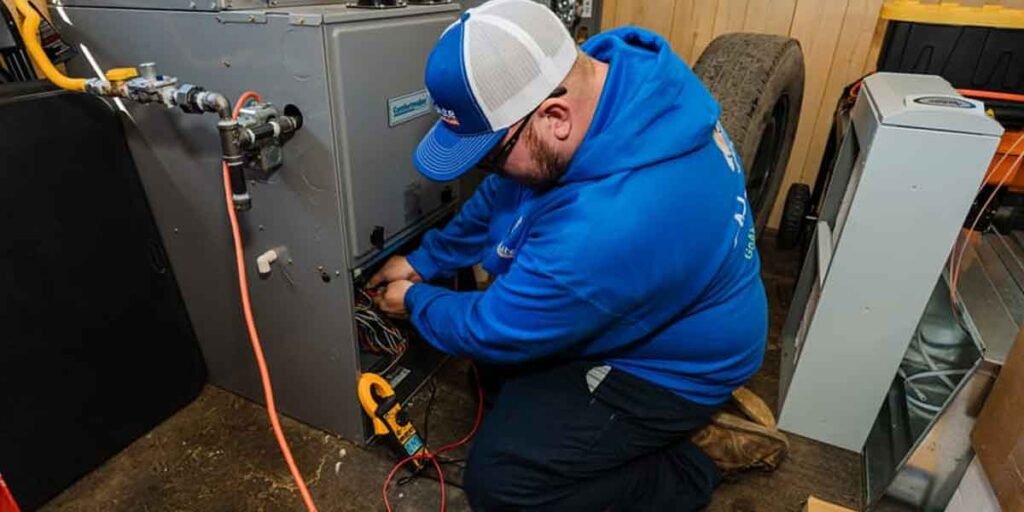
A furnace repair is a diagnostic sequence, not a part swap.
Most no-heat calls end at one of four parts: the flame sensor, the hot-surface igniter, a pressure switch, or the blower motor. Getting from “no heat” to the right one takes about an hour of metering and twenty minutes of wrench work, and the order of those checks decides which of those four parts you end up paying for. What follows is that order, the readings it depends on, and the point where the work stops being yours.
What a Furnace Repair Visit Actually Includes
Four phases: confirm the call for heat, read the fault code, meter the components that code implicates, then prove the repair with a temperature-rise and combustion check. The middle two consume most of the appointment, and they are the two nobody describes in detail.
Technicians work cheapest-test-first on purpose. A thermostat in the wrong mode costs nothing to find. A failed heat exchanger costs thousands to find and shows up far less often. Walking that ladder from free to expensive is what keeps a thirty-dollar problem from being quoted as a three-thousand-dollar one.
The Cheapest-Test-First Order
- Thermostat. Mode set to heat, setpoint above room temperature, working batteries, and 24 volts present between the R and W terminals at the control board.
- Service switch and breaker. A furnace has its own wall switch, usually at the top of the basement stairs. Someone flips it for a repair and forgets to flip it back.
- Filter and return air. A gray filter is usually a choked filter, and a choked filter overheats the furnace on purpose: the high-limit switch cycles the burners off.
- Blower door switch. A panel that is not seated fully holds the safety circuit open, so the furnace never attempts ignition at all.
- Fault code. Most boards flash a sequence through a sight glass. Two flashes is a different problem from seven, and the code narrows the meter work to a handful of parts.
- Flame sensor and igniter. The two most frequent failures, checked with a microamp reading and a visual inspection of the igniter element.
- Pressure switch, inducer, and condensate trap. On condensing furnaces, a clogged trap or a blocked intake keeps the switch open and the burners locked out.
- Gas pressure, combustion, and the heat exchanger. The end of the ladder, and the only steps that carry a carbon monoxide risk.
The first five items are the ones a homeowner can finish before calling anyone. Item six onward needs a meter on live equipment, and the last one needs a combustion analyzer and a borescope camera.
The Readings That Decide the Diagnosis
A furnace repair is a comparison exercise. Each measurement gets checked against a number printed on the furnace’s own rating plate or published in its service manual, and the distance between measured and specified is what tells the technician which part to replace.
| Reading | Instrument | Comparison value | What a bad number points to |
|---|---|---|---|
| 24-volt control signal at W | Multimeter | 24 volts AC present when the thermostat calls for heat | A missing signal means the thermostat, the wiring, or an open safety switch |
| Flame signal | Microamp meter | The minimum microamp value listed in the service manual | A falling signal means carbon on the sensor rod or a weak flame |
| Manifold gas pressure | Manometer | The rating plate value, commonly 3.5 inches of water column on natural gas | Pressure outside the plate value skews combustion in one direction or the other |
| Temperature rise | Two probes, return and supply | The rise range printed on the rating plate | A rise above that range means restricted airflow, not a failed burner |
| Flue carbon monoxide | Combustion analyzer | A steady low reading, tracked against the manufacturer’s limit | A rising or unstable number points to combustion or venting trouble |
| Blower amp draw | Clamp meter | Full-load amps stamped on the motor nameplate | High amps with weak airflow means the motor or its capacitor is failing |
Temperature rise accounts for a whole category of furnace repair callbacks. A furnace that trips its high limit eight minutes into a cycle is usually not broken. It is hot because the filter, a return grille, or the cooling coil above the cabinet is restricting air, and the control is doing exactly what it was built to do.
Replace parts before measuring rise and you buy a return visit and a second invoice.
What Is the Most Common Furnace Failure?
The most common furnace failure is a safety control refusing to run the burners: a dirty flame sensor, a cracked hot-surface igniter, or a pressure switch that will not close. Restricted airflow sits behind a large share of the rest, because a furnace that cannot move air overheats and shuts itself down long before any component actually breaks.
Ranked by how often each one shows up on a service call:
- Flame sensor. It sits in the flame all winter and collects a carbon film. The burner lights, the control loses the flame signal three to five seconds later, and the furnace shuts off with the blower still running. Cleaning the rod restores it; the part itself rarely fails.
- Hot-surface igniter. Silicon carbide, about the size of a pencil eraser, and brittle. A hairline crack leaves it drawing current with no glow, which is why “clicking but never lighting” so often ends at a small part and a labor charge.
- Pressure switch and inducer. On high-efficiency condensing furnaces the trap that collects condensate clogs with debris, the intake pipe can ice over in a hard cold snap, and the switch never proves draft.
- Blower motor and capacitor. A weak capacitor makes the motor start slowly or run hot. A motor that has run hot for a full season usually needs replacement rather than a new capacitor.
- Control board. Less frequent and more expensive than the parts above, and the failure most often mis-diagnosed by homeowners swapping relays on guesswork.
When the Problem Is the Heat Exchanger
The heat exchanger is a stamped steel chamber with flame on one side and the air you breathe on the other. It is the only barrier between combustion gases and the supply ducts, and its walls flex each time the furnace heats up and cools down.
A crack at 15 to 20 years is a fatigue failure, not a brand defect.
A cracked exchanger is not a repair item. Welding, patching, or sealing one creates a rigid spot next to the weld that cracks again, no manufacturer approves field repair, and the surrounding metal shares the same fatigue history as the section that opened. The legitimate options are the exchanger assembly or a new furnace, and assembly replacement means stripping the cabinet down to bare steel: burners, gas valve, manifold, blower, controls, and wiring all come out, then the reassembly has to be combustion-tested before the unit runs again.
That labor bill is why replacement usually wins on older equipment.
One technical detail matters when a technician hands you readings. The fireside of a furnace runs under negative pressure while the airstream runs positive, so a crack does not always push flue gas into the ducts; air tends to move toward the flame instead. A zero carbon monoxide reading in the supply duct does not prove the exchanger is sound. If your furnace gets tagged out of service, ask for the borescope images and the flue reading that produced the call. NFPA 54, the National Fuel Gas Code, directs a technician who finds a condition that could cause unsafe operation to shut the appliance off and inform the owner, and a documented tag is the normal way that gets done.
How Long Does a Furnace Repair Take?
A typical furnace repair runs 90 minutes to three hours on site when the part is on the van, plus travel. A part that has to be ordered adds one to four business days, and the first cold snap of the season stretches both numbers, because every contractor in the area is booked at the same hour.
What sits on the van decides which half of that range you land in. Flame sensors, igniters, capacitors, pressure switches, and the common control boards are stock items. Heat exchanger assemblies, blower motors for older models, gas valves, and anything for a discontinued furnace get ordered, and the wait starts when the office finds the part rather than when the technician finds the fault.
What to Do While You Wait
Protect the pipes first, then the people. Plumbing freezes when indoor air sits near or below freezing for hours, so if the forecast is hard and the repair is days away, let a faucet on an exterior wall trickle, open the cabinet doors under the kitchen and bathroom sinks, and shut off the main valve and drain the lines if you will be away from the house.
Space heaters are the usual stopgap and the usual cause of a second emergency. Keep them three feet from anything that burns, plug them straight into a wall outlet instead of a power strip, and never run one overnight in an empty room. The CDC’s carbon monoxide guidance is blunt about the shortcut people reach for: never heat a home with a gas oven, and never bring a charcoal grill or a camp stove indoors.
By mid-afternoon on a cold day the house reads 59 degrees on the kitchen thermostat, the dog has relocated to the sunniest rug, and whatever happened that morning has already blurred into a vague story about the heat not coming on. So write it down while it is fresh: the sequence of events, the time, and a phone photo of the fault code flashing in the sight glass.
Repair or Replace: The Math That Decides
No industry threshold sets a dollar figure at which furnace repair stops making sense. Carrier, which publishes one of the most widely read repair guides for its own equipment, states that no universal $5,000 rule exists, because cost depends on the system, the equipment type, the region, and the specific failure. The decision inputs that survive scrutiny are three: the age of the equipment, the repair estimate measured against the price of a new furnace, and how long you plan to stay in the house.
Carrier’s own guidance draws the line at a furnace over 15 years old when a repair estimate approaches 50 percent of the cost of a new unit. Read that as a benchmark rather than a law, because a cheap repair on an old furnace still buys time, and an expensive repair on a five-year-old furnace usually does not.
Two conditions push past the benchmark regardless of age. A confirmed crack in the heat exchanger makes assembly replacement uneconomic on equipment past its mid-teens. Repeated failures in a single season are the other signal, not because any one part is expensive but because failures cluster at the end of a component’s service life.
Repair-or-replace math shows up in other trades with the same shape. A structurally sound hardwood floor gets renewed; a floor with water damage under the boards gets torn out. The floor refinishing process explained for hardwood follows an identical rule, and a furnace reaches the same verdict through a diagnostic instead of a moisture meter.
What You Can Do Yourself, and When to Schedule Service
Homeowner work covers the air side and the safety devices, which is more of a furnace repair contribution than most owners assume. Everything that touches gas, combustion, or appliance wiring belongs to a licensed technician, and in most U.S. states that is a licensing requirement rather than a preference.
The Homeowner Side
- Filter changes on schedule, or by pressure drop instead of by calendar if you run a thick media filter.
- Return grilles and supply registers kept open and clear of furniture, rugs, and stored boxes.
- Outdoor intake and exhaust terminations cleared of leaves, nests, and snow. A blocked intake is the reason a high-efficiency furnace quits on the coldest night of the year.
- Carbon monoxide alarms on every level and near sleeping areas, tested when the clocks change and replaced every five years, per the CDC.
- Flame color watched through the sight glass. A steady blue flame with a flicker of yellow at the tip is normal. A flame that is mostly yellow, large, or unsteady is incomplete combustion, and the EPA treats a persistent yellow-tipped flame as a sign of a misadjusted burner and higher pollutant emissions.
The Stop Line
Stop and call for help the moment the work involves the gas valve, the burner assembly, the igniter or flame sensor, the heat exchanger, the venting, or any wiring behind the furnace panels. Soot on the cabinet or the vent is another stop signal, and a yellow flame that is still yellow after a minute of running is the same thing. The EPA’s indoor air guidance is direct on the point: shut the appliance off and have a qualified technician service it, because incomplete combustion does not correct itself.
Maintenance Timing
One professional service a year, scheduled in early autumn before the first cold night, is what the CDC recommends for furnaces and every other fuel-burning appliance. It also prevents more furnace repair work than any part you can buy, because a tune-up covers the burners, the heat exchanger, the safety controls, and airflow, which is precisely the list that produces mid-winter breakdowns when it goes unchecked for two or three years running.
If You Smell Gas
A gas smell is a different emergency from a cold house, and the risk is ignition rather than carbon monoxide. The odor is mercaptan, added to natural gas so a leak announces itself. Pipeline safety guidance from the U.S. Department of Transportation’s PHMSA is specific: do not operate light switches, do not use a phone indoors, do not start a vehicle, do not strike a match. Get everyone out, then call 911 or the gas utility from a neighbor’s house. If a carbon monoxide alarm sounds instead, the CDC’s instruction is to move into fresh air and call 911, and to stay out until responders say the building is safe.
Frequently Asked Questions
How much does an average furnace repair cost?
Carrier’s furnace repair guide, citing cost reporting from Forbes, puts a typical repair between $150 and $300, with minor fixes near $50 and a cracked heat exchanger past $1,200. Diagnosis fees, part availability, and after-hours scheduling move a bill within and beyond that band.
What is the most expensive part to fix on a furnace?
The heat exchanger and the blower motor top the list, with the control board close behind. All three cost more in labor than in parts, because reaching them means pulling the cabinet apart and re-testing the unit afterward.
Can I do part of a furnace repair myself?
Yes, and the safe half is the air side: filters, registers, and the outdoor terminations, plus testing carbon monoxide alarms and watching flame color. Gas valves, burners, igniters, flame sensors, heat exchangers, venting, and control wiring are technician work in every state.
What is the $5,000 rule for HVAC?
It is not a real rule. No standard names $5,000 as the point where repair turns into replacement, and the figure spreads because whole-system replacement prices often land near it. Age, the estimate against new-equipment price, and your plans for the house are the inputs that hold up.
Is it worth replacing a heat exchanger instead of the furnace?
Rarely. Exchanger replacement requires stripping the cabinet and combustion-testing the reassembly, so the labor approaches the price of a new furnace. On a unit past 12 to 15 years, a new furnace usually costs less per year of remaining service.
Two numbers decide most furnace repair calls: the measured reading against the rating plate, and the repair estimate against the price of new equipment.
