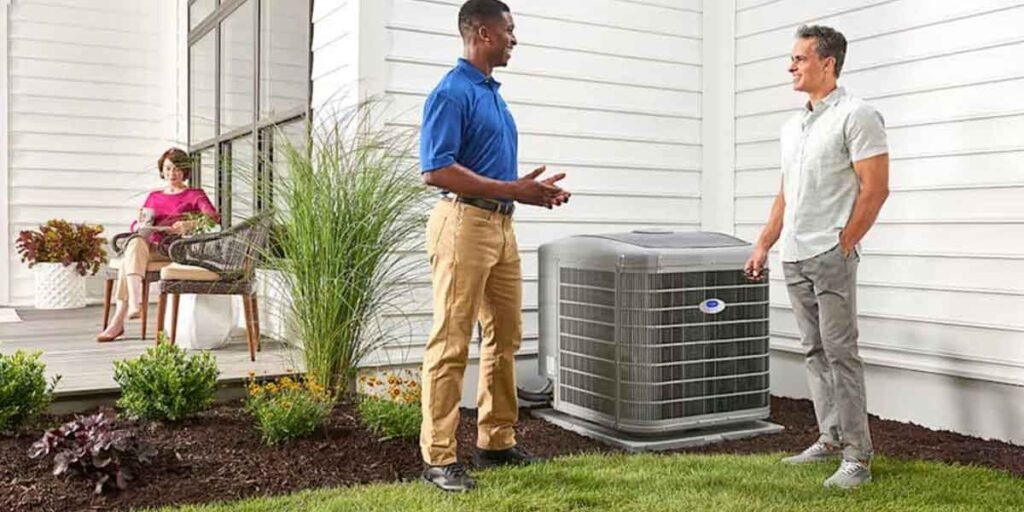
Air conditioning installation splits along a federal line before it ever tests a homeowner’s skill.
Section 608 of the Clean Air Act decides who may open a refrigerant circuit, and a well-stocked garage does not change that. What stays inside a homeowner’s control is smaller and more useful: the load calculation, the permit, the warranty terms, and the model numbers on the invoice.
Air Conditioning Installation Has Four Stages, and Two of Them Are Not Yours
Every residential job runs through the same four stages, and each one has a different owner. Sizing is research a homeowner can demand in writing. The electrical circuit and the refrigerant loop are the two that leave your hands.
Sizing. Section M1401.3 of the International Residential Code requires heating and cooling equipment to be selected with ACCA Manual S from loads calculated with ACCA Manual J or an approved equivalent. The 2021 and 2024 editions add a ceiling: cooling equipment may not exceed the calculated load by more than 15 percent.
That limit is why “same size as the old one” is not a sizing method. A 3-ton unit in a house that shed load to new windows and added insulation is oversized, and an oversized system cools the air without pulling moisture out of it.
Electrical. A split system runs on a 240-volt circuit with a disconnecting means. NEC 440.14 keeps that disconnect within sight of the equipment, which the code defines as visible and no more than 50 feet away, and the 2023 edition added the working-space rule in 110.26(A). St. Paul’s residential inspection checklist spells that out as at least 3 feet of clearance in front of the disconnect and the control panel.
Checking whether your panel has room for the circuit is a fair question for an electrician. Adding the circuit is not a homeowner task in most jurisdictions, and it gets inspected either way.
The refrigerant loop. This stage has a legal owner rather than a skill requirement, and the next section covers what that means.
Commissioning. Vacuum, charge, and airflow verification. It is the stage homeowners pay for without knowing its name, and the stage where most of the measured performance loss lives.
Which of the four stages can a homeowner hold? Preparation, and only preparation. If the job opens the sealed loop or adds a 240-volt circuit, it belongs to someone licensed and insured to do it.
The Refrigerant Line Is a Federal Boundary
The EPA’s Section 608 program covers anyone who could reasonably be expected to breach the refrigerant circuit, and its definition of a technician lists the exact moves that installation work requires: attaching or detaching gauges and hoses, adding or removing refrigerant, adding or removing components, and cutting refrigerant lines.
The agency answers the mini-split question directly. Installing a mini-split, including connecting pre-charged line sets, requires Section 608 certification. A supply-side restriction closes the same door from the other end: distributors may sell HFC refrigerants only to certified technicians or their employers, which is why the jug on a hardware shelf is never there.
Knowingly venting refrigerant is illegal on its own, and violations of the refrigerant rules carry penalties up to $25,000 per day per violation. The EPA has also said in rulemaking that uncertified people are more likely to release refrigerant, on purpose or by accident. A pre-charged DIY kit changes the tools, not the requirement, because the couplings still create a refrigerant connection, and the person holding the wrenches is covered by the same rule that covers a service van.
What changed for new equipment in 2025, and what changed back in 2026
The refrigerant inside a new system is no longer R-410A. Under the American Innovation and Manufacturing Act of 2020, HFC production and consumption fall 85 percent below baseline by 2036, and the EPA’s 2023 Technology Transitions Rule capped residential and light-commercial air conditioners and heat pumps at a global warming potential of 700.
R-410A sits near 2,088 on that scale, so manufacture and import of new equipment using it stopped on January 1, 2025. The replacements are R-454B at roughly 465 and R-32 at roughly 675, and ASHRAE classifies both as A2L: lower toxicity, low burning velocity.
The “2” is the part that changes installation practice. A2L systems carry charge limits and leak detection, and technicians train on both, which is one more reason the sealed-loop work stays with them.
The compliance dates moved after that. The EPA proposed a revision in October 2025 and finalized it on May 21, 2026, removing the January 1, 2026 deadline for installing pre-2025 R-410A equipment, as the Air Conditioning Contractors of America reported at the time.
The phasedown itself did not move, so R-410A keeps getting scarcer and more expensive while existing systems stay legal to run and service. New York took no relief, and its Part 494 keeps a January 1, 2026 installation deadline.
Two consequences follow for anyone replacing equipment. An R-410A system cannot be retrofitted to an A2L refrigerant, and a split-system replacement generally means a matched indoor coil and outdoor unit rather than one box off a truck.
What Commissioning Actually Measures
A wrongly sized or badly installed air conditioner still blows cold air, which is how the loss stays invisible. The EPA’s ENERGY STAR program puts that loss at as much as 30 percent of performance.
Its fact sheet states that more than half of the air conditioners in American homes are believed to be affected by at least one installation problem.
The fault list behind those two figures is specific. In the field studies ENERGY STAR cites, airflow over the indoor coil was inadequate in roughly 70 percent of units, about 62 percent were charged incorrectly, around 50 percent were oversized, and total duct leakage averaged 35 percent.
Quality installation under the ANSI/ACCA specification ENERGY STAR builds on comes down to four checks: equipment matched to a documented load, sealed ducts, correct refrigerant charge, and enough airflow.
Each check leaves a document a homeowner can ask for by name. Static pressure across the coil, superheat or subcooling readings matched to the manufacturer’s charging chart, and the load calculation itself are records, not opinions.
The outdoor unit sits in the corner of the yard the fence and the downspout already claimed. By four in the afternoon it is pulling ninety-degree air across a coil that never gets a full breath, and it shuts off before the house dries out.
None of that shows up on a thermostat display. It shows up in a humidity reading and a July electricity bill.
Warranty, Permit, and the Paperwork That Outlives the Install
Warranty coverage is the argument homeowners hear most, and the paperwork is narrower than the sales pitch. Hotpoint’s ductless limited warranty states that installation must be performed by a licensed HVAC technician and that failing to use one voids all warranty on the product. Gree’s contractor page says DIY installations void warranty coverage, and MRCOOL splits its own catalog, selling pre-charged lines for homeowner installation while labeling its Tech-Install units as not intended for self-installation.
Federal law limits how far that language reaches. The Magnuson-Moss Warranty Act and the FTC rule at 16 CFR 700.10 bar a warrantor from conditioning coverage on a service identified by brand or corporate name unless that service is free, and they leave room for a denial only where the manufacturer shows the defect came from the unauthorized work.
A denial letter that cites nothing beyond “installed by the homeowner” is a position the manufacturer has to defend.
Permits run the other way, and they attach to the house rather than to the installer. Full equipment replacement reads as mechanical work under the International Residential Code, which means a permit and an inspection in most jurisdictions, and California’s Title 24 and Washington State go further by requiring third-party verification of sizing at permit close-out. Unpermitted mechanical work surfaces at resale and can complicate an insurance claim, because the first question an adjuster asks is who installed it and whether anyone inspected it.
Where air conditioning installation repair lands later
Parts warranties cover parts. Labor is usually excluded, so a compressor that fails inside the coverage window still costs the homeowner the diagnosis, the recovery, the recharge, and the service call.
The repairs that trace back to commissioning are the expensive ones. A system charged below the manufacturer’s chart runs high superheat and a hotter compressor than its design assumed, and the failure shows up two summers after the installation that caused it, long past the point where anyone connects the two events.
What professional air conditioning cleaning covers
Filter changes and the outdoor coil rinse belong to the homeowner, and skipping them costs efficiency every month. Professional air conditioning cleaning goes past the user-serviceable surface: the indoor coil, the drain pan and trap, the blower wheel, and a pressure-drop reading taken across the filter and coil.
That last item is why a cleaning visit sometimes turns into a diagnostic one. A coil that has never been washed registers as low airflow, and low airflow sits at the top of the fault list above.
Which Home Fits Which Path
Most homes fall into one of three situations: a shared building where exterior equipment is not yours to place, a like-for-like replacement where the tonnage on the old nameplate may be wrong, and an older house whose load has changed since the last system went in.
A condo or townhome often cannot host an owner-supplied condenser at all. Equipment on shared walls, roofs, or balconies usually needs association approval before it needs a contractor, and anything hanging off the building follows one rule: whether it is a condenser bracket above a walkway or balcony safety net installation by trusted experts, the crew needs fall protection, insurance, and the association’s sign-off.
A single-family house replacing like for like still needs a certified technician for the line set and a licensed electrician for the circuit. The paperwork is what the homeowner controls, so ask for the Manual J report and check whether the proposed capacity lands inside the 15 percent ceiling.
An older house that has gained windows, insulation, or an addition is the case where old tonnage is least reliable. Loads move when an envelope changes, and a house that tightened up usually needs less cooling capacity rather than more, which is the opposite of what a like-for-like swap delivers.
A homeowner who cannot get a load calculation in writing is comparing prices, not systems.
Frequently Asked Questions
Can you legally install your own HVAC?
You can buy and work on the parts that stay outside the sealed circuit. Federal law requires a Section 608-certified technician for anything that opens the refrigerant circuit, and refrigerant cannot legally be sold to anyone else. State and local rules cover the rest: electrical work, permits, and inspection, so skipping the permit is a local violation rather than a federal one, and the unpermitted work stays attached to the house.
Can you DIY air conditioner installation?
The legal DIY range is narrow: window and portable units, thermostats, filters, equipment pads, and line-set covers. A split or central system needs certification, and the permit and inspection follow it.
Do DIY air conditioners really work?
Pre-charged mini-split kits do cool a room, and the couplings still make a refrigerant connection that the EPA treats as certification work. Self-installation also risks the manufacturer’s coverage, since several brands void it without a licensed installer.
New A2L equipment adds leak detection and charge limits that the installation has to support, and those requirements are covered in technician training rather than a homeowner manual.
What is the $5,000 rule for AC units?
Multiply the age of the unit by the estimated repair cost. Above $5,000, replacement usually costs less over the life of the system; below it, repair is generally the better spend. Trane and American Standard both publish that arithmetic, and neither treats it as a decision on its own, because repair history, remaining warranty, and refrigerant type all move the answer.
Is DIY Air Conditioning Installation worth it for a homeowner?
For the equipment, rarely; for the preparation, often. Requesting a load calculation, clearing access around the outdoor unit, and confirming what the permit office requires costs nothing and shapes every bid that follows.
What does “HEP air conditioning” mean?
Most often it means HEPA filters: high-efficiency particulate air media rated to capture 99.97 percent of particles at 0.3 microns and larger.
Filter choice belongs to the installation design rather than the accessory list. A dense filter adds pressure drop the blower has to overcome, and low airflow sits at the top of the fault list above.
