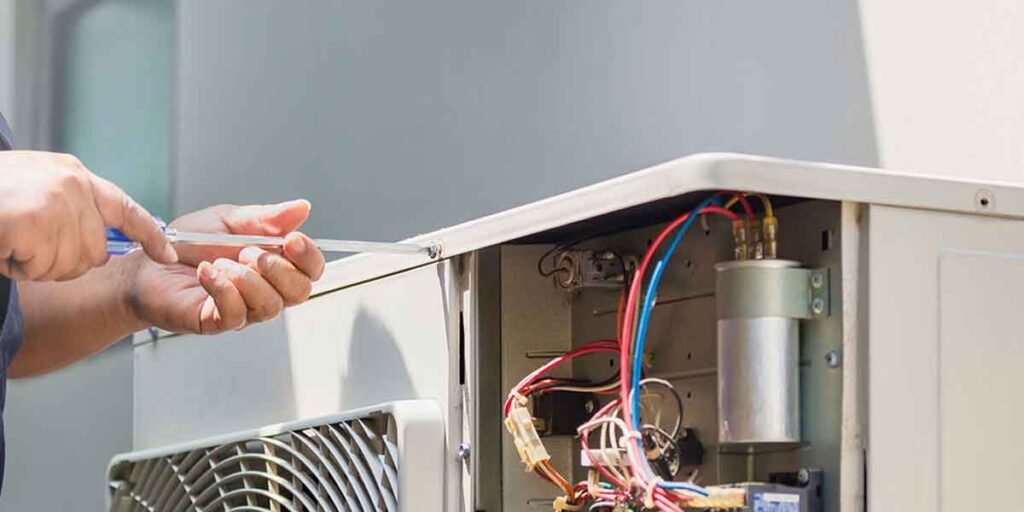
An AC Repair visit in the United States usually lands between $150 and $650, and six inputs decide where inside that window the invoice ends up: the diagnostic call, the part tier, refrigerant rules, the hour you book, the age of the equipment, and how hard the equipment is to reach.
HomeAdvisor’s 2025 HVAC figures put the average repair near $350, with most bills falling between $130 and $2,000. Angi’s component data spreads just as wide, because a capacitor and a compressor share an invoice category and almost nothing else.
A quote states what one company charges for one house. It rarely says which of the six inputs moved, and that is the part worth understanding before the second bid arrives.
The diagnostic visit sets the entry price
Expect $75 to $200 for the diagnostic visit during business hours, with most weekday calls clustering between $99 and $159. Angi’s guidance for a standard service call is a flat $75 to $150 covering travel and inspection.
Whether that money stands is a billing question rather than a technical one. Most companies credit the fee to the work when you approve a repair, so a $125 diagnostic on a $350 job bills at $350. Decline the work, ask for a second opinion, or hand over a problem the technician cannot reproduce, and the fee is collected on its own.
Two figures are worth requesting before anyone drives out: the total due if you approve no work, and the total if the diagnostic applies to the repair. That difference is the price of the appointment itself, and it is the number homeowners forget to ask about.
What an AC repair technician is certified to do
Anyone who attaches gauges, adds or removes refrigerant, or opens the refrigerant circuit on stationary equipment needs certification under Section 608 of the Clean Air Act. The EPA’s program issues four credential types, Type I through Type III plus Universal, after an exam administered by an approved certifying organization. The credential never expires.
The same rule set restricts who may legally buy regulated refrigerant and prohibits intentional venting during service. Carbon dioxide, sold as R-744, is the SNAP-listed alternative exempted from the venting ban.
That closes off a common plan. Refrigerant is not a consumable a homeowner tops off from a jug, and a technician offering to add a couple of pounds without hunting the leak is pricing a return visit rather than a repair.
Parts and labor band into three tiers
Parts sort into three tiers with very different ceilings, and the tier explains the invoice better than the national average does. Angi’s 2025 component pricing and HomeAdvisor’s labor range of $100 to $250 an hour line up closely enough to build an estimate on.
| Tier | What sits in it | Quoted range |
|---|---|---|
| Electrical small parts | Run and start capacitor, contactor, relay | $100 to $450 |
| Motors, boards, valves | Blower and condenser fan motors, control board, TXV | $100 to $700 |
| Refrigerant circuit and major components | Leak detection and repair, compressor, evaporator or condenser coil | $250 to $3,000 |
Inside each tier, the spread comes from things that have nothing to do with the part. A rooftop package unit, an air handler in a 120-degree attic, a second system that has to be shut down for the shared zone, an OEM part against a universal one, and a manufacturer’s warranty that covers the part but not the labor all move the number.
Comparing bids only works when the inputs match. Scope, material, and access drive any repair estimate the same way, which is why a floor repair cost calculator asks for room dimensions and material before it returns a figure. A cooling bid that skips part grade and access is answering a smaller question than the one you asked.
Tier one failures account for the majority of service calls. A failed run capacitor, the small part that keeps a motor’s current in phase while it runs, is the most common reason a system blows warm air, and it is also the least expensive item on the list to swap.
Why one tier-one part costs two prices
Access is the first variable. A condenser in the side yard takes minutes to open; an attic air handler reached through a hatch in a closet takes a ladder, a floor covering, and twenty minutes of crawling before diagnosis starts.
The part source is the second. A universal capacitor sells for $10 to $30 and an OEM part for the same circuit can run several times that, which matters on warranties and hardly at all on a 15-year-old unit.
Refrigerant work carries its own curve
A recharge runs $100 to $500, and Angi splits the range by chemistry: $100 to $350 for R-410A and $250 to $600 for the older R-22. Leak detection and repair sits well above that at $250 to $1,500, since finding a leak in a sealed circuit is hours of instrument work.
Regulation moved this line item twice in three years. Under the EPA’s Technology Transitions Rule, equipment manufactured or imported for U.S. residential and light-commercial use on or after January 1, 2025 must use a refrigerant with a global warming potential at or below 700. R-410A, at 2,088, misses that limit by a wide margin, since global warming potential measures the heat a refrigerant traps relative to carbon dioxide. The replacements are R-454B at 466 and R-32 at 675.
A system already running R-410A is neither illegal nor scheduled for retirement. It also cannot be converted. The two chemistries operate at different pressures, carry different flammability classifications, and A2L equipment needs leak-detection sensors that a 2015 condenser does not have. In May 2026, ACCA reported that the EPA dropped the January 1, 2026 installation deadline for pre-2025 R-410A inventory, which keeps older systems serviceable while the supply of the refrigerant they run on tightens.
R-22 sits at the other end of the same logic.
Production ended years ago, the per-pound price runs well above R-410A, and each recharge is an unbudgeted repeat of the last one.
The hour you call changes the multiplier
Emergency AC repair is priced by the clock, and the multiplier is steep. After-hours work runs $150 to $300 and holiday calls $200 to $400 against a weekday visit of $99 to $159, with surcharges quoted at an additional $100 to $300.
A 24-hour dispatch line buys a technician at the door, not always a finished repair. Parts houses are closed at midnight, so a failed condenser fan motor usually ends with the system locked out safely and a return trip scheduled. The after-hours rate gets paid twice for one fault.
Genuine urgency is worth the premium: no cooling with an infant, an older adult, or a medical condition in the house, medication that has to stay cold, or a rental losing habitability in a heat advisory. A 95-degree afternoon with everyone healthy is a Tuesday morning appointment.
Window units follow different arithmetic
Professional window AC repair averages about $229 across a range of $104 to $354, while a new unit sells for $150 to $800 and lasts eight to ten years with clean filters.
The parts tell the same story: a capacitor runs $10 to $60, a fan motor $100 to $300, a control board $50 to $250, and a recharge $100 to $250, with window-unit labor near $75 an hour.
The threshold follows from those numbers. A quote above $200 approaches half the price of a new, more efficient unit, and a dead compressor ends the discussion. Washing the filter and the drain pan is the free version of the same service call.
Age and warranty decide whether repair still adds up
Run the arithmetic twice, because the two published rules disagree at the edges. The $5,000 rule multiplies the age of the equipment by the repair price: 12 years against a $500 repair produces $6,000 and points toward replacement, while 7 years against a $400 repair produces $2,800 and points toward fixing it.
The second test is simpler. A single repair costing more than half of a new system’s installed price ends the argument at any age, which is the version Trane and most contractors apply to compressor and coil failures.
ENERGY STAR draws its line at 10 years of service life, and central air conditioners typically last 10 to 15. Trane’s guidance adds the reason the second half of that window gets expensive: parts availability thins out and efficiency has already fallen well behind current equipment.
Efficiency standards are not a reason to replace a working unit. The Department of Energy’s SEER2 minimums took effect January 1, 2023, at 13.4 SEER2 for split systems in the North, 14.3 in the Southeast, and 14.3 with 11.7 EER2 in the Southwest. They govern new equipment only, and they set the size of the energy penalty an older system carries rather than a legal deadline.
One financing assumption expired. The federal Section 25C credit no longer applies to equipment placed in service after December 31, 2025, per the IRS fact sheet on Public Law 119-21 and the termination clause in 26 USC 25C(i). Efficiency programs run by states and utilities, including the HOMES and HEAR rebates active in roughly two dozen states, are a separate question to check before signing anything.
Warranty coverage moves the math as much as age does. Manufacturer warranties on compressors and coils are usually parts-only, a claim has to run through an authorized dealer, and a compressor swap on a covered part still carries the hours of labor that made it a $800 to $3,000 job in the first place.
Four checks worth doing before you pay for a visit
Four conditions look like a breakdown and are not. Each costs nothing to rule out and one avoided diagnostic fee to confirm.
The three-minute rule covers the first. After a shutdown or a power blip, refrigerant pressures need time to equalize, and thermostats and control boards hold the compressor off for two to five minutes to protect it. The anti-short-cycle delay is old enough to have patents behind it, including US 3,814,991, and an outdoor unit that stays quiet while the indoor fan runs is following that design rather than failing.
A float switch is the second. It is a safety sensor in the drain pan that shuts the system down before water overflows, and a clogged condensate drain is what lifts it. Clearing the drain line at the indoor unit restarts cooling.
Airflow is the third. A filter loaded with dust, or a MERV rating the blower cannot pull through, starves the coil until it frosts over. Replace the filter, leave the system off long enough for the ice to melt, then run it again.
The thermostat is the fourth. Fan ON blows room-temperature air indefinitely, and a unit in the wrong mode or running on weak batteries mimics a failed compressor from the couch.
I paid two trip charges for one dead capacitor because I approved the second visit before asking what the first technician measured.
A reading takes one sentence to give and one number to check against the manual.
Overruns that repeat on invoices
Three habits push repair bills past the range they belong in.
The first is replacing a part without naming the cause.
Capacitors fail from heat, high voltage, and a dirty condenser coil, so a system that burns one a year is reporting something the invoice leaves out.
The second is bundling. Coil cleaning, drain treatment, UV lamps, and whole-house sanitizing belong on a maintenance list, and they arrive on repair invoices as add-ons nobody approved. Ask what the price is without them.
The third is skipping the second opinion. A diagnosis that names a compressor or a coil justifies one more diagnostic fee, and the cost is recovered the first time two readings disagree.
Ask four questions of any bid: the part number, the reading that condemned the old part, whether the diagnostic fee applies to the work, and whether the price includes the refrigerant charge and a post-repair test. A bid that answers all four can be compared with another bid. A total by itself cannot.
Where homeowner work stops
Part of a cooling system is ordinary house repair, the kind a careful homeowner with a multimeter and a filter can handle. The rest is regulated, energized, or both, and that boundary is worth drawing before a Saturday project starts.
Refrigerant work is closed to homeowners under Section 608, and the venting prohibition removes the shortcut around it.
Capacitors hold a charge after the disconnect is pulled, which is why technicians discharge them before touching the terminals. The equipment runs on 240 volts, and contactor and compressor terminals stay live whenever the disconnect is closed.
A2L refrigerants added flammability to the list. R-454B and R-32 carry an A2L classification, and equipment using them requires leak-detection sensors, charge limits tied to room volume, and recovery tools rated for the chemistry.
Gas furnaces, heat pumps with electric backup, rooftop package units, and anything needing a ladder above the first story belong to licensed trades in most jurisdictions. Whole-system replacement usually requires a permit from the local building department, which is a separate call from the one to a contractor.
AC Repair questions with short answers
What is the $5,000 rule for AC repair?
It multiplies the age of the equipment by the repair quote, and a product above $5,000 favors replacement. A 12-year-old system needing a $500 repair produces $6,000 and points toward a new unit.
How much does AC repair cost?
Most bills land between $150 and $650, with a national average near $350 in HomeAdvisor’s 2025 data. Small electrical parts stay under $450, while compressor or coil work reaches $3,000.
Why is my AC running but not cooling?
The usual causes are a failed capacitor, low refrigerant from a leak, restricted airflow from a dirty filter, and a frozen evaporator coil. Capacitor replacement is the least expensive of the four.
How long should an air conditioner last?
Central systems last 10 to 15 years, and ENERGY STAR advises weighing replacement instead of repair once a unit passes 10. Window units last eight to ten years.
Is 24 hour AC repair worth the surcharge?
It is worth it when heat threatens an infant, an older adult, or someone with a medical condition. For a healthy household in a hot week, a weekday appointment avoids the $100 to $300 emergency surcharge.
Two bids for one broken system differ because someone priced access, part grade, and after-hours labor and someone else did not. The three answers that make the totals comparable are the part number, the measured reading, and whether the diagnostic fee applies to the repair.
