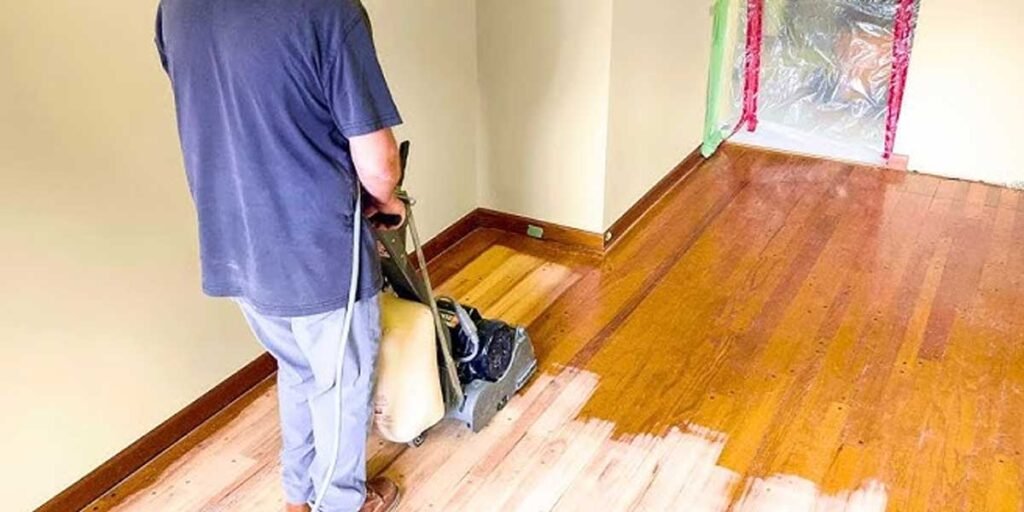
The floor repair cost calculator for a damaged floor depends on the harm done, and the honest anchor is that a single small patch on a wood floor runs about $450 to $570, because a repair is mostly skilled labor and equipment, not material. A May 2026 estimate from Homewyse priced one wood-floor repair at $453 to $571, with the labor and tools doing the work. Refinishing a whole hardwood room runs about $2 to $8 per square foot, a water-damaged section can run $10 to $80 per square foot, and replacing a whole floor starts where the new material lands. The cheapest way to redo a floor is usually to repair the damaged section rather than tear out the whole thing, and the decision rule comes down to how much of the floor is hurt.
The following steps work like a calculator: name the damage, count or measure it, apply the unit cost, and add the hidden lines, and the number shows up fast.
Below is how repair cost is built, the per-damage numbers to apply, the repair-versus-replace rule, and the hidden lines that break a budget.
How floor repair cost is really built
Floor repair is labor-dominated, with most of the cost in the skilled work and the equipment, while the material is small, which is the opposite of a new floor install where the flooring is the big line. A small patch pays the hours and the tools, not the wood.
| Cost line | What it covers | Share of a repair | Why it varies |
|---|---|---|---|
| Installation labor | Remove, measure, fit, patch the section | Largest, about 80% | Damage type, room, layout |
| Equipment | Finish nailer, saw, planer, miter saw | Medium | Tools needed for the patch |
| Supplies | Underlayment, fasteners, adhesive | Small | Surface and material |
| Removal and disposal | Take out the damaged pieces | Depends | Scope of the damage |
Homewyse, which itemizes repair cost line by line, prices one wood-floor patch into the labor, over three hours of work, a small supplies line, and an equipment allowance, and its May 2026 example comes to $453 to $571 for that repair. That the labor and the equipment dominate, with the material nearly an afterthought, is the useful fact, because it means a repair is worth doing only where the damage is small, and it is why a whole floor replacement, where the material becomes the big line, is a different and larger decision than a patch.
The floor repair cost calculator
Choose the damage type and its size, apply the unit cost, and add the hidden lines, and the repair budget shows itself. A single patch runs about $450 to $570, refinishing runs $2 to $8 per square foot, water damage $10 to $80 per square foot, and a stubborn stain or mold adds its own line.
| Repair | Unit cost | What you are paying for |
|---|---|---|
| Patch one damaged section | $450-$570 each | Labor and tools |
| Refinish a room | $2-$8 per sq ft | Sand and recoat, material and labor |
| Water-damaged section | $10-$80 per sq ft | Section, subfloor, or structure |
| Stubborn stain or mold | $15-$30 per sq ft | Removal and prep |
The table is the calculator. For a small patch, plan the per-repair figure and multiply by the number of damaged sections, and batch the repairs in one visit, since the labor and the equipment get shared. For refinishing a whole room and for water damage, work by the square footage, and for a stain that will not come out, add the removal line. The floor repair cost per square foot: average prices guide sorts the unit-price detail, and three itemized quotes for your exact damage give the real number.
Repair vs replace: the decision rule
Repair a floor when the damage is small, a section or a seam, and replace when a large share of the surface is damaged, the subfloor is failing, or water has rotted the structure, because at that point the repair costs approach the replacement and the result is still weak. The honest rule is to patch what you can and replace what needs it.
The break is easy to find. A single gouge, a few scratched planks, a popped nail, or a small water spot is a patch-or-refinish job, and fixing it now is cheap. A floor that is buckled, warped across a big area, or sitting over a rotted or sagging subfloor is a replacement problem, since patches over a failing base do not hold and the water, mold, and safety questions go beyond a cosmetic fix. The cost crosses when the damaged area grows, so the deciding test is how much of the floor is hurt: patch the small, replace the large, and let the flooring’s own value and the resale decide the in-between. The same judgment applies to a tile that has one cracked piece versus a grout-and-subfloor failure that is best redone.
Hidden costs and regional variability
Add the hidden and regional lines on top of the repair: removal and disposal of the damaged pieces, subfloor repair, moving the furniture, and, where local rules add them, a permit and sales tax. A per-foot price hides these, so an itemized quote for your damage is the honest total.
The hidden items are worth naming. Removing and hauling the failed section and repairing the subfloor it sat on add real money, moving the furniture and clearing the room is often your job or an extra, matching a stain or a wood species can add a premium on top of the repair, and a permit or local tax where required lands in the bill. Labor rates and the in-store price of matching flooring also shift by region, so one state’s figure will not hold in another, and the honest comparison gives each repairer the same damage and asks for an itemized scope, not a single lump number. A sagging floor or a suspected mold or structure issue is a professional-diagnosis call, not a guess a budget should make blind.
DIY or professional: the threshold
Patch a small, simple spot yourself to save the labor that dominates a repair, and hire a professional for refinishing, structural, water, or mold work, because the risk and the rework outweigh the labor saved on a floor that needs an even result. The labor is the big line, so DIY on a small repair genuinely saves, but only where the job is within reach.
The threshold is honest. A small gouge, a cracked tile, or a loose plank that you can patch and touch up is a reasonable DIY, and since the material is small, you keep most of the cost by doing it yourself. A full refinish, a rotted subfloor, a buckled area from water, or a matching of a hard-to-find species is the professional’s call, because a poor finish or a weak patch costs more in the end and a structural or mold problem needs a proper fix. Where the damage is small and the tools are simple, DIY wins, and where the floor’s long-term soundness is at stake, the professional protects it, with the same care one gives planning any repair in the home.
Frequently asked questions
How much does it cost to fix a damaged floor? It depends on the damage: a single small patch on a wood floor runs about $450 to $570, refinishing runs about $2 to $8 per square foot, and water damage can run $10 to $80 per square foot. A small repair is cheapest done early.
How much would it cost to replace 1000 sq ft of flooring? Replacing about 1,000 square feet runs roughly $5,300 to $7,700 for carpet and $13,000 to $17,000 for a mid-grade hardwood, before any removal or subfloor work. If only part of the floor is damaged, a patch is cheaper than a whole replacement.
How much does it cost to floor a 12×12 room? Flooring a 12-by-12 room, about 144 square feet, typically runs roughly $650 to $1,150 for carpet and $2,000 to $2,500 for hardwood installed. A small repair instead of a full redo is the cheaper first step.
What’s the cheapest way to redo a floor? The cheapest way is usually to repair the damaged section rather than replace the whole floor. When a replacement is needed, carpet and a mid-grade engineered or laminate are the budget materials, and a small repair early beats a large replacement late.
When should I not repair and instead replace a floor? Replace when a large share of the surface is damaged, the subfloor is failing or rotting, or water has warped the structure, because patches over a failing base will not hold. A repair is the cheaper call while the damage stays small and the base stays sound.
Let the damage scope and the base decide
Estimate the floor repair cost by naming the damage, applying the per-patch or per-square-foot cost, and adding the hidden lines, and patch the small while the base is sound. A repair is labor-dominated, so the material is not where the money goes, and the decision between patching and replacing falls to how much of the floor is hurt. The honest next step is three itemized quotes for your exact damage, and the rest of the floor’s upkeep is part of the same homeowner care.
