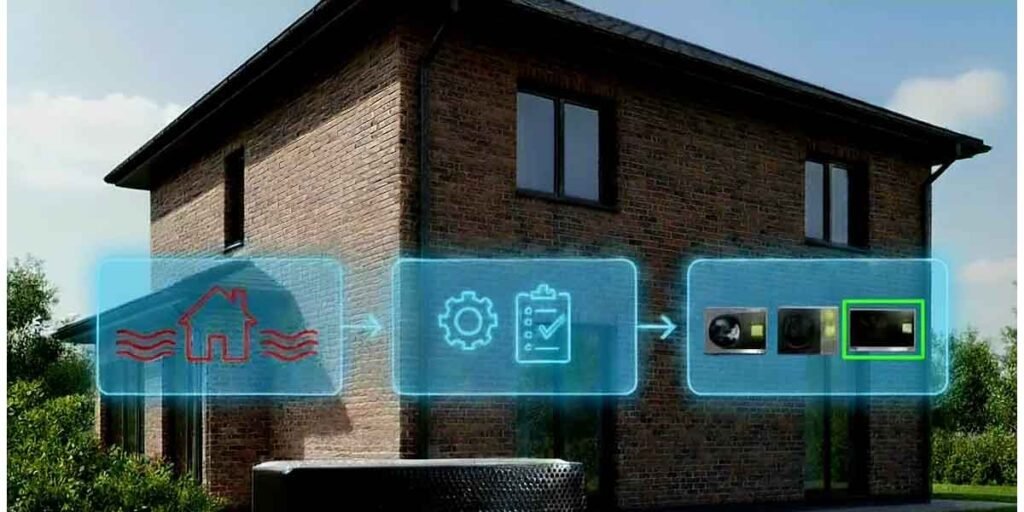
Ducts, panel capacity, and winter load decide the fit. A heat pump moves heat instead of generating it, and that one difference is what turns three house measurements into the whole decision.
Moving heat takes air. Airflow belongs to the duct system, and most duct systems were built around the equipment that came before. Moving heat also takes current, and how much of it a service can spare comes out of a load calculation. The third measurement is the weather: output thins as outdoor air cools, so the coldest week of the year is what governs the working size, and the annual average hides that.
Any one of the three can remove a ducted heat pump from a shortlist on its own. Airflow comes first because it costs the most to change, then amperage, then the cold-weather number.
Three Constraints That Decide a Heat Pump Fit
Airflow, electrical headroom, and cold-weather heating load rule a heat pump in or out, and they are checked in that order because each one costs more to fix than the last.
Airflow sits first because it hides inside ceilings and walls. Electrical capacity comes second because it is measured at a single panel and corrected under a permit. Cold-weather load comes last because it is arithmetic, and arithmetic is free.
A heat pump is a compressor-driven system that moves heat between outdoor air and the house, which is how one unit both heats and cools. Equipment that generates heat on the spot avoids the airflow question entirely, which is why a furnace can sit on ducts that a heat pump cannot use.
Equipment selection sits outside the filter. A mid-priced unit sized from a documented Manual J load calculation, checked against a static-pressure reading, and rated for low-temperature operation will outperform a premium unit dropped onto a duct system nobody measured. The difference shows up in the second winter, not the first, which is why the ordering carries more weight than the price bracket.
A house can fail the fit test for reasons that have nothing to do with heat pumps. When the answer is no, it is the duct system that said no, and the fix is often a different system layout.
The Duct System Limits Everything After It
A ducted heat pump needs roughly 400 cubic feet per minute of airflow per rated ton, and furnace-era ducts are frequently sized below that. Airflow is what limits how much heat a retrofit can deliver, and the nameplate capacity on the outdoor unit does not change that.
A gas furnace delivers air at about 120 to 140 degrees Fahrenheit, which lets a modest airflow carry plenty of heat. A heat pump delivers air at roughly 90 to 100 degrees, so the same heat requires more air moving for longer. Performance drops off sharply once airflow falls under about 350 cubic feet per minute per ton.
The arithmetic gets uncomfortable fast. A three-ton system wants around 1,200 cubic feet per minute, and a duct system that quietly moved 900 for the old furnace becomes the bottleneck. Because static pressure climbs with the square of airflow, the resistance the blower fights can rise from a comfortable 0.4 inches of water column to roughly 1.0, at which point the equipment is working against itself.
Leakage compounds the problem. ENERGY STAR estimates that 20 to 30 percent of conditioned air is lost through leaks, holes, and poor connections, and return leaks pull attic or crawlspace air straight into the system to be reheated. A duct-sealing study built on DOE figures shows a nominal 16 SEER heat pump degrading to about 11.1 SEER at 20 percent leakage, and to 8.6 SEER at 30 percent.
None of this means the ducts have to be replaced. Common fixes are a larger or added return, rigid trunk line where crushed flex was used, mastic at every joint, and rebalancing the registers afterward. A full Manual D design rarely earns its fee on a like-for-like swap and usually does when capacity moves by two tons or more.
What Static Pressure Reveals
Total external static pressure is the number that settles whether an existing duct system can carry a heat pump, and a technician can read it in a few minutes with a manometer.
Residential equipment is designed around roughly 0.5 inches of water column. Readings up to 0.5 are healthy, 0.6 to 0.8 is borderline, and 0.8 or above means duct work comes first. In older houses the restriction traces back to the returns far more often than to the supply runs, because one undersized central return was standard practice for decades.
Two cheap checks belong in the same visit. A filter reading above 0.1 inches of water column gets replaced, and a duct run squeezed by 15 percent can add 400 to 800 percent to its own pressure loss.
Homeowners hear airflow problems before anyone measures them: a return grille that whistles, a supply register that pops when the blower starts. Those sounds mean the duct system is already at its limit, and a heat pump pushes that limit harder than the furnace did.
When the Ducts Cannot Be Fixed
A restricted duct system does not make a house a bad candidate for a heat pump. It makes that house a candidate for a different system layout.
Three layouts work. A smaller central ducted heat pump paired with one or two ductless heads puts load where the ducts are generous and skips them where they are not. A multi-zone ductless design abandons the ducts entirely, which suits houses with no ducts or with ducts that cannot be reached. A dual-fuel setup leaves peak heating to a furnace and hands the milder majority of the year to the heat pump.
The trade-off is distribution. Ductless heads serve the rooms they are mounted in, so open floor plans handle them better than a closed-off bedroom wing, and any room left without a head needs a door left open or a transfer path sized on purpose.
Electrical Service Is a Load Calculation
Whether a heat pump fits an existing service is settled by a load calculation under NEC Article 220, and the amperage printed on the main breaker is only an input to it.
The calculation has two accepted routes. The history method in NEC 220.87 multiplies a measured or billed peak by 1.25 and adds the new equipment, and it is unavailable in homes with solar, batteries, or load-control devices. The standard method in 220.83(B) totals the nameplate loads, takes the first 8,000 volt-amperes at full value, discounts the remainder to 40 percent, and adds the heating load in full.
The treatment of the heat pump itself is where the math turns. A unit with no electric backup counts at 100 percent of its breaker rating. A unit with electric backup counts at 100 percent of the heat pump breaker plus 65 percent of the supplemental heating watts. A 100-amp service carries 24 kilowatts in total, and one California electrification study found fewer than 2 percent of homes peaked above 88 amps, which leaves headroom on services that look full.
Why Backup Heat Strips Drive Upgrades
Electric resistance backup heat, not the heat pump, is what pushes most services over the line. A modern inverter unit typically draws in the 30- to 40-amp range, while strip heaters run 14 amps at 3.4 kilowatts, 42 amps at 10 kilowatts, and 60 to 83 amps at 15 to 20 kilowatts.
A design that relies on large strip heat can therefore add as much load as the heat pump it backs up. Keeping a gas furnace as the backup takes that load out of the calculation, and a cold-climate unit with more low-temperature capacity needs less strip heat to begin with.
When a calculation fails, a service upgrade is not the only fix. A subpanel adds breaker spaces, which solves crowding and adds no capacity. A load-management device watches total draw and briefly sheds a controlled load, and NEC 750 and 220.70 allow the managed load to be left out of the calculation. Both routes cost far less than a service change, and a licensed electrician has to make the call.
Cold-Weather Numbers Worth Asking For
The ENERGY STAR cold climate designation means a unit holds a coefficient of performance of at least 1.75 at 5 degrees Fahrenheit and delivers at least 70 percent of its rated 47-degree heating capacity at that temperature, confirmed under a controls verification procedure.
Those two figures replace the marketing language about working in the cold. The coefficient at 5 degrees describes how much heat each unit of electricity buys when the house needs the most, and the capacity percentage describes how much of the rating survives. A unit that keeps a high coefficient but sheds most of its capacity leans on backup heat on exactly the nights that backup heat exists for.
The designation lives inside ENERGY STAR’s Version 6.1 and 6.2 specifications for central air conditioners and air-source heat pumps. The 6.2 amendment, finalized in December 2024, lowered the EER2 requirement to 11.0 for split systems, allowed the DOE controls verification procedure as an alternative, and added reporting for the 5-degree numbers.
Federal minimums are a floor. Split-system heat pumps manufactured since January 1, 2023 must reach 14.3 SEER2 and 7.5 HSPF2, and heat pumps carry no regional standard, so one national minimum applies in every state. Cooling-only air conditioners are the equipment that gets split into North, Southeast, and Southwest tiers. The added 2 in those ratings reflects a test procedure run at higher external static pressure, which is the same resistance that limits what a duct system can carry.
Dual Fuel and Backup Heat
A dual-fuel system pairs a heat pump with a furnace and hands the coldest hours to whichever source costs less to run, which suits houses that already have a working furnace.
The changeover point is where dual-fuel systems go wrong most often. Set it too high and the furnace carries hours the heat pump could have handled at a fraction of the cost. Set it too low and strip heat quietly covers the shortfall. Where a furnace stays in the system, the two sources get compared on the same utility bill, and that arithmetic has its own moving parts: heat pump vs furnace turns on the local price of gas, the outdoor temperature where the switch happens, and how much auxiliary heat runs below it.
One operating habit carries more weight under a heat pump than under a furnace. ENERGY STAR’s guidance is to hold a steady setpoint instead of setting the system back overnight, because recovery from a setback is when auxiliary heat runs hardest. Manual mode also beats auto mode in shoulder seasons, when a system left in auto can flip between heating and cooling in one afternoon.
Heat Pumps Against Electric Resistance
Electric resistance heat converts one unit of electricity into at most one unit of heat, while an air-source heat pump typically returns two to four units of heat per unit of electricity.
That gap is the strongest case a heat pump has, and it applies directly to houses already heated by baseboards, wall heaters, or an electric furnace. ENERGY STAR’s 2023 mini-split fact sheet puts certified ductless systems at about half the heating cost of conventional electric heating and up to 60 percent less energy use than standard electric radiators.
Seasonal performance is the honest comparison, since instantaneous efficiency falls as outdoor temperature drops and recovers in the shoulder seasons. Resistance heat holds a coefficient of performance of 1.0 year-round. A cold-climate heat pump might run near 4 in mild weather and closer to 2 during the coldest hours, which is still twice the delivered heat per kilowatt-hour. Backup strip heat erodes that advantage in proportion to how often it runs.
Against natural gas the answer changes. Research from Columbia’s energy policy center found that natural gas often remains the cheapest heating fuel per unit of delivered heat even after heat pump efficiency is counted, which is one reason dual-fuel designs keep appearing in cold-climate recommendations.
The Refrigerant Change and the Rules Around It
Since January 1, 2025, new residential heat pump equipment has been limited to refrigerants with a global warming potential below 700, which moved the market to R-454B and R-32 and their mild flammability classification.
The schedule comes from the AIM Act’s technology transitions rule, and the numbers explain the shift. R-410A carries a global warming potential of 2,088 and an ASHRAE A1 rating, which means it does not burn. R-454B lands near 466 and R-32 near 675, and both are classed A2L: low toxicity, mild flammability, and a flame speed under 10 centimeters per second.
Two equipment-level consequences matter for a buyer. Existing R-410A systems cannot be converted to an A2L refrigerant, so a failed outdoor unit on an older system generally means a new system, not a different refrigerant. A2L equipment also falls under UL 60335-2-40, which brings leak detection sensors, charge limits tied to room volume, and warning labels stating that the system contains a flammable refrigerant.
The installation deadline attached to the rule has moved since it was first written. EPA’s original schedule barred installation of above-700-GWP equipment from January 1, 2026, then proposed in September 2025 to reconsider that date in light of refrigerant supply problems, and the reconsideration allowed qualifying pre-2025 inventory to keep being installed. Service on existing R-410A equipment stays legal in any case, and the restriction that took effect in January 2025 applies to new equipment.
What A2L Means in Practice
A2L refrigerants change installation details more than daily operation, and the details land in the room where the indoor unit sits.
Charge limits scale with room volume, so a big single-zone system can be constrained in a small sealed room, where ventilation or a leak-detection sensor may be needed to keep the charge legal. Servicing requires technicians trained on A2L handling, and EPA Section 608 certification remains the baseline credential for anyone touching a refrigerant circuit. Mixing refrigerants is prohibited, which is why an A2L cylinder has different connection threads from the one it replaced.
States can move faster than the federal schedule. California and Washington set a 750 global warming potential limit on their own timelines, and New York proposed rules a year ahead of the federal dates, so the equipment a contractor can stock differs by state.
What It Costs, and Why Quotes Disagree
Marketplace quotes collected by EnergySage average about $15,400 installed before incentives, with ducted systems near $14,500, ductless systems near $26,000, and hybrid heat pump plus furnace setups near $14,400.
Those quotes come from homeowners working through a contractor marketplace, and they skew toward whole-home conversions that include duct work and electrical upgrades. Published ranges starting near $4,000 describe a different scope: a like-for-like replacement that reuses the existing ducts, wiring, and refrigerant lines. Both numbers can be accurate about jobs that differ by five figures.
| Scope of work | EnergySage average, 2026 | What the number assumes |
|---|---|---|
| Ducted heat pump | $14,529 | Existing ducts can be reused or repaired, and the service passes a load calculation |
| Hybrid, heat pump plus furnace | $14,353 | An existing furnace stays as backup, with new controls and a changeover setting |
| Ductless multi-zone | $25,957 | One indoor head per zone, plus line sets and electrical runs for each |
| All residential projects | $15,393 | Most installations land between $14,353 and $25,957 before incentives |
A 2,000 square foot house sits in the middle of that spread. The square-footage rule manufacturers publish puts a house that size near a 4-ton system, while a Manual J calculation often lands lower once insulation levels, window area, and local design temperatures are counted. Duct condition and electrical capacity move the total far more than square footage does.
Incentives changed at the end of 2025. The federal 25C credit, which had been worth up to $2,000 for a qualifying heat pump, was terminated by the One Big Beautiful Bill Act for property placed in service after December 31, 2025, as the IRS confirmed in Fact Sheet 2025-05. State programs funded through the HEAR and HOMES allocations remain active in many states on income tiers, and utility rebates commonly run from a few hundred to a couple of thousand dollars. Ground-source systems follow a different federal path from air-source equipment, and that is a question for a tax professional.
An itemized quote is the practical defense against all of this. It should list the Manual J result, the AHRI reference number for the matched equipment, the static-pressure reading before and after any duct work, the electrical scope, the permit line, and the changeover temperature on a dual-fuel design.
Maintenance, Lifespan, and the DIY Line
Homeowner maintenance comes down to filters, outdoor clearance, and a steady setpoint. Refrigerant circuits, service upgrades, gas piping, and duct diagnosis belong to licensed trades.
Filters are the routine that keeps everything else working, and ENERGY STAR’s guidance is to clean or replace them when they are visibly dirty or when the system says so. Outdoor units need the clearance their installation manual specifies, since a cabinet boxed in by shrubs recirculates its own air. The thermostat should hold a steady temperature, and the fan belongs on the lowest speed that still distributes air through the house.
Expected life is consistent across sources. DOE models 15 years for residential air-source heat pumps, the Energy Information Administration uses an average life of 15.3 years, and NYSERDA lists about 15 years for air-source equipment and roughly 25 for ground-source. Underground loops in ground-source systems are rated for 50 years or more, so the indoor unit is the part that gets replaced.
Where do-it-yourself work stops is not a gray area. Refrigerant handling requires EPA Section 608 certification, and doing it without the credential is illegal. Panel and circuit work is electrical work, gas connections on a dual-fuel install are gas work, and both require licensed trades in essentially every jurisdiction. Sealing duct joints with mastic is a reasonable homeowner project. Diagnosing a return with a manometer and redesigning it is not, because the measurement is what determines whether the fix works at all.
Attic and crawlspace work adds hazards that have nothing to do with the equipment: heat, framing that will not carry weight, and in older houses, insulation or duct wrap that may contain asbestos. Anyone who finds suspect material should stop and have it tested before work continues. A permit and inspection are also standard requirements for a system replacement in many jurisdictions, and skipping them tends to surface at resale.
FAQ
Which heat pump brand is the most reliable?
Reliability tracks installation quality, parts availability, and local service depth more closely than it tracks the nameplate. The verifiable parts of the question are the equipment data: the cold climate designation and its coefficient of performance at 5 degrees in the ENERGY STAR product finder, the AHRI reference number on the spec sheet, and the warranty terms, especially whether labor is covered and for how many years.
Which heat pump is best for a home?
The best fit is the system type that survives the three house constraints: ducts that can carry the airflow, a service that passes a load calculation, and low-temperature capacity that matches the design heating load. A ducted cold-climate unit suits a house with generous ducts, while a ductless or hybrid layout suits a house with restricted ducts or a furnace worth keeping.
How much is a heat pump for a 2,000 square foot house?
Marketplace data puts a ducted installation near $14,500 on average, and most residential projects land between $14,353 and $25,957 before incentives. A house that size is usually described as needing three to four tons, though duct condition and electrical capacity move the price more than the tonnage does.
What are the top 5 heat pumps?
Published top-five lists change with the sponsor and rarely cite test data. A screen that can be checked in minutes: filter the ENERGY STAR dataset for the cold climate designation, compare the 5-degree coefficient of performance and capacity percentage, and hold the HSPF2 rating against the federal minimum of 7.5.
Do heat pump water heaters follow the same rules?
No. A heat pump water heater is a separate product category with its own efficiency standard, its own installation constraints, and no ductwork question. It needs air to draw heat from, a condensate path, and space where compressor noise is tolerable, and its incentives move on a separate schedule from space heating equipment.
A load calculation, a static-pressure reading, and a documented 5-degree capacity figure take an afternoon to collect. They cost the least of anything in the project and decide what the expensive parts cannot fix afterward.
