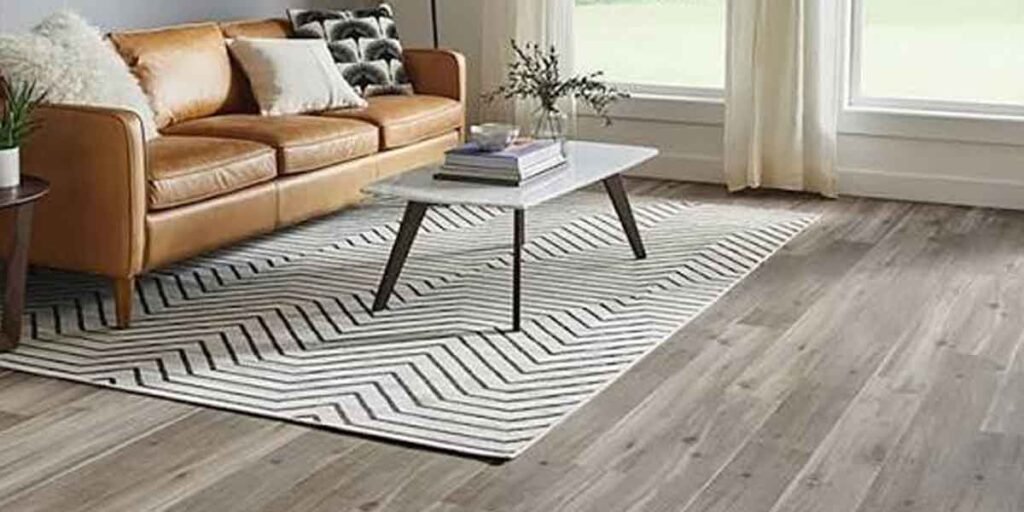
The best vinyl flooring for a home is the carton whose printed numbers match the room. Those numbers sit on the end of the box, a few inches from the price sticker: wear layer in mils, core thickness in millimeters, square feet per carton, plank length mix, and edge profile.
Brands carry less information than buyers expect, because the same factories run similar boards under a dozen labels and rename a line whenever it is refreshed. The spec block stays comparable, and it is the part that decides whether a carton belongs in a bedroom or in a kitchen.
How Do You Compare Two Cartons at the Same Price?
Compare five printed figures in this order: wear layer in mils, core thickness in millimeters, square feet per carton, plank length mix, and edge profile. Wear layer buys traffic tolerance, core thickness buys dent resistance and quiet, and the remaining three decide how much of the box you can install and how the joints read from across the room.
Format comes before any of them.
Sheet, plank, and tile fail in different places, and the differences between types of vinyl flooring surface mostly at the seams and in how a single damaged piece gets replaced. Assume that choice is settled and two cartons are in front of you.
The wear layer is the clear coat on top, measured in thousandths of an inch. Six mil suits a closet or a guest room, twelve mil handles ordinary family traffic, and twenty mil and up is what a kitchen or a two-dog household pays for.
Dent resistance comes from the second figure, the core, printed in millimeters. A dense SPC core around four millimeters shrugs off a rolling chair or a refrigerator foot, and it feels hard underfoot with a hollow click on every step. A foamed WPC core at six to eight millimeters trades some of that resistance for a warmer surface and less noise in the room below.
Coverage is where a price comparison usually breaks down. Cartons hold anywhere from about eighteen to more than forty square feet, so the box costing four dollars less may contain a third less floor. Divide the box price by its coverage before ranking anything.
How the boards are cut matters just as much. Cartons holding a single plank length drive the end joints into a ladder pattern unless you cut boards shorter, while mixed-length cartons, usually two or three lengths per box, let the seams land where a wood floor would put them. A run of identical lengths along a hallway is the fastest way to make an expensive floor look manufactured.
The edge profile is the detail buyers notice a month after installation. A micro-bevel, the small chamfer along each edge, hides minor unevenness and reads like wood from standing height. The shallow channel it leaves holds dust that a dry mop slides over, and a square edge trades that dust line for a surface that telegraphs every dip in the deck underneath.
Carton Coverage Sets the Real Cost of the Room
Installed cost per square foot of vinyl flooring starts with coverage, and the shelf price is the last number that matters.
A 200-square-foot room takes nine cartons at twenty-four square feet each, and ten when the layout runs diagonally or the room has three doorways to cut around. Order five to ten percent over the measured area and leave the extra carton sealed, because that carton covers a miscut on the final row and becomes the only patch that will match when a dishwasher line drips two years later and every store has moved on to a new shade run.
Trim is the line item that catches first-time buyers. Transition strips where the vinyl meets carpet or a threshold, quarter round or baseboard, underlayment for an unpadded carton, adhesive for glue-down work, and a tapping block and pull bar for a floating floor. On a small room that list runs into real money, and none of it appears on the shelf tag.
Pattern Repeat Is the Tell
A printed plank carries a limited set of images, and the run repeats every few boards. Walk the finished floor and you learn the repeat by heart, because the same knot cluster and the same grain swirl appear two rows away from where you first saw them. Multi-length cartons break that rhythm, and the ones cut from a single image do not.
Two specs separate the tiers. Products printed from several cylinders repeat less often than products printed from one, and embossed-in-register texture, where the pressed grain follows the printed pattern, survives a close look instead of fading into a flat sheet at arm’s length.
Gloss finishes the effect.
A matte surface hides scuffs and the dust that collects on a high-gloss plank under a window, and the high-gloss carton that sells the sample shows every footprint within a year of real traffic.
Match the Dye Lot Before You Open the Pallet
Every carton carries a lot or shade number, and that number decides whether the finished floor is one color. Boxes from different runs are the same product in a slightly different shade, and a mismatch shows up as a rectangular patch in the middle of the room.
What to Check Before the First Cut
Compare the shade numbers on every carton while the tape is still on, and stand two boards from two different boxes side by side in the light of the room they will live in. Retailers accept returns on sealed cartons under one policy and on open ones under another, so verifying the lot before opening anything keeps the exchange option alive. That step takes ten minutes on a driveway and prevents the argument that starts after nine boxes are already down.
Then open one carton and inspect the boards. Locking tabs should be intact along both edges, the face should be free of scratches and crushed corners, and thickness should measure the same at each end. Two or three damaged boards in one carton is a shipping problem a phone call fixes, while a carton that opens with a bent tab is a reason to check every box behind it.
Where Vinyl Flooring Stops Being the Right Floor
Four room conditions send a buyer back to the sample room: flatness, temperature, moisture under the deck, and standing water at the joints. A fifth constraint upstairs is about noise.
Flatness comes first. Installation instructions set a tolerance, commonly around three-sixteenths of an inch across ten feet, and a floor laid over a deck that misses it moves and clicks for the life of the job. Leveling compound turns that into a separate project with a curing wait, which is why the tolerance is worth measuring before the cartons are paid for.
Temperature is the second. Installation instructions print a service range, and most ranges top out in the mid-eighties Fahrenheit. A three-season porch or an unconditioned sunroom passes that ceiling on an August afternoon, and the planks that lift first sit against the sun-facing wall.
Moisture under the floor is the third. Concrete takes a moisture test before anything covers it, and a wood subfloor has to return to normal indoor humidity after a flood, a leak, or a fresh pour. The waterproof label describes the board itself; the deck underneath stays a dry product requirement.
Standing liquid at the seams is the fourth.
A pet bowl that overflows for an hour, a dishwasher supply line that drips behind the cabinets, a mop bucket parked in one corner every week. Water that sits at a joint works past the click and into the core edge or the subfloor. Waterproof planks handle a spill and lose to a wet week.
Sound matters upstairs. A thin, dense plank over a second-floor deck moves footfall noise downward, and a building with an impact insulation class target treats that as the binding constraint on the whole project. An acoustic underlayment under a floating floor is the usual answer, and the manufacturer has to approve the specific pad or the warranty goes with it.
When a room fails the flatness check, the temperature range, or the moisture test, a different floor is the cheaper answer even at a higher price per square foot.
Vinyl Flooring FAQs
Which is better, 6 mil or 12 mil vinyl plank flooring?
Twelve mil is the better buy for any room a family uses daily. Six mil belongs in closets, guest rooms, and turnover rentals where the cheapest carton is the whole point. Twelve mil takes hallway traffic for years before a gray scratch haze appears, and it costs a fraction more per square foot than the thin carton beside it on the shelf.
What grade of vinyl flooring is best for a house?
A twelve- to twenty-mil plank over a rigid core fits most houses. Twenty mil earns its premium in kitchens, entryways, and homes with pets. A twelve-mil plank in a foamed core is the more comfortable choice for bedrooms, where quiet and warmth matter more than dent resistance.
Is luxury vinyl plank cheap looking?
Planks that read as cheap share two traits: one print cylinder repeating every three or four boards, and a high-gloss finish. Multi-length cartons with embossed-in-register texture and a matte surface look like wood from standing height, and they cost more for those two reasons.
What is the most common mistake buyers make with vinyl flooring?
Buying from the sample and the price per box. The box price hides coverage, waste, and trim. Two cartons with an identical price per square foot can differ by eight mils of wear layer and two millimeters of core thickness.
