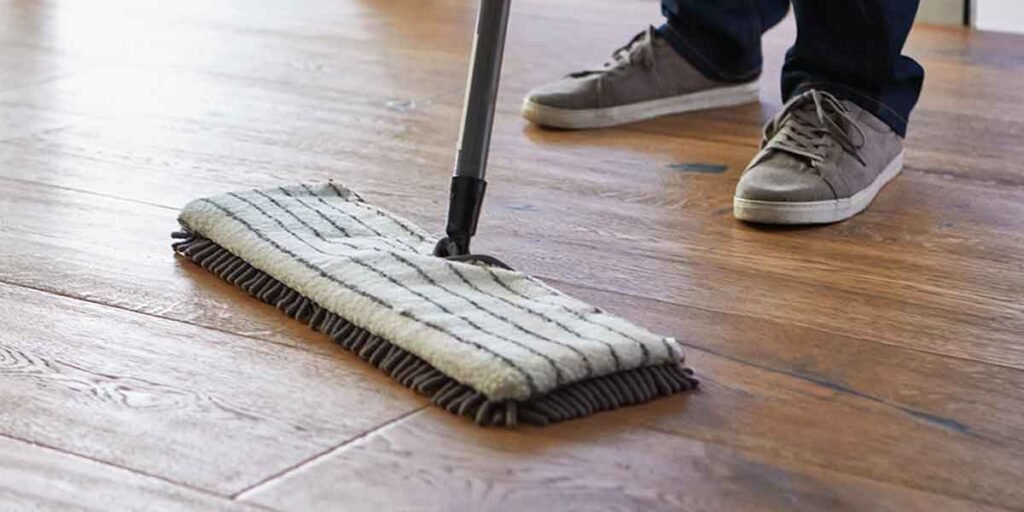
Wring the mop almost dry, then dry the seams behind it. Cleaning laminate flooring is a water-control job before it is a detergent question, and the part that fails is not the surface.
A laminate plank is a printed decor layer sealed under a clear overlay, bonded to a core of high-density fiberboard. The overlay sheds water. The fiberboard underneath does not, and water gets to it along the joints.
The Water Line Around Laminate Flooring
Fiberboard that takes on moisture swells, and the thickness does not come back to its original figure when it dries.
That is why a floor soaked once can look fine for a season and then show lifted edges and open seams in one traffic lane while the rest of the room reads as new. Thickness swelling is not small print in the standards either. NALFA, the North American Laminate Flooring Association, runs an ANSI-accredited performance standard called LF-01, with minimum thresholds across 14 categories that include static load and moisture resistance, dimensional stability, cleanability, and stain resistance. The association publishes a separate Surface Swell Test as well, measuring how an assembled joint system holds up under prolonged water exposure, and offers it as an add-on certification rather than part of LF-01. Two cartons can each carry a certification seal and still differ in what their seams do with a spilled bowl of water.
The published cleaning rhythms disagree, running from a weekly maintenance pass at Lowe’s to a monthly wet mop at Seventh Generation to a damp mop every two to three months at Home Depot. Traffic reconciles them, and the calendar does not. An entry hall with a door to a yard and a dog collects grit that scratches the wear layer, so it earns weekly attention, while a spare bedroom can wait for a monthly pass. The floor is identical in both rooms. What differs is how much abrasive material lands on it.
Three habits keep water where it belongs. Wring the mop head until nothing drips from it. Work in sections small enough that no puddle stands while you finish the room. Dry each section with a clean cloth before moving on. A bucket that has turned grey halfway through is its own problem, since the pad is picking dirt back up and laying it over boards you already cleaned.
Bathrooms and laundry rooms get a blunt answer from the same source. NALFA’s consumer FAQ does not treat laminate as suitable for areas with excessive moisture, bathrooms and saunas named, unless the manufacturer specifies the product as waterproof. A waterproof core describes what sits underneath a soaked floor. It says nothing about the seam, so the mop rule stands either way.
Steam is the one practice where published care advice splits. Lowe’s tells readers not to steam-mop laminate unless the flooring manufacturer recommends it, because steam seeps into the seams. Home Depot’s sustainable-living guide allows a steam mop used sparingly, with immediate drying afterward. The care sheet inside the carton settles the question for one specific floor.
Cleaners Worth Using, and What to Leave Out
A microfiber pad and water handle routine cleaning. A pH-neutral laminate cleaner, diluted exactly as its own label states, deals with the greasy film that plain water leaves behind in a kitchen.
The published guides converge on small doses when a dedicated cleaner is not on hand. Lowe’s care guide, updated in July 2025, lists one cup of white vinegar in a gallon of warm water, or one third of a cup of no-suds household ammonia as the alternative, along with a reminder to use very little liquid. Home Depot’s sustainable-living guide, published in September 2021, scales down further, to a teaspoon of unscented clear dish soap or a teaspoon of baby shampoo in a gallon of water. That teaspoon is the number worth remembering. A capful poured by eye is several times the dose in either guide.
Anything that builds a layer on the floor is the wrong product for it. NALFA states that the laminate surface does not need wax or varnish, and wax on this floor collects grit that grinds against the overlay. Oil-based wood cleaners and furniture polish leave a haze that plain water will not lift. Abrasive creams, scouring powder, and steel wool cut into the clear layer doing the protecting. Bleach and other harsh cleaners, used at full strength on a floor, attack the same layer.
Dish soap comes up often enough to answer directly. One drop of Dawn or another grease-cutting soap in a gallon of water is a reasonable one-off for a sticky patch. Soap left behind dries into a film that grabs dust, so the last pass is clean water and a dry cloth.
A film is also why a floor can look worse after mopping than before. Too much cleaner, or water with a high mineral content, leaves a thin residue that dries into a cloudy map of the mop path. The answer is dilution, not more scrubbing: mix to the label, change the water before it turns grey, and finish with a clean damp cloth followed by a dry one. Where the tap water is hard, distilled water on that last pass takes the mineral streaks with it.
Heavily soiled floors respond to a second pass more than to a stronger mix: break up the film with a neutral cleaner at label dose, then go over it again with clean water on a fresh pad, and dry the boards.
Spills, Stains, and What Backfires
A spill sitting on the surface is harmless for hours. A spill working into a seam is not, so blot instead of wiping, then dry the area.
Three marks call for something other than a wet cloth:
- Wax and chewing gum: harden the material with a bag of ice or a freezer pack, lift it with a plastic putty knife or a plastic knife, then wipe the residue with a barely damp cloth.
- Ink, lipstick, marker, and shoe polish: acetone or nail polish remover on a cloth, applied to the mark and not poured across the boards, with a patch test in a corner first. Two of the guides list a drop of silicone furniture polish as a last resort for a stubborn scuff, and both say to wash the spot afterward, because polish on a hard floor is slippery.
- Dried food and tracked mud: soften with a warm damp cloth for a few minutes, then lift it with a plastic scraper. Sharp metal blades and scouring pads leave marks that no cleaning will remove.
Pet accidents are the case where speed counts most, since urine that reaches a seam is the exposure the core was never built for. Blot it, clean with a neutral cleaner, dry the boards. A smell that comes back out of the joint after drying means liquid went past the surface, and that is a board replacement question, not a cleaning one.
When Cleaning Stops Being the Answer
Cleaning removes what sits on the floor. It cannot reverse a core that has already taken on water, and four situations belong to a licensed trade.
- Seams that have lifted or opened, boards that flex underfoot, or one traffic lane that has swelled: the fiberboard has absorbed moisture, and the repair means removing and replacing affected planks.
- An appliance leak, a refrigerator ice maker line, an overflowing toilet, or a washing machine hose: standing water needs extraction and drying within the first day or two, which means pulling boards and checking the subfloor. Replacement pricing follows the same lines as a new floor, and laminate flooring cost shows how material, underlayment, trim, and labor divide the bill.
- Visible mold or a musty smell that keeps returning: fix the water source first. Growth that comes back after cleaning points to moisture behind the floor, and remediation sits outside normal floor care.
- Sheet flooring or adhesive from before the 1980s, uncovered when boards come up for a water repair: those layers can contain asbestos. A licensed abatement contractor tests and removes them, and scraping or sanding them to speed up a repair spreads the hazard.
No product on a store shelf changes any of those four items. Once the core has swollen, a mop and a bucket are the wrong tools.
Quick Answers on Cleaning Laminate Flooring
What is the best thing to clean laminate flooring with?
A barely damp microfiber pad with water covers routine cleaning. For greasy buildup, use a pH-neutral laminate cleaner mixed to its label, or a teaspoon of clear dish soap in a gallon of water.
What should you not use on laminate flooring?
Keep wax, polish, oil-based wood cleaners, abrasive creams, scouring powder, steel wool, and undiluted bleach off the surface. The wear layer does not need wax, and residue traps grit and dulls the finish.
Can you use Dawn dish soap on laminate floors?
Yes, at roughly one teaspoon per gallon of water, the dose Home Depot’s guide publishes for clear dish soap. A stronger mix leaves a film that collects dust, so a plain-water pass usually follows.
Is vinegar safe on a laminate floor?
Diluted white vinegar, one cup per gallon of warm water as Lowe’s lists it, lifts sticky residue from a sealed surface. Acid does not clear a film or a mineral haze, and vinegar in a seam is still water reaching the core.
Should you steam mop a laminate floor?
Not unless the flooring manufacturer recommends it, which is Lowe’s position on steam. Home Depot allows sparing steam followed by immediate drying, so the care instructions shipped with the carton decide for a specific floor.
