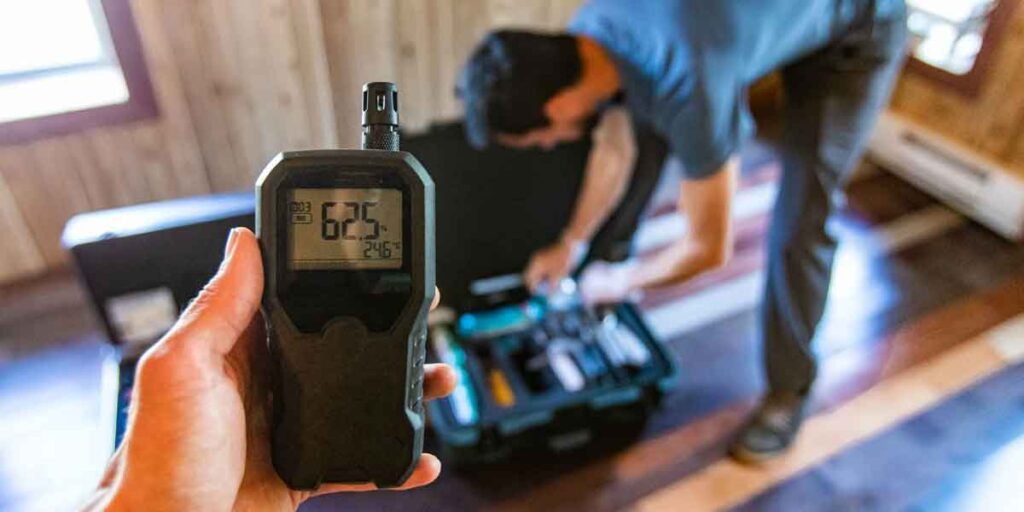
Air quality testing measures one pollutant in one room on one day. The figure that comes back carries no meaning by itself, because no home arrives with a label stating what its fine particles should read at dawn on a Tuesday.
A reading earns its keep against a reference. Radon and carbon monoxide have lines that force a decision, which is why those two results end in a repair or a service call. Most other numbers people pay for sit beside nothing official, and the person holding that report is the one who has to decide what it means.
Three things settle how far a result travels: the yardstick you compare it to, the grade of evidence behind it, and the window it was sampled in.
The three yardsticks behind every reading
Every defensible interpretation rests on one of three comparisons: a legal limit that settles the matter, a published guideline that sets a target without force, or a baseline you build in your own home. Knowing which one you are holding separates a result that demands action from one that only deserves attention.
Household legal limits are rare. Radon is measured against one, carbon monoxide is alarmed for rather than measured against one, and neither reading needs a laboratory to turn useful. The do-it-yourself yardstick then reaches what the other two cannot, because comparison is cheap: a monitor showing 40 while the official outdoor count for that hour is 15 has proved your filter is doing work, whatever the absolute figure means. Cook, open a window, run the exhaust fan, and log what the display does in each condition. Two weeks of those notes outlast a sensor that drifts.
Where federal limits actually stop
Two indoor readings come with a line attached: radon at 4 pCi/L, and carbon monoxide through alarm and workplace rules. Fine particles have a health-based outdoor limit and no matching indoor limit, while mold spores, formaldehyde and total VOCs carry no federal line at all. That short list decides which tests can end an argument.
PM2.5: the 2024 standard and a rebuilt index
In 2024 the EPA tightened the primary annual PM2.5 standard to 9.0 micrograms per cubic meter and rebuilt the Air Quality Index around the lower figure. On the breakpoints now in force, a 24-hour PM2.5 average of 9.0 µg/m³ marks the top of “Good,” 9.1 opens “Moderate,” and that band runs to 35.4 µg/m³ before it turns “Unhealthy for Sensitive Groups.” The EPA’s PM standards page sets out both changes.
Run the interpolation once and the shift turns concrete. At 20 µg/m³ on a 24-hour average, the index lands near 71, inside “Moderate.” The same reading sat comfortably in the clean range on the older scale. That is why a monitoring app can look amber this winter at a particle count that looked green two years ago.
Radon and carbon monoxide keep their lines
Radon is the one pollutant that arrives with a consumer test, a number and a next step in the same sentence. The EPA treats 4 pCi/L as the level to fix and the band from 2 to 4 pCi/L as a reason to consider mitigation, which gives a kit costing a fraction of a lab panel more decision value than a shelf of sensors. Carbon monoxide runs on a different logic, since no residential air limit exists for it. The device on the ceiling answers to an alarm standard engineered to stay quiet through concentrations a handheld meter will show plainly. A reading and an alarm can disagree without either one being broken.
Mold spores and VOCs have no line
The EPA’s mold guidance states it without hedging: no EPA or other federal limits exist for mold or mold spores, so sampling cannot check compliance with a federal standard, and growth you can see makes the sample unnecessary. A spore count, a formaldehyde badge and a total-VOC badge all return laboratory figures that cross no legal threshold, because non-industrial indoor air has none to cross.
Those kits keep honest uses. Confirming that a remediated area is clean counts, and so does comparing an indoor count with an outdoor sample drawn the same morning. What a spore count cannot do is answer whether a level is dangerous, since no agency has published the level it would have to beat.
How much weight a number carries
Three grades of instrument produce three grades of claim. Regulatory-grade monitors settle compliance questions, accredited laboratory analysis answers what the sample contains, and consumer sensors track change. Mixing the tiers is how a household overreacts to a cooking spike or sleeps through a real trend.
PM2.5 separates the tiers cleanly. A federal reference method pulls air through a filter that gets weighed on a microbalance in a laboratory, which is why an official monitoring site’s figure arrives days late. Optical sensors count scattered light and convert it to mass, which works well in smoke and poorly in humid air, where water droplets scatter like particles do.
The EPA’s Air Sensor Toolbox exists for that gap. The agency describes consumer units as cheaper, portable and generally easier to run than regulatory-grade monitors, collocates them beside official shelters to see how the two track, and publishes performance targets for makers. A sensor that went through that comparison carries a known error. One that did not carries an unverified number.
The sampling window changes the answer
Two hours and ninety days are different questions, and the instrument is rarely the deciding variable. A short window reports what is happening right now, while a long one averages toward the exposure that matters, which is why radon guidance treats a multi-month test as the better estimate of an annual average.
Detection limits decide whether an answer means anything. A passive badge reporting a figure below its own detection limit has not measured zero, and a lab report that omits the limit is quoting a number with no floor under it. Ask for both figures before the order ships, not after.
A particle sensor parked on the counter above the stove records the griddle.
What a paid test should hand back
A professional visit buys real-time instruments, several sampling points in one trip, a chain of custody, and a report that a buyer, an insurer or a physician will accept. A companion breakdown of air quality tests for a home sorts the kits by the source you can point at.
Ask what the report names: the analytical method, the detection limit for each compound, where every sample was drawn, and which accreditation covers the analysis. Price follows the pollutant count and the number of sampling points, so a panel quote is never a single figure. The question worth asking on the phone is what the cheapest version of the test would leave out.
Paying makes sense when someone else has to accept the result: a lender, a seller, a landlord, a remediator about to be handed a scope of work, or a physician hunting a cause. Where the only reader is you, a well-chosen kit plus a written baseline at home closes the matter for less.
Plain answers on air quality testing
How can I test my air quality at home?
An air quality testing plan at home starts with the two readings that end in a decision: a radon kit placed in the lowest lived-in level, and a carbon monoxide alarm on every level. Add a particle monitor once you can name a source, so the numbers have something to explain.
How much does an air quality tester cost?
The method sets the price. Passive kits mailed to a laboratory cost the least and answer one pollutant at a time. Continuous particle sensors sit in the middle, and the EPA rates them as trend trackers that show change without giving a defensible level. A multi-point professional visit with laboratory analysis costs the most.
What are the symptoms of poor air quality?
Irritated eyes, nose and throat, headaches and a cough that eases within a day of leaving the building form the pattern that points indoors. Symptoms describe a person. A test measures the air.
Is a test needed before you act?
No. Source control sits first in the EPA’s order of operations for indoor air, ahead of ventilation and filtration, and the repairs a test points toward, such as sealing a flue or drying a wet crawl space, are visible without a laboratory report. A reading is a screening tool, not a diagnosis: a physician reads symptoms, and a licensed mitigator owns any radon result above the action level.
