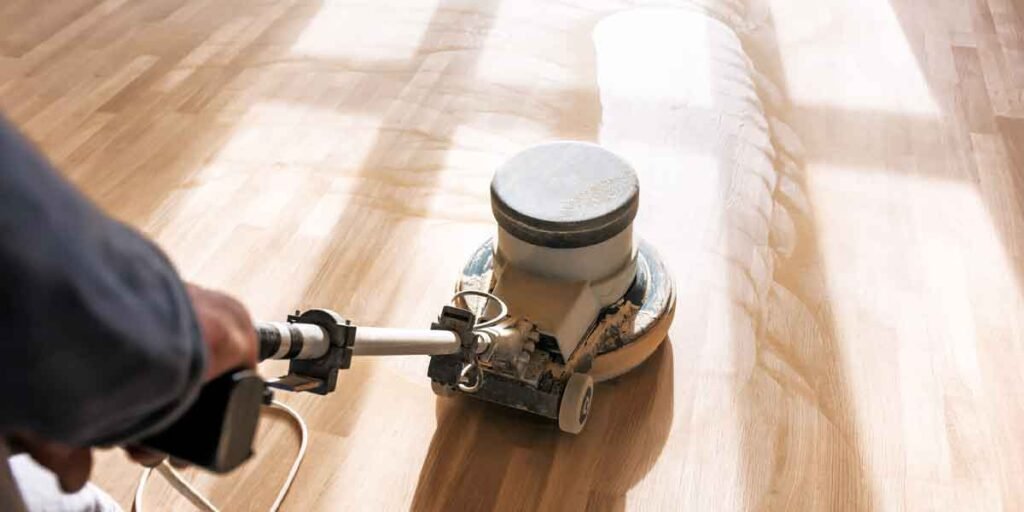
Floor refinishing calculators return a range, not a bid.
Each one multiplies your floor area by a rate for the services you tick, then applies the shop minimum. The two inputs almost none of them ask for are how much sandable wood is left and when the house was built, and those two decide whether the range means anything.
A single 400-square-foot floor shows the spread: a published do-it-yourself ledger reaches $760, while a professional estimator with a $2,500 minimum returns more than three times that.
Which services were priced, whether material was included, and where the minimum sits explain the distance between them.
What the calculator is multiplying
A calculator multiplies floor area by a per-square-foot rate for each service you select, then applies a minimum. Area and service selection are the only two variables you control, so an error in either one shifts the total further than the rate does.
Estimators that publish their rates follow one shape. Enter an area, tick the services, read a rate attached to each. Rhodes Hardwood Flooring charges $4.99 per square foot for a three-coat natural finish, $1.49 for staining, and $0.99 for a hard-wax or commercial topcoat.
Square footage and sandable area
You measure the room; the machine works around whatever is fixed to the floor. Cabinet toes, floor registers, a tile transition at the bathroom door, and the two inches under a radiator stay on your measurement while taking extra time and a hand-held edger.
A 300-square-foot room rarely prices like 300 square feet of open space, and small rooms carry a higher per-foot rate for the same reason: the drum never gets a long straight run.
Ever tried to hold a sander steady through a doorway?
Coats, stain, and the finish product
Each billed line maps to a stage of work. A screen-and-recoat skips sanding to bare wood and charges $1 to $2 per square foot. A full sand strips the old finish, takes a thin pass of wood with it, and rebuilds the surface in two or three coats.
The order of those passes matters more than the labels on them — floor refinishing process explained shows what each pass removes — and an estimator prices only the passes you tick.
A $1.49 stain line and a $0.99 topcoat upgrade move the same floor to a different total.
Where the minimum charge lands
Minimums run from $400 to $3,000 in the howtosandafloor cost breakdown, and two company calculators publish $700 and $2,500. A 300-square-foot floor at $4.99 per square foot comes to $1,497, so the higher minimum adds a thousand dollars on its own.
The same room on four published calculators
Four published price models, run on the same 300-square-foot living room, return $1,200, $1,050 to $3,000, $1,497 before a minimum and $2,500 after it, and $760 for the do-it-yourself version of a larger floor. Every one of those numbers is defensible, and none of them is your price.
| Price source | What the rate includes | Same 300-square-foot room | Why it lands there |
|---|---|---|---|
| Inch Calculator price guide | Labor only, at the $4 midpoint of its $3 to $5 range | $1,200 | No stain, no material, no minimum |
| Rhodes Hardwood Flooring | $4.99 per square foot for a three-coat natural finish | $2,500 | The published $2,500 minimum overrides the area math |
| Big Bro Hardwood | $3.50 to $10 per square foot for sanding and refinishing | $1,050 to $3,000 | The spread reflects stain, wood species, and aluminum-oxide finishes |
| howtosandafloor DIY ledger | Material and equipment rental for a 400-square-foot floor | $760 at 400 square feet | Owner labor removed, consumables added back in |
Only the Rhodes figure is built like a quote: a minimum plus per-foot service rates. The other three answer different questions. Inch Calculator answers what labor alone costs a crew, and howtosandafloor answers what a careful owner spends at the rental counter.
Read the same table as a checklist.
A bid at $1,200 for a room this size invites one question about what the $4 rate left out.
A bid sitting exactly on the minimum invites a second one about which parts of the job that floor covers.
What floor refinishing calculators leave out
Detailed calculators price sanding, stain, coats, and sometimes stairs, then stop. Board replacement, subfloor repair, flooring removal, and the days you cannot use the space sit outside the fields, and each one has a published rate attached.
Big Bro Hardwood lists repairs at $200 to $1,500, subfloor leveling at $1 to $3 per square foot, and flooring removal from $0.70 for carpet to $3.50 for tile. Those fields appear only if the estimator offers them, so a short form returns a smaller number than the finished job will.
Stairs are priced by the tread.
The same calculator quotes tread refinishing at $100 to $130 each, which is why a staircase can rival the cost of a bedroom measuring twice its square footage.
The days the floor is unusable
No calculator outputs the occupancy calendar. Water-based finishes dry to the touch in two to four hours, take sock-only traffic around 24 hours, and hold furniture on felt pads at 48 to 72 hours.
Rugs wait longer.
Minwax tells owners to keep them off for seven days, and Benjamin Moore’s Endure-2K sheet stretches that to 15. Canlak Coatings describes the case that ends badly: a family back to full daily life at 24 hours, scuffed boards within two weeks.
By the third day the smell is gone and the floor still marks under a thumbnail. The chairs sit in the hallway, the rugs stay rolled in the garage.
Two questions the calculator never asks
The year the house was built and the depth of wood above the tongue matter more than any rate field on the form. One is a legal boundary and the other a physical limit, and either can cancel the project as priced.
The EPA’s Renovation, Repair and Painting Rule applies to pre-1978 housing and begins at more than six square feet of disturbed painted surface in a room. Work in the same room within 30 days counts as one job, so a Saturday of sanding and a return visit add together.
Power sanding without a HEPA shroud counts as a prohibited practice under that rule, which puts ordinary floor sanding on the wrong side of it. The rule binds paid contractors and not owners working on their own home, and the EPA recommends lead-safe practice either way.
If the paint has never been tested, stop before the first pass. A certified inspector can test the components, and a certified firm takes over anything above the threshold.
Sanding depth is the second limit. National Wood Flooring Association guidance repeated in Hardwood Floors Magazine puts the minimum remaining wear layer for sanding at 3/32 inch.
Most solid three-quarter-inch floors tolerate six to eight sandings across their service life, and contractors in the field often give four to six.
Engineered floors follow the NWFA Refinishable Program minimums of 3.2 millimeters unfinished and 2.5 millimeters factory-finished.
Laminate and vinyl carry no wood above the printed wear layer, so a refinishing calculator has nothing to price for them. Replacement, or a new floor covering, is the only route.
Below two millimeters, sanding is off the table and a recoat is the only refinishing work left.
Pull a floor register or a threshold to see the board’s cross-section before paying for a full sand.
Either limit ends the project as priced.
The wood runs out first.
Using the number on a bid
A floor refinishing estimate earns its place when a written bid is sitting next to it, because lines can be checked one at a time. Ask for area, sanding scope, coat count, product names, the minimum, and exclusions in writing.
Floor refinishing priced per square foot rewards a larger job with a lower rate, so one bid covering two rooms can undercut two single-room bids. The rate falls as the area grows, and no discount code is involved.
Coat count is the line that stays vague most often. “Refinish” can mean a screen-and-recoat at $1 to $2 per square foot or a full sand to bare wood, and those two jobs differ in price and in how long the surface lasts.
Three questions cost nothing and change the total: who moves the furniture, how many days the room is out of service, and what happens if a board fails during sanding.
The rate is the last variable to argue about. Sandable depth, the age of the paint, and the coat count decide the number first.
Frequently asked questions
How much does it cost to refinish 1,000 square feet of hardwood floors?
At $3 to $8 per square foot, 1,000 square feet lands between $3,000 and $8,000, with sanding and coat count setting the low end and stain, repairs, or a premium finish pushing toward the top.
Minimum charges matter less at this size, and the per-foot rate tends to drop on a large continuous floor. A single-story 1,000-square-foot job with three coats and no stain is the cleanest case for a firm number.
Is floor refinishing cheaper than replacing the floor?
Floor refinishing costs less than replacement in material, because the wood stays in place. Sanding and refinishing runs $3.50 to $10 per square foot in one company calculator, and new solid hardwood installation charges $3 to $9.50 per square foot for labor alone before any boards are bought.
Replacement becomes the cheaper answer when the boards have no sanding left, when damage reaches the subfloor, or when the species and finish are changing anyway.
Can I stay in the house while the floors are refinished?
Most owners can stay when the work uses a water-based finish with dust containment.
Households with infants, elderly residents, or respiratory conditions should isolate the work zone or leave during the sanding days.
Minwax sets light traffic at 24 hours and furniture on felt pads at 72, with rugs off for seven days. Bona’s Traffic GO data sheet reports 80 percent cure at 24 hours and full cure at three days.
How long does it take to refinish 1,000 square feet?
Plan on three to five working days for sanding, staining, and three coats, then curing days before furniture and rugs go back. Each coat needs its own drying window, so coat count sets the calendar more than area does.
A one-room job fits into three days when nothing needs repair. Add board replacement or a slow-curing finish and the floor stays off-limits for a week.
