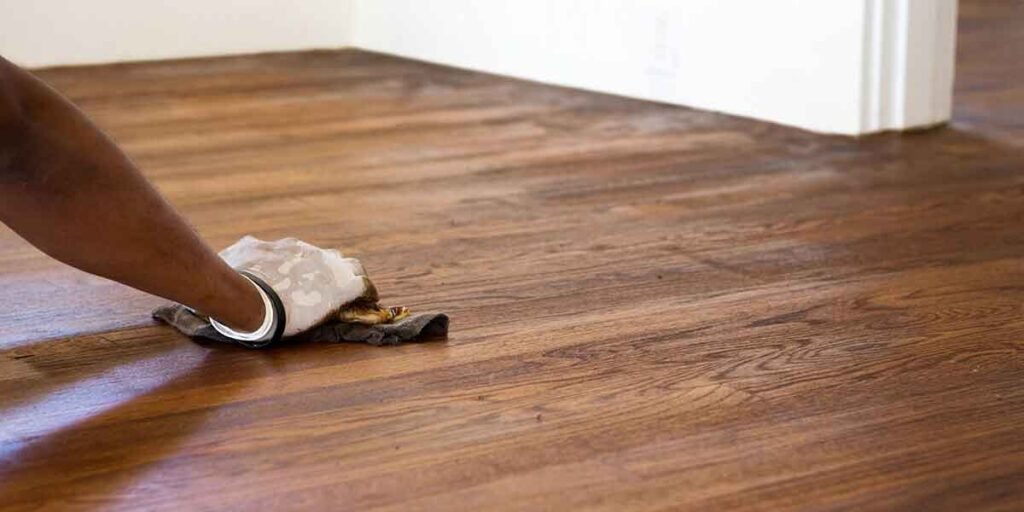
Floor refinishing is worth it when three readings come back your way: sanding depth still left in the wood, damage sitting in the coating instead of inside the boards, and a replacement quote that lands at two or three times the refinish price. When one of the three fails, the money buys more somewhere else, and no quality of finish makes up for it.
Contractors quote labor. Homeowners judge the surface. That mismatch is why the same floor refinishing job draws confident answers pointing in opposite directions, and why two houses with similar-looking floors get opposite verdicts: one needs a sanding pass, the other needs new boards.
The cost figures here are 2025 U.S. numbers from Angi and HomeAdvisor. Everything else follows from what the machine finds when it touches the wood.
What Two Quotes for Floor Refinishing Say
Professional floor refinishing runs about $3 to $8 per square foot, and Angi quotes dustless work at $5 to $8, roughly $2 above the standard rate. Angi puts the average project at $1,900 with a typical range of $600 to $4,500, and HomeAdvisor’s 2025 survey of more than 10,000 customers reports the same band.
New hardwood installation averages $5 to $15 per square foot across both guides, which makes replacement about twice the refinish bill before anyone hauls the old flooring out. That ratio carries the whole economic case, and it holds only while the existing wood can still be cut.
A lump-sum bid hides four separate prices. HomeAdvisor breaks the work into sanding at $0.50 to $3 per square foot, staining at $1 to $3, topcoat at $1 to $2.50, and board replacement at $6 to $12. The board row is what turns a modest estimate into a large one, and it is the one line worth questioning before signing anything.
Species and layout move the number as well. Oak, cherry, and parquet sit at $3 to $5 per square foot in HomeAdvisor’s data, pine at $4 to $7 because it dents and needs patching, maple and mahogany at $6 to $8 because dense woods load abrasives faster. A hallway or a single bedroom rarely prices like a fraction of the whole floor.
Can the Floor Take Another Cut?
A wear layer is the wood above the tongue, and it is the only thing a sander can work with. Once it is gone the floor cannot be refinished again at any price. Solid three-quarter-inch strip gives up several cuts. Engineered boards give up one or two. Laminate and vinyl plank give up none.
Cut counts are estimates rather than guarantees, because the real limit is how much each pass removes and how flat the floor is. Contractor guidance commonly puts solid three-quarter-inch flooring at four to six refinishes and engineered boards at one or two, and that spread is the reason to measure instead of assume.
Measuring at the register
Pull a floor register grate or lift a transition strip and look at the plank edge where it meets the subfloor. On solid wood, judge the distance from the surface down to the tongue. On engineered boards, look for the boundary between the wood face and the plywood or fiberboard core beneath it. Calipers answer the question in a minute, and a manufacturer spec sheet answers it faster when the product name is still known.
A test patch answers the same question with a machine instead of calipers. Sand a hidden corner for twenty minutes and look at what the cut exposes: wood, or the core.
Factory finishes cost more to cut
Prefinished boards are coated in a mill oven, where a UV-cured film is built up with aluminum oxide, a mineral abrasive, suspended in it. The result resists dog nails, chair legs, and sanding belts. Wood Floor Business’s abrasive guidance for those floors names silicon carbide and ceramic grains as the two that hold up, and notes that ceramic costs roughly half again as much per belt while lasting two to four times longer. Clarke’s rental guidance tells crews to fit a stiffer 80-grit brush to an aluminum-oxide floor, where a site-finished floor takes a 120-grit brush.
Extra belt changes and cutting time land in the bid somewhere. Ask whether the quote assumes a factory finish, because the answer moves both the price and the schedule.
Recoating one of those floors is a separate bet. The National Wood Flooring Association’s guidance on recoating factory-finished flooring starts with the manufacturer’s recommended system, not with whatever the contractor normally sprays, and Bona’s recoat-adhesion product for aluminum-oxide floors instructs users to contact the floor maker and coat a sample area first. Prefinished flooring carries wear-through warranties rather than appearance warranties, and a recoat done outside the approved system puts that coverage at risk.
Damage That Survives Sanding
A sanding pass removes well under a sixteenth of an inch of wood, so anything that soaked deeper comes back once the finish dries and light rakes across it. Stains held in the fiber are the most common reason a homeowner pays for work and still ends up unhappy with the result.
Pet accidents are the usual cause. Urine breaks down into ammonia and uric acid, those react with the tannins in oak, walnut, and cherry, and the reaction leaves a dark compound locked into the wood instead of sitting on it. Fine Homebuilding’s write-up on ebonized oak floors describes the same chemistry and the one chemical that sometimes helps: oxalic acid lifts mild iron-tannin stains on bare wood, then has to be neutralized with baking soda and water. Mixed strong or left too long, it can drive oak toward green.
Reading a stain by its color
How deep did it go? Color is the fastest test available before spending anything. A light gray or amber haze belongs to the finish or the top fibers and comes out in the sanding. A medium brown mark with soft, blended edges may leave a faint ghost after the final cut. Black or dark brown with hard, defined edges has reached the fiber, and further sanding will lighten it a little and then stop helping.
Contractors who handle these jobs describe the same deciding step: test-sand a hidden spot, take a sixteenth of an inch off, and look again. If the mark holds, the fix is replacing the affected boards and weaving matching stock into the surrounding rows before the whole floor is sanded and finished as one surface.
Matching stock decides whether a repair disappears or announces itself. Boards pulled from a closet or from under carpet match better than new material of the same species, because old boards have aged. When urine reached the subfloor, a shellac-based odor-blocking primer goes down before new boards do, and contractors describe that step as the difference between an odor that is gone and one that comes back months later.
Boards that cannot take a cut
Water and movement are the second category, and their signals are physical rather than visual. Boards that cup and stay cupped through the dry season. A plank that gives slightly underfoot. A floor that has heaved along a seam. Finish that bubbles or peels in the same pattern year after year.
Bubbled film usually means moisture arriving from below or from a leak nobody fixed, and a new coat over it lifts in the same shape within a season. Sanding answers none of those problems, and every dollar spent on it is a dollar taken away from the repair that would have worked.
Four Routes and What Each One Fixes
Four options exist for a worn wood floor, and they are not interchangeable. Screen and recoat is a light abrasion of the existing film plus a new topcoat, and it never touches the wood. Refinishing cuts the surface back to bare fiber and rebuilds the finish there. Board replacement reaches the boards. A new floor replaces the decision.
The cheapest route has the narrowest conditions attached, which is why the price gap between the four matters less than which one the damage allows.
| Route | Typical price | What it fixes | Where it fails |
|---|---|---|---|
| Screen and recoat | $1 to $2.50 per square foot | Dull traffic lanes, light surface scratches, a finish worn thin but still intact | Bare wood in a lane, gray weathering, stains, any color change |
| Full refinish | $3 to $8 per square foot | Deep scratches, gray wood, most surface staining, color changes | Stains past the sanding depth, soft or cupped boards, a wear layer already spent |
| Board replacement inside a refinish | $6 to $12 per square foot for the new boards | Localized black staining, pet damage, water-damaged runs | Damage spread across most of the floor, which turns the job into a new floor |
| New floor | $5 to $15 per square foot installed | Floors with no cuttable wood left, repeated moisture failure, a change of material | Nothing structural, but the existing wood is discarded and a thin veneer still cannot be refinished later |
Recoat is the route most often oversold. It needs an intact film to bond to: water beads on the surface, no lane has gone bare, and the wood underneath has not gone gray. Where those hold, a recoat buys years and consumes none of the floor’s cut budget. Where they do not, the new coat sits on a failing layer and lets go at the worn spot first.
The rule I would use: worn film over intact wood, recoat. Exposed, gray, or deeply scratched wood, a full floor refinishing. A stain that lightens and stops, replace those boards. No wear layer left, a new floor, and at that point the decision shifts from finish to material.
Recoating on a schedule instead of waiting for visible wear is the cheaper habit over a decade, since it never spends the wood. That argument holds only on floors with a healthy wear layer and no wax or silicone in their history, both of which stop a new coat from bonding no matter how the surface is prepared.
The Long Math, and the Timing
The resale case for refinishing is stronger than for most home spending. The National Association of Realtors’ Remodeling Impact Report, produced with the National Association of the Remodeling Industry, estimated cost recovery on refinishing hardwood floors at 147 percent, the highest of the interior projects it covered, against a median remodeler cost near $3,400 and an estimated $5,000 added to the sale price. New wood flooring came in at 118 percent.
NAR attaches its own warning to that figure: the estimates ignore regional markets and the condition of a particular house. The number describes a floor that is already a candidate for refinishing, and it says nothing about a floor that cannot spare another cut.
Timing follows wear rather than a calendar, since no manufacturer publishes an interval for floor refinishing. The useful signals are local and specific: a traffic lane in front of the refrigerator going dull, gray showing where sunlight falls across the same boards all day, scratches you can catch with a fingernail. The first belongs to a recoat. The other two belong to a sand.
The work itself takes days rather than hours. Sanding, dust removal, and coats with drying time between them cannot be compressed, and the week the house spends with furniture in the garage and one level off limits is part of the bill. Households doing the job around a move, a vacation, or another remodel absorb that cost for free. Households squeezing it into a busy month pay for it in other ways.
Where Homeowner Work Stops
Refinishing suits a homeowner on a thick solid floor with no contamination history and no staining past the surface. Four situations end that, and each has a signal visible before any equipment is rented.
- A wear layer that cannot spare another cut, whether the veneer is thin or the floor is core material with a printed face.
- A stain that survives a test sand, or a board that is soft, cupped, or heaved.
- A floor with wax or silicone polish somewhere in its history, which stops a new coat from bonding.
- A house built before 1978, where sanding can disturb lead paint on trim, thresholds, and painted floors.
Lead carries the written threshold. EPA’s Renovation, Repair and Painting rule covers paid work that disturbs more than six square feet of painted surface per room in pre-1978 housing, and it allows high-speed sanding machines only when a shroud and a HEPA vacuum collect dust where it is generated. That rule binds contractors. EPA’s separate guidance for do-it-yourself work reaches homeowners in the same housing, and it asks for an N-100 respirator, no dry sanding or dry scraping, and a HEPA vacuum instead of a shop vacuum.
Aluminum-oxide dust from a factory-finished floor is a respiratory hazard for the person sanding it, and two-component waterborne finishes carry isocyanate warnings on their safety data sheets, which keeps them a professional product even when a homeowner can order them. Both hazards are manageable with the right respirator and ventilation, and both are worth settling before the sander is in the room.
Frequently Asked Questions
How much does floor refinishing cost?
Floor refinishing costs about $3 to $8 per square foot in Angi’s and HomeAdvisor’s 2025 pricing, and dustless equipment adds roughly $2. Angi’s average project runs $1,900, with a typical range of $600 to $4,500.
Is it cheaper to refinish or replace floors?
Refinishing is cheaper whenever the existing wood can take another cut, because replacement adds removal, disposal, and $5 to $15 per square foot of new material. Replacement wins when the wear layer is spent, boards are structurally failing, or stains run deeper than a sanding pass reaches.
Can I refinish my floors myself?
Homeowners can refinish a thick solid floor with no wax history and no deep staining, and the work runs three to five days of sanding, dust removal, and coating. A thin wear layer, a soft or cupped board, or a stain that survives a test sand belongs to a contractor.
Can I stay in the house while floors are refinished?
Households can stay on one level while the other is worked, since dust and solvent fumes peak during sanding and in the hours after each coat. Most move out of the coated rooms for the first day and seal those rooms off from HVAC returns while the finish sets.
Does floor refinishing add value to a house?
The National Association of Realtors’ Remodeling Impact Report estimates 147 percent cost recovery on refinishing hardwood floors, the highest among the interior projects it studied. The report notes that the figure does not account for regional markets or the condition of a particular house.
