Epoxy holds a floor repair together only where the crack is dry and no longer moving. A patch that cures rigid loses to a crack that opens a few thousandths of an inch every winter.
Floor repair is a materials decision before it is a labor decision. Most epoxy patches that fail were mixed correctly; the material went into a joint that was still working, and the chemistry had nothing to do with the outcome.
Test the damage first. Pick the material second. Some floors should not be patched at all.
Dormant or Active: What Decides Whether Epoxy Works
Cured epoxy bonds both faces of a crack and carries tensile stress across them, so a joint that eventually fails usually breaks in the concrete beside it, not along the glue line. That same rigidity sets the limit, because cured epoxy cannot follow a crack that keeps opening and closing.
ACI divides cracks into dormant and active in its evaluation guidance. A dormant crack is stable, restrained by reinforcement or by the surrounding structure, with no future movement expected. An active crack is still moving, whether settlement, thermal cycling, or traffic is driving it, and the distinction decides the material.
Dryness is the second condition. The ACI specification for epoxy crack injection, 503.7-07, calls for the crack to be dried before standard bisphenol-A amine epoxy goes in, because moisture at the bond line is where injection repairs quit.
Wet and moving. Those two conditions retire more epoxy patches than any mixing mistake.
Test the crack before you buy anything
Span the crack with a tell-tale: a strip of glass, a plaster bridge, or a commercial crack monitor, dated with tape. Read it again after 30 to 90 days, and treat movement of more than roughly 0.25 mm as proof the crack is active.
The tell-tale sits there for a season. Nothing shifts for eleven weeks. Then a cold snap and a thaw move the reading by two hundredths of an inch, and the plan for that floor changes.
A single reading proves little, so take two at the same point in the year, with the house in its normal condition and the furniture where it lives. A crack that looks still in July and has moved by February is seasonal, a pattern that turns up in slabs over expansive clay as often as it turns up in wood floors.
How long does the test take? A hairline crack in a residential slab needs a season to show its habit. Water changes the schedule, because a leak announces movement and moisture in the same event.
When flexible polyurethane is the answer
Active cracks take flexible polyurethane injection. Polyurethane stays elastic after cure and tolerates later movement, and hydrophilic grades react with water and foam to fill a joint that is weeping, which is work no standard epoxy will do.
What polyurethane does not do is restore tensile strength across the crack. The trade is water control and movement tolerance in place of load transfer, and for a crack that is still working, that trade is the better one. Stop the leak first, let the crack dry, and a structural epoxy injection becomes possible later if the slab needs it.
Where Epoxy Earns Its Cost
Epoxy is the right purchase for damage that is dry, stationary, and worth holding in one piece: slab cracks, spalled edges, divots, split or knotted boards, and small failures in a floor coating.
Concrete slab cracks
Low-viscosity injection epoxy reaches cracks as narrow as about 0.002 in. (0.05 mm), which is why it repairs damage a flashlight will not find. The work needs ports bonded along the crack, a surface seal, and controlled pressure, and it is normally done before a coating goes down so the finished surface reads as one plane.
Cost efficiency turns over at the wide end. Above roughly 5 mm, the volume of epoxy and the preparation around the crack stop competing with a polymer or cementitious repair mortar that fills the same void with cheaper material.
Craters, spalls, and divots
A two-part epoxy putty trowels into a void, sets hard enough to take foot traffic, and accepts a coating on top. Press it in firmly. A patch that is smoothed flat over a pocket of trapped air breaks out within a season.
Voids deeper than about half an inch take a foam backer rod first, so the filler has something to sit on and does not drain into the slab. A patch that has to finish perfectly flush with the surrounding surface is usually left to cure for two days and then ground back.
Splits, knots, and gouges in wood
Two-part epoxy is the filler that belongs in a split board, a knot hole, or a gouge, and on reclaimed stock the trade standard is to trowel filler across the whole surface and sand it back. Cured epoxy does not shrink, which is what a floor headed for a drum sander needs.
Check the seam’s habit before the filler goes in. The National Wood Flooring Association caps filler use at 3/32 in. and puts the best filling window in spring or fall, when the wood sits at its mid-range moisture content and not at its driest.
Coating failures on garage and shop floors
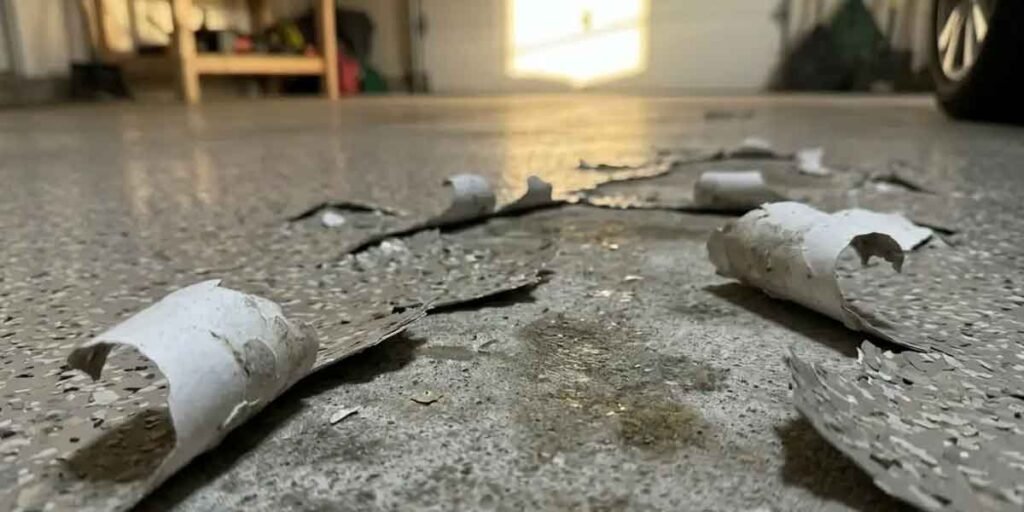
Two different problems get called a coating repair. A coating that has chipped usually hides a void in the concrete beneath it, and the void gets filled before the finish goes back on. A coating that has peeled in sheets has lost its bond, and a new layer applied over it leaves with the old one.
Some repair compounds are formulated so a coating can go on while the patch is still wet, which saves a day of waiting. That is a property of the individual product, and the data sheet is where it is stated.
Where Epoxy Will Fail
Four conditions sink a cured epoxy patch: movement, moisture, width, and a joint that was cut or built to move in the first place.
| Condition | Cured epoxy | Material that fits |
|---|---|---|
| Dry crack, dormant, load transfer needed | Works | Low-viscosity epoxy injection to ASTM C881 |
| Crack still moving from settlement, heat, or traffic | Fails | Flexible polyurethane injection |
| Wet, weeping, or leaking | Will not bond | Hydrophilic polyurethane foam, then let it dry |
| Wider than about 5 mm | Inefficient | Polymer or cementitious repair mortar |
| Expansion joint, or a joint cut to let the slab move | Fails | Flexible joint sealant |
| Hardwood seam that opens each winter | Fails | Humidity control, or a flexible filler on a finished floor |
A rigid patch in a live crack does not simply come loose. The movement travels to the next weakest point, and the new crack opens beside the patch or past its end.
The joint nobody should fill
Expansion joints and saw-cut control joints exist so the slab can move without cracking somewhere else, and filler poured into them defeats the purpose. A control joint can be left open and coated across for a scored look, which many installers in fact prefer. Expansion joints already holding flexible material take a flexible sealant.
When to Stop and Call a Professional
Bring in a licensed structural engineer when a crack is wider than 1/4 in., when the two sides sit 1/4 in. or more out of level with each other, or when the crack has kept widening across a season. Those findings point at the structure under the floor, not at the material in the crack.
Published thresholds cluster around the same numbers. NAHB’s residential performance guidelines treat a slab crack above 3/16 in. as the builder’s item; the Builders Association of the Midlands guidelines trigger repair at 1/4 in. of width or 1/4 in. of vertical displacement; the HUD NSPIRE foundation standard flags a crack 1/4 in. or wider and 12 in. or longer as a moderate deficiency. ACI’s own answer is that some cracking is normal and that no single number settles the question, which is why the pattern tells you more than the measurement does.
Offset is the signal worth respecting. A flat crack, even a wide one, is usually shrinkage. When the faces no longer line up, the slab flexed or the soil beneath it moved, and a coin or a straightedge laid across the joint will catch on the ledge.
Neighboring symptoms belong in the same phone call: doors and windows that have started to stick, a floor that has taken on a slope, gaps opening at the baseboards, stair-step cracks in a brick veneer, a horizontal crack in a basement wall. An engineer measures and photographs the cracks and may run an elevation survey across the slab to set a baseline for monitoring.
The work that follows is not a patch and is not priced like one. Where a structural finding is involved, the estimate covers a report, a repair design, and sometimes work under the slab; the floor repair cost per square foot figures for ordinary patching and injection work are the right comparison for the smaller jobs and only for those.
The hazard sits in the uncured resin
NIOSH draws the line at the cure. Fully cured epoxy is essentially inactive, while the uncured resin, the hardener, and the reactive diluents are the materials to treat as hazardous.
Skin is the main route in, and the effect does not wear off. Epoxy resin systems account for a large share of occupational skin disease, and once sensitization develops it is permanent, so a person who reacts has to avoid further contact for good. Amine hardeners add to that risk and are volatile enough that sensitized workers break out on the face and neck, not only on the hands.
Glove choice is counterintuitive. NIOSH health hazard evaluation reports that epoxy resins penetrate many plastic and rubber gloves, with polyvinyl alcohol or a multilayer laminate glove (Silver Shield, 4H, Barrier) giving protection that a single-layer nitrile glove does not. Cotton and latex are both wrong for this work because they hold the resin against the skin, and NIOSH’s epoxy hazard alert names them. Local exhaust at the mixing point, and keeping solvent off skin, cover the rest.
Frequently Asked Questions About Epoxy Floor Repair
Can epoxy be used to repair cracks in a concrete floor?
Yes, when the crack is dry and dormant. Epoxy injection restores tensile continuity across a stable crack, while a crack that still moves or leaks takes flexible polyurethane first.
What drives the cost of a floor repair?
Scope drives it. A troweled patch, a pressure-injected crack, and a replaced board are priced by area or by crack length, and a job that begins with an engineering evaluation moves into a different bracket.
Is it cheaper to repair a floor or replace it?
Repair is cheaper while the damage is local and the subfloor is sound. Replacement wins when boards or tiles have failed across a room, when the subfloor has taken on water, or when a coating has peeled in sheets off a damp slab.
Can new epoxy go over an old epoxy floor?
Sometimes. A dull but sound coating can be cleaned, abraded, and recoated. A coating that has peeled in sheets comes off first, and peeling across broad areas usually points to moisture moving through the slab.
Does epoxy work on hardwood floors?
For knot holes, splits, and gouges that will be sanded flush, it works well. A seam that opens every winter is a different job, because the wood moves with the humidity and cured epoxy does not.
A dry, dormant crack and a trowel of epoxy is the whole recipe. A crack with a quarter inch of offset goes to a licensed engineer, because the repair that follows is a design problem and not a filling problem.
