An online carpet installation estimator answers with a budget band. Floor area goes in; a carpet quantity, a pad allowance, and an installed cost range come out.
The band holds only as far as the tool’s assumptions match the house. Two assumptions carry the weight — how the tool handles roll width and seams, and what it leaves out because nobody can type it into a form.
Run one before an installer visits, because a written quote has to beat, match, or explain its number.
What an online estimator is actually calculating
A carpet calculator multiplies floor area by a goods price and a labor rate, adds padding, and allows for waste. Measured dimensions are the part it handles well, and condition, access, and the flooring being removed sit outside its arithmetic.
Retailer and flooring-store tools look alike on the surface and differ underneath. Lowe’s Carpet Measurement Calculator takes a length and a width, then returns the materials and the labor hours the job requires. MeasureSquare’s version exposes roll width, cut margin, a maximum T-seam count, a waste add-on percentage, and layout direction, while The Perfect Carpet’s asks for room dimensions plus a count of staircases.
Those extra fields decide the material line. A 5% waste allowance and a 15% one cover the same room with different amounts of carpet.
These calculators are free and open to anyone with a tape measure, which is the cheapest part of the whole project.
Two outputs come back from most of these tools: a quantity of goods, in square feet or square yards, and a cost or work-hour figure. Hours are the honest output while the goods price still depends on what you pick off the rack.
Most people leave the settings alone.
The defaults were written for a rectangular room with square corners and nothing to tear out.
Where floor area stops matching the carpet you buy
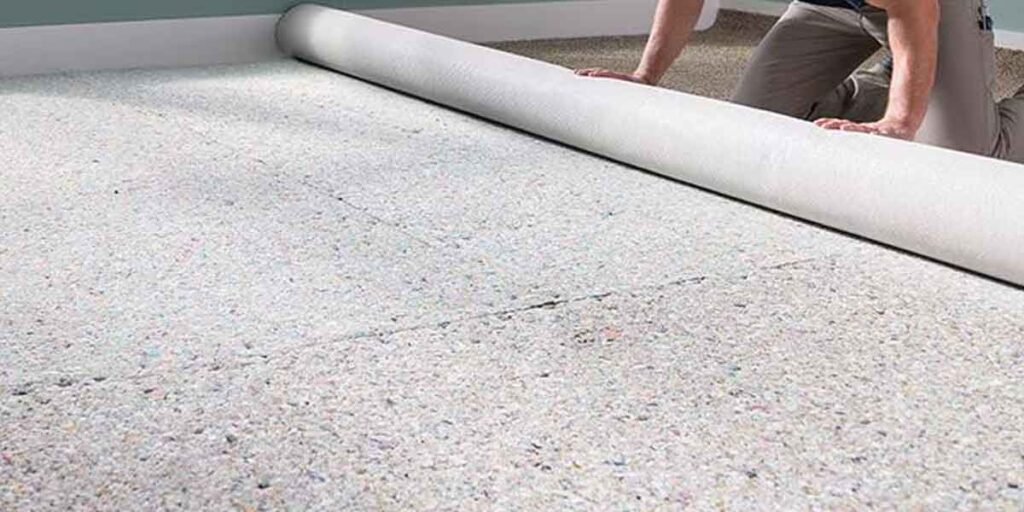
Carpet comes off rolls, so the square footage you buy is not the square footage of the floor. Residential goods usually arrive 12 feet wide, and a 15-by-20-foot room measures 300 square feet of floor while consuming roughly 400 to 480 square feet of carpet once roll width, seams, and trimmed edges are counted.
Rooms 12 feet across or narrower fit in a single length.
Wider rooms need a second piece, a seam, and enough length in both pieces to match the pile direction.
Take that 15-by-20 room. Covering 15 feet of width from 12-foot goods means a second length of about 3 feet, cut from another 12-foot-wide run of the same roll. The material line can be written against two 12-by-20 lengths, which is 480 square feet of carpet for a 300-square-foot floor.
Patterned goods widen that spread.
The repeat has to line up across the seam, which adds length to each run.
Layout direction is the setting with the largest effect and the least explanation. A long hallway may need one seam run one way and three run the other.
Offcuts accumulate at the curb. A second 12-foot length that yields a 3-foot strip leaves 9 feet of width unused, and the material line paid for all of it.
Stairs are counted one piece at a time, by tread, riser, and the width of the run.
A 3-foot-wide stair with a 10-inch tread and a 7-inch riser carries a little over 4 square feet of carpet per step before the edge allowance, so 13 steps carry 55 square feet of goods and 13 separate cuts.
Doorways, thresholds, and transition strips land on the quote as line items that a square-foot estimate never sees.
Two numbers carry most of the risk: the widest measurement across each room, which decides whether the goods run in one length or two, and the count of steps, doorways, and thresholds, which a square-foot price does not cover at all.
How accurate a carpet installation estimator really is
The accuracy question is usually a scope question. Published per-square-foot figures for installed carpet span 69 cents to $11, and each number describes a different set of things included in the price.
Home Depot’s services page splits the job three ways: carpet at $1 to $4 per square foot, padding at $1.01, and installation starting at 69 cents.
Labor by itself usually runs $0.50 to $1.50 per square foot, per Carpet Exchange’s 2026 breakdown, with stairs, tight corners, and awkward layouts pushing it higher. Modernize’s 2026 guide stretches the labor band to $2 per square foot for complex jobs.
Homewyse’s May 2026 figure for a basic carpet installation comes in at $5.27 to $7.72 per square foot. Carpet Exchange’s 2026 breakdown quotes $2 to $8 per square foot installed, carpet, padding, and labor included, with a 1,000-square-foot project at $1,800 to $7,500. Carpet Now’s 2026 guide uses $3 to $6 per square foot and includes removal, and NerdWallet’s replacement figure reaches $3 to $11 per square foot.
Side by side, the spread stops looking like disagreement.
The comparison for anyone running a carpet installation estimator is against the same three lines, not against a bottom-line total.
Three questions settle which figure applies to a particular house: whether the goods and the pad are inside the price, whether removal and disposal of the old carpet are inside it, and whether stairs, furniture moving, and tight access count as extras.
Estimating tools rarely expose all three, and written quotes often fold them into a single total.
Matching a band to a quote takes three passes: line the scopes up first, compare the measured areas second, and compare the totals last. A total that disagrees usually traces back to a line that exists on one side only.
An estimate written for a real carpet installation separates those buckets, which is what makes it checkable line by line against the estimator’s output.
What no estimator can price
Two site conditions move a carpet job further than any pricing assumption: the material under the old flooring and moisture inside a concrete slab. Both are found during a visit, and both can push a job past its estimate.
Flooring installed before 1980 is the one to slow down on. The EPA’s homeowner guidance lists resilient floor tiles, vinyl sheet backing, and the adhesives under them as materials that may contain asbestos in homes of that era.
For suspect flooring that is still intact, the EPA’s advice is to leave it in place, cover it, or encapsulate it.
Sanding, dry scraping, dry power stripping, and dry sweeping are the operations it warns against, with HEPA vacuuming for cleanup and qualified professionals for testing and removal.
That boundary is the practical one. If the house predates 1980 and the plan involves lifting old tile, sheet vinyl, or the adhesive under it, stop there and have the material tested before a pry bar goes in.
Concrete slabs carry a quieter version of the same problem. Carpet laid over a slab that is still releasing moisture can fail at the adhesive and the backing. The test that catches it is ASTM F2170, an in-situ relative humidity reading taken from holes drilled to about 40% of the slab’s depth.
The acceptance range most often cited for carpet and carpet tile is 75% to 80% relative humidity, extending to 85% with a moisture-tolerant adhesive.
The governing limit is the one printed by the carpet or adhesive manufacturer, and it overrides the general range.
Subfloor repair is the quieter cost. A sheet of plywood that has to be replaced, a levelling pour over a hump, or new tack strip around every wall adds labor that no square-foot rate covers.
Three conditions justify handing the work to a professional: flooring installed before 1980, a moisture reading above the adhesive manufacturer’s limit, and a subfloor that moves underfoot or smells damp.
Any one of them can turn a floor covering job into a repair job.
Frequently Asked Questions
How much does it cost to install 1,000 square feet of carpet?
Most 1,000-square-foot jobs land between $3,000 and $6,000 with materials, padding, labor, and disposal included. Carpet Now’s 2026 guide puts basic carpet near $3,000 at that size, mid-grade near $4,600, and luxury near $6,000, while Carpet Exchange quotes a wider band of $1,800 to $7,500.
What is the average cost to install carpet?
Homewyse’s May 2026 figure is $5.27 to $7.72 per square foot for a basic installation. Advertised rates as low as 69 cents per square foot cover the labor side, with the carpet bought separately. Both numbers are accurate as far as their scopes reach.
What is the average cost to carpet a 12×12 room?
A 12-by-12 room holds 144 square feet of floor, which prices near $760 to $1,110 at Homewyse’s May 2026 range before any roll allowance. Goods cut from a 12-foot roll leave offcuts, so the material line usually climbs above the floor area.
How much does it cost to carpet a 20×20 room?
A 20-by-20 room measures 400 square feet and prices around $2,100 to $3,100 at the same range. Because the room is wider than a 12-foot roll, it takes a second length and a seam, which adds material and a visible joint without adding labor hours.
Can a carpet installation estimator replace an in-home measurement?
A carpet installation estimator cannot replace an in-home measurement, because it only prices the dimensions someone types in. A soft subfloor, a slab reading wet, or a stairwell that needs 13 cuts never appears in its output. Lowe’s labels its own calculator an estimating tool only and asks customers to schedule a measurement for actual project cost.
