Dust daily; wash monthly with a barely damp pad. Hardwood flooring care comes down to controlling liquid, not to buying a stronger bottle.
The rest of hardwood flooring care is detail layered onto those two habits. Water volume decides more than product choice does, and the NWFA’s maintenance page reduces the whole subject to one instruction: clean with a product made for the finish that is on your floor.
Three finish families cover most hardwood flooring in American homes, and each takes a different product. Match them wrong and nothing dramatic happens at first. The floor dulls, darkens at the seams, or peels along the plank edges over the following weeks, and no cleaner reverses it.
What your finish will tolerate
Surface finishes take a cleaner made for film finishes. Wax takes a wax cleaner and fresh wax. Oil and hardwax floors take the maker’s soap, diluted, with no rinse afterward.
The American Hardwood Information Center sorts wood flooring finishes into three families: surface finishes, the urethanes and polyurethanes that sit on top of the planks; wax, which soaks in and hardens; and acrylic impregnated, which shows up mostly in commercial buildings.
Where the protection sits decides how you clean it. A surface finish is a film over the wood, so that film is both what you clean and what you can wear through. Wax goes into the wood and gets rebuilt thin coat by thin coat. Oil and hardwax finishes live in the fiber and get replenished with maintenance oil, which is why their care sheets read like a system, not a shopping list.
How do you know which finish you have?
The installer’s paperwork or the finish can label settles it fastest. The American Hardwood Information Center’s fallback for a floor of unknown history is a generic hardwood floor cleaner from a flooring retailer, which works across the common finishes.
The same source is strict about one combination: wax-based and petroleum-based products should never go on a surface finish, because they soften the film. Makers of oil systems are just as direct. Rubio Monocoat’s help pages answer whether other cleaners are allowed with a flat no, explaining that household cleaners are designed to attack oil, the base of the product.
Vinegar belongs on that list too.
WOCA’s cleaning FAQ calls vinegar and water too harsh for oil-finished wood and predicts it will strip the finish over time.
| Finish on the floor | What cleans it | What damages it |
|---|---|---|
| Surface finish (urethane, polyurethane, factory aluminum oxide) | A wood floor cleaner made for film finishes, misted onto a barely damp microfiber pad | Wax and petroleum-based products, steam mops, wet mopping, power scrubbers |
| Wax | A cleaner made for wax finishes, then a thin coat of solvent-based wax | Any product not labeled for wax floors |
| Oil or hardwax oil | The finish maker’s soap, diluted in water, plus maintenance oil on schedule | Household and over-the-counter cleaners, vinegar |
| Acrylic impregnated | The manufacturer’s own schedule, built for heavy commercial traffic | Any product outside that schedule |
The daily habit and the monthly wash
Dust, sweep, or vacuum on the bare floor setting every day, and wash about once a month. The daily pass removes grit that acts like sandpaper underfoot.
The NWFA’s routine is sweeping, dust mopping, or vacuuming to lift dust and dirt, with spills wiped as they happen using a dry or slightly damp cloth. The monthly step adds a wood floor cleaner, applied lightly.
Good Housekeeping’s cleaning lab puts numbers on the monthly pass: work in small patches of about 3 feet square, wipe in the direction of the planks, and keep the surface from getting soaked before the pad picks the liquid up. Vacuum with the brush roller off, since a beater bar scratches a finish that has grit under it.
Humidity belongs in the same routine.
The NWFA recommends indoor conditions between 60 and 80 degrees Fahrenheit and 30 to 50 percent humidity, because wood swells and shrinks with the moisture around it.
The schedule on one line: dry pass daily, wash monthly, humidity held in that band year round, and a recoat once the wear reaches the film.
“Damp” has a physical meaning worth checking once. A pad that leaves a dark trail or a sheen of standing liquid is too wet. Wring it until it releases no drips and the floor looks dry a few seconds after the pad goes over it.
Near the sink the pad comes back gray after one pass. Near the door it comes back clean. The gray is grit from the kitchen floor, and it shows up in the same two spots every week.
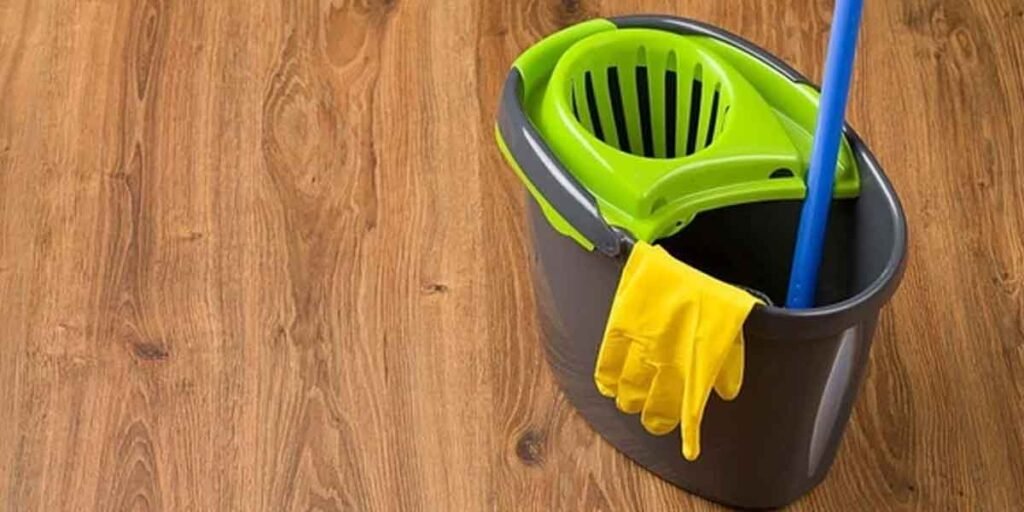
Most hardwood flooring care failures come from one shortcut: pulling out a bucket and a string mop because sweeping takes longer than mopping. That habit pushes liquid into seams where the finish is thinnest, and the damage shows up months later.
I keep a dry microfiber pad by the kitchen door, with a spray bottle beside it. The habit that took longest to break was mopping a whole room in one pass; the floor dried with a dull haze near the sink and took a weekend to bring back.
Why wet mops and steam backfire on hardwood flooring
Steam drives heat and moisture into end joints and seams. Warranty language treats the result as owner damage, and repeated cycles leave cupping, gaps, and a cloudy finish that no cleaner repairs.
The NWFA does not hedge on this one: do not use wet mops or steam mops, which damage the finish and the wood over long periods of time. Spills get a dry or slightly damp cloth. Liquid is the thing being managed, not the cleaning agent.
The argument gets real in occupied houses. Manufacturers may approve steam on sealed hardwood, and Carolyn Forté, former executive director of the Good Housekeeping Home Care & Cleaning Lab, points out that most homes are not perfectly or completely sealed. People and pets walk those floors, leaving fine scratches and worn spots, so steam, pressure, and moisture get past the surface anyway. Her list of outcomes goes from warping and dulling to voided warranties.
Warranty text backs her up. Provenza Floors excludes damage from wet mopping, steam or steam cleaners, and power scrubbing machines. Damage caused by a cleaning method lands on the owner, which is the practical weight of the rule.
Signs that moisture won: raised board edges, new gaps at the seams, a white or cloudy haze on the film, finish peeling along plank edges, a board that still reads wet on a meter days after the spill.
Spills, scuffs, and pet urine
Blot a spill; do not wipe it across the boards. Pet urine is the fastest hardwood flooring stain there is, and an enzyme cleaner made for sealed wood is what breaks down the uric acid holding the smell in place.
Speed decides.
Fine Homebuilding’s refinishing coverage explains what happens when urine sits. The ammonia in it reacts with tannins in oak, walnut, cherry, and chestnut through a process the trade calls ebonizing, and the mark that forms is bonded into the fiber.
Press paper towels down on the wet spot rather than dragging them sideways, so liquid does not travel along the seam.
An enzymatic cleaner labeled safe for finished wood comes next, given the dwell time on the label. Baking soda left overnight pulls residual odor and moisture from the grain.
Deep black stains are where households stop. Oxalic acid, sold as wood bleach, lifts iron and tannin stains from bare wood, and the procedure Fine Homebuilding describes ends with a neutralizing wash of baking soda in water. Oxalic acid goes on after sanding, which puts the job past what most owners should attempt alone.
Scuffs split into two groups. One lifts with a fingertip or a soft eraser and was never damage, just residue from shoe soles and rubber. One stays put through cleaning and sits inside a matte ring, the edge where the film has worn through.
When cleaning stops helping
A dull patch that stays dull through a wash is worn finish, not dirt. Recoating adds a new wear layer over an intact film; sanding and refinishing cuts back to bare wood and rebuilds the whole system.
Hardwood flooring wears from the top down, film first. The NWFA puts recoating on a three-to-five-year rhythm for floors that take heavy use, applied while the wear is still in the finish.
Bona describes full refinishing on roughly a seven-to-ten-year cycle for a typical home, with four to six sandings possible over a floor’s life. Those two figures describe two different jobs, which is why they do not match.
Three signals set the scope: how much of the film is left, how many boards have darkened underneath it, and whether the wood itself has grayed or swelled. Only the first is a recoat. The others mean boards come out.
Price the work by scope, not by square foot. A recoat that costs a fraction of a full refinish is the wrong first move when wear has reached the wood, and the line items in a hardwood flooring cost breakdown show which of the two jobs a contractor is proposing.
Quick answers on cleaners and mops
What is the best thing to clean hardwood flooring with?
A wood floor cleaner made for the finish on your floor, applied with a barely damp microfiber pad. Surface finishes take a film-finish cleaner, oil finishes take the maker’s diluted soap, and wax takes a wax-specific product.
What should you not use on hardwood floors?
Steam mops, wet string mops, power scrubbers, wax and petroleum-based products on a surface finish, and any household cleaner that was not made for wood.
Can you use Dawn and water to clean hardwood floors?
Not on a surface finish. Dish soap is a grease cutter built for tile and stainless, and the care documents for wood floors name a product made for the finish instead.
The finish maker’s care sheet settles the rest: makers who approve a little mild soap in water write it into the care sheet, and where they do not, a wood floor cleaner is the safer call.
Is it okay to wet mop hardwood floors?
No. NWFA maintenance guidance warns against wet mops and steam mops because moisture damages the finish and the wood over time, and Provenza’s warranty excludes damage from wet mopping.
Ten seconds settles the routine question for a specific floor. Wipe a small patch with a barely damp pad, wait two minutes, and look at it in raking light.
A dull spot that comes back with the next wash was dirt. One that stays dull, or shines only where your hand pressed hardest, is the finish.
