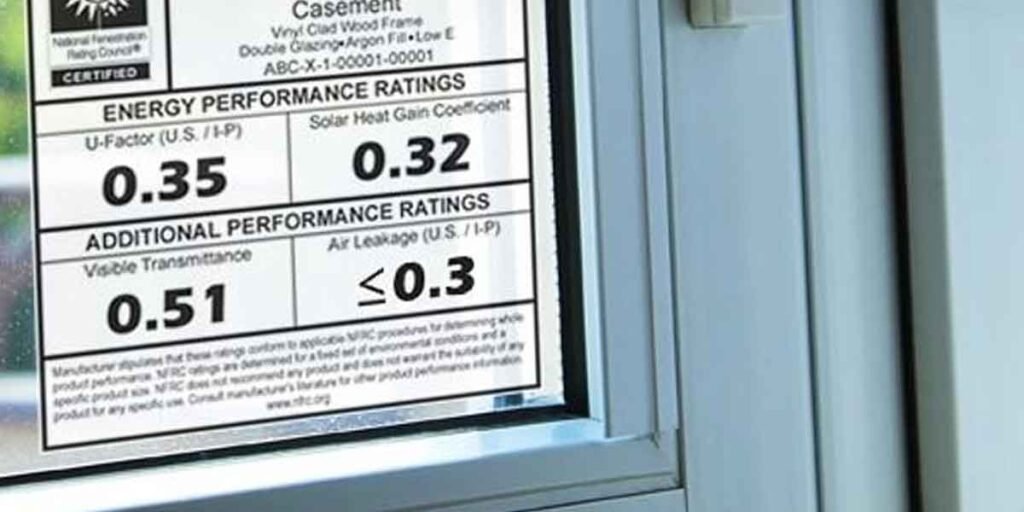
The certified number that matches your climate zone decides. Two lines of energy-efficient windows can share a frame material and a glass thickness and still end up with different ratings, because certification is issued per product line, per climate zone, and per date of manufacture.
That is also why the blue mark on its own settles very little. What settles the purchase is the certification supporting the mark, the ceilings that apply where the house stands, and whether any federal credit is still left to offset the price.
Most of it checks out in about two minutes, from one photograph of the label.
What the label on energy-efficient windows certifies
Five ratings travel with every NFRC-certified unit. U-factor describes heat loss and appears in the top left. Solar heat gain coefficient, top right, reports how much solar heat the assembly admits.
Visible transmittance and air leakage share the middle and bottom rows, and condensation resistance, scored 1 to 100, appears at the bottom left. Manufacturer, model number, and unit size are printed on the same sheet.
Condensation resistance earns its place on that list in cold climates, where a warm interior surface and a cold pane meet. A higher score means less water collecting on the frame and the glass edge, which is where the damage starts.
Air leakage is the figure with a hard cutoff. A unit has to test at or below 0.3 cfm/ft², meaning air movement through the finished assembly measured in cubic feet per minute per unit of area, before any ENERGY STAR claim can attach to it.
The ratings come from testing the whole assembly, frame and sash included. Glass suppliers publish separate figures for the glazing alone, and those tidier values do not carry over to the finished window.
A component cannot hold the mark by itself. Certification belongs to the assembled unit, so a high-performance glass package advertised on its own says nothing about the window it will end up inside.
Which numbers count in your climate zone
Version 7.0 of the ENERGY STAR window specification sets four zone ceilings, and the ceiling where the house stands decides whether a given unit qualifies at all.
| Climate zone | U-factor ceiling | Solar heat gain coefficient |
|---|---|---|
| Northern | 0.22 or lower | 0.17 or higher |
| North-Central | 0.25 or lower | 0.40 or lower |
| South-Central | 0.28 or lower | 0.23 or lower |
| Southern | 0.32 or lower | 0.23 or lower |
Air leakage remains at 0.3 cfm/ft² in all four zones, which makes it the one filter that applies everywhere.
The solar heat gain ceiling moves the other way, tightening from 0.40 in North-Central to 0.23 across the two southern zones. In a cooling-dominated climate the specification wants the sun kept out, so a dark-tinted or spectrally selective glazing is doing the work the U-factor does up north.
The Northern zone is the only one with an equivalent-performance path. A unit at U 0.23 qualifies when its solar heat gain coefficient reaches 0.35, and the pairing loosens as the U-factor climbs. U 0.24 pairs with 0.35 or above, U 0.25 and U 0.26 with 0.40 or above.
Winter sun is worth keeping in a cold climate, and energy-efficient windows that block solar gain in every direction save nothing during the expensive half of the year.
North-Central, South-Central, and Southern offer no such trade, and neither do doors or skylights anywhere in the country.
The specification took effect on October 23, 2023, replacing the Version 6.0 criteria that had governed since 2015.
The manufacture date changes the version
ENERGY STAR judges a unit by the specification in effect on the day it was manufactured, not the day it was sold or installed. That single sentence explains most of the confusing comparisons between energy-efficient windows that look identical on two showroom floors.
Stock that sat in a distributor’s yard since 2022 can bear Version 6.0 ratings, still wear the mark, and still be legal to sell. Nothing printed on the sheet identifies which version produced the numbers.
Certifications also age.
U-factor gets recertified every five years, air leakage every ten, and the directory lists only products holding a current certification.
A label photographed on an earlier shopping trip is therefore a statement about the past. Ask what the certification status is this week, or look it up yourself.
Verifying one specific window by its CPD number
Every certified unit has a CPD number, printed in a form like AAA-X-11-01234-01234, and the National Fenestration Rating Council’s Certified Products Directory searches by that number.
The directory also searches by manufacturer, by product type, and by applied film. Results return products with a current certification only, so a lapsed product will not appear at all.
A separate label-verification search takes a full CPD number and returns the ratings printed on labels for that product, current or historical. That tool turns the sheet taped to a display unit into something you can check against the file.
An empty result is an answer in its own right.
A missing record means the unit in front of you is not currently certified, whatever the placard beside it claims.
The 2026 federal credit question
There is no federal tax credit for windows installed after December 31, 2025. The IRS position behind that date arrived after the One Big Beautiful Bill Act moved the original 2032 sunset forward.
Through 2025 the credit covered 30% of the cost, capped at $600 a year for windows and skylights, for a primary residence only, and unused amounts did not carry forward. Work completed during 2025 can still be claimed on a 2025 return.
For an order placed now, treat the federal credit as zero and price the job without it. State programs, utility rebates, and manufacturer promotions run separately and change by territory, so they are worth asking about directly.
That one correction moves the payback math on a whole-house order further than any glass upgrade discussed here.
Where the label stops and the installation starts
Certification measures a unit in a test frame, while the finished opening performs according to the flashing, the shims, the air sealing at the rough opening, and whether the sash was adjusted before the crew packed up.
A certified window set out of square, with the exterior flashing detailed wrong, will leak and lose heat at a rate no rating predicts.
Some openings fail for reasons the rating system never touches, including egress clearances, safety glazing, and frames that have gone out of square. Those constraints belong to the opening itself, and the energy efficient windows page walks through them.
Hand the work to a licensed trade when the job involves egress windows, safety glazing beside a door or tub, structural framing, or painted surfaces in pre-1978 housing, where disturbing paint brings a legal obligation the rating has nothing to do with. Long reaches from a ladder above a first-floor sill belong in the same category.
Everything else, comparing two units, photographing a label, pulling a certification record, you can settle before you sign.
Frequently asked questions
What type of window is most energy-efficient?
A fixed window with a low U-factor and glazing matched to the zone performs best in the rating system, because it has no operable seam for air to pass through.
Operable units trade a little air leakage for ventilation, and the rated air leakage figure on the label is where that trade appears.
Is there a federal tax credit for energy-efficient windows in 2026?
No. Under current IRS guidance the Section 25C credit applies to property placed in service on or before December 31, 2025, and nothing installed this year qualifies.
What U-factor should I look for?
Start with the ceiling for your zone: 0.22 Northern, 0.25 North-Central, 0.28 South-Central, 0.32 Southern. Lower numbers help everywhere, and in the Northern zone a higher U-factor can be exchanged for more solar heat gain.
Who sells the most energy-efficient windows?
Sales volume does not identify the best performer, because certification is issued per product line and per climate zone. One manufacturer can hold a line certified for the Northern zone and another line that only clears the Southern ceiling.
Does an ENERGY STAR certification expire?
Certification has to be renewed: U-factor ratings are reviewed every five years, air leakage every ten. Products whose certification lapses drop out of the directory until the manufacturer recertifies them.
Does a higher price mean better ratings?
Price tracks frame material, hardware, and warranty terms more closely than it tracks U-factor. Two quotes built to the same zone ceiling can look very different with identical certified numbers.
