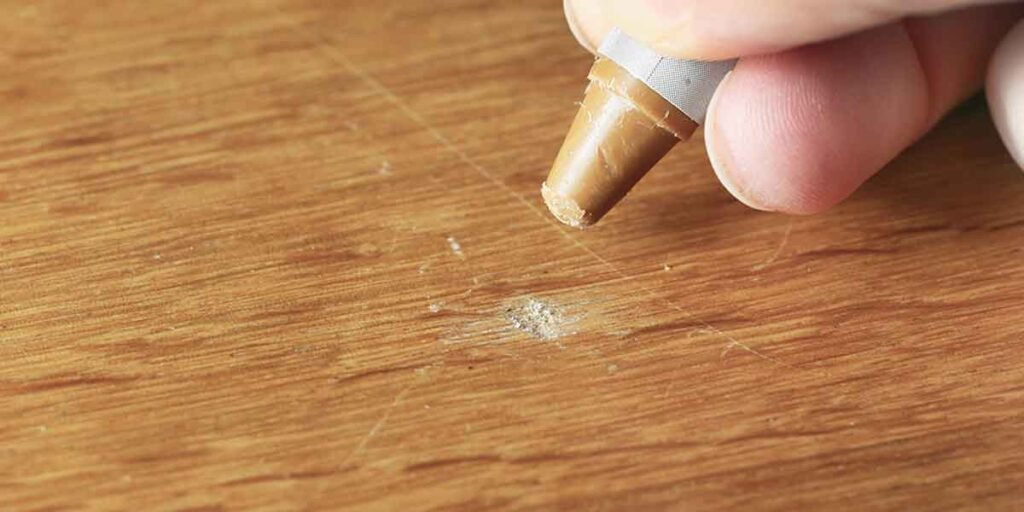
A floor repair call turns on where the damage sits.
A scuff lives in the finish, a raised seam lives in the material, and a soft spot lives beneath both of them. Two floors that look equally worn can need opposite responses, and the marker itself usually says which one you are looking at, provided you read it against the material it sits on.
Three questions settle most cases before a tool comes out: does it feel different underfoot, does it change with the season, and is its footprint growing?
Which Damage Markers Change Your Next Step?
Markers sort into three groups: finish damage that can be touched up, joints and edges that show a material responding to moisture or movement, and system markers that come from the subfloor, the framing, or a leak. Only the first group is reliably a small repair on its own.
A system marker is any change that survives a repair, a season, or a cleaning.
Finish damage is shallow by definition. A scratch your fingernail catches has reached the wood or the wear layer, while a mark that appears only in raking light stays in the topcoat and usually answers to a touch-up pen or a fresh coat of finish. Finish wear on solid wood is worth catching early, because once the color layer is gone the boards have to be recoated or replaced rather than blended.
Joints and edges tell you more, since they open and close with moisture content. Boards that gap in February and close by June are doing what wood does. Boards that gap in July, when indoor air is at its wettest, are telling you the material has taken on permanent change.
The third group is the one people cover up. Repeated repairs, movement underfoot, and a smell that returns after cleaning all describe something under the surface, and an overlay of new flooring on top of it inherits the same problem.
The Same Marker, Read Against the Material
One raised seam reads differently in five materials, because each responds to moisture in its own way. The response below is what the marker usually points to, not a guarantee about any single floor.
| Marker | Material | What it usually signals | Usual response |
|---|---|---|---|
| Seam peaking along a joint | Laminate | The core has absorbed moisture and swollen | Fix the water source, then replace the swollen boards |
| Seam rising, board faces intact | Solid hardwood | Humidity swing, or fastening that has let go | Control indoor humidity; refasten or swap single boards |
| Scratch line that catches a nail | Solid wood | Wear layer still present, finish gone | Screen and recoat before bare color shows |
| Scuff visible only in angled light | Vinyl plank or sheet | Topcoat marring, wear layer untouched | Touch-up or polish; no plank replacement |
| Hollow or drummy tile | Tile | Bond failure, or movement beneath the bed | Remove and reset after the substrate is checked |
| Ripple running across the room | Carpet | Stretch lost, or padding crushed flat | Power-stretch the carpet; replace padding if it is flat |
| Gap that opens and closes | Solid wood | Normal seasonal moisture change | Nothing, unless the gap stays open year round |
The laminate row is where most optimistic repairs die. Swollen laminate core does not dry back to its original thickness, so a seam pressed down with weight comes back up within days. A floating vinyl plank is the opposite case: if the same product is still available and the damaged plank sits away from the walls, a single plank can be cut out and a new one locked in.
Carpet hides its markers better than any hard surface, which is why padding failure is usually diagnosed by feel. Walk the room in socks and compare the rebound under your foot at the traffic lane against the rebound near a wall.
Squeaks, Bounce, and Dips Come From Underneath
Noise and movement point below the visible surface, where the subfloor and the framing decide what a repair can achieve. APA, the Engineered Wood Association, lists the common causes of floor squeaks as spacing between panels, fasteners driven wrong, joist movement, ductwork clearance, and poor connections between the subfloor and the finished flooring.
One squeak in one spot is a fastening problem, and it is often reachable from a basement or crawlspace. I spent two weekends on the same three boards in a hallway, adding screws from below each time, before I measured the gap between the subfloor and the joist and found the panel was simply bowed. The screws had nothing to pull against.
Widespread noise is a different finding. Squeaks in several rooms, a floor that dips when you cross it, and a slope you can see along a wall are framing markers, and new flooring laid over them will follow the same slope.
Test the movement deliberately. Set a straightedge across the suspect area and look for daylight under it, note whether the dip sits at a wall or in the middle of a span, and check the doors nearest to it. A door that has started to catch its frame alongside a floor that slopes is no longer a flooring question.
Water Markers and the Window That Closes in 48 Hours
Damp materials have to be dried quickly or they stay damp. The EPA’s mold guidance is that wet or damp materials should be dried within 24 to 48 hours to help prevent mold growth, and that window is what separates a repairable floor from a replacement.
Cupping is the condition where a board’s edges rise above its center and the middle hollows out. Cup-shaped boards, crowned edges, dark staining around a seam, a musty smell at floor level, and a plank that gives slightly underfoot all belong to this group, and so does any laminate or engineered floor whose edges have started to swell.
Two of those markers rarely reverse. Carpet padding that has been soaked and left wet loses its structure and has to come out even if the carpet above it cleans up. Laminate core that has swollen stays swollen. A solid wood board that cupped from a one-time spill can flatten again as it dries, which is why drying the room, not pulling the floor, is the first move.
Before replacing anything, find the source. A stained seam near a bathroom wall, a dishwasher, or an exterior door is a plumbing or drainage problem showing up as flooring, and a new floor over an active leak buys months, not years.
Which Markers Need No Floor Repair at All?
Seasonal gapping in solid wood, scuffs that appear only in angled light, and furniture dents that rebound within a day are normal behavior for those materials. Treating them as damage is how a floor ends up sanded thinner than it needed to be.
Solid wood moves with indoor humidity, and a house that swings from dry winter air to a humid summer will show and then close gaps at the board edges. That movement is a humidity signal rather than a flooring failure, and adding a filler to it usually means the filler cracks out the next season.
Furniture dents behave the same way in reverse. Carpet pile and vinyl wear layers recover with warmth and time, so a dent under a sofa leg that fades over a day is not damage. A dent that stays after a week, especially one that stays white or cloudy, has compressed or cracked the material at that spot.
One caveat on the sanding question: a solid floor can only be refinished as many times as the wear layer allows, and each pass lowers the surface. Once a floor has been sanded to the point where the board edges sit close to the fasteners, another pass is no longer an option, and the honest next step is a recoat rather than a sand.
When the Correct Move Is to Stop
Some markers end the DIY conversation. Resilient floor tile and sheet flooring installed before 1980 should be presumed to contain asbestos unless a lab has confirmed it does not, and OSHA’s guidance for asbestos-containing flooring is blunt: do not sand the material or its backing, scrape only with wet methods, and keep any mechanical stripping under 300 rpm.
That last line is the one most people cross. Sanding a worn vinyl tile floor, or dry scraping the backing, is what sends fibers into the air. EPA’s homeowner guidance is to leave intact asbestos flooring alone when possible and install new flooring over it rather than remove it.
Older wood floors carry a different version of the same problem. Lead-based paint was banned for residential use in 1978, and the EPA’s Renovation, Repair and Painting rule governs paid work that disturbs painted surfaces in pre-1978 housing, with an interior trigger of 6 square feet per room and 20 square feet outside. Power sanding without a HEPA attachment and dry scraping are among the practices the rule prohibits. A homeowner working in their own house is outside that rule, but the dust hazard and the working methods it describes apply anyway.
Structural movement belongs in the same category. A floor that has gone out of level across a room, doors and windows that have started to stick, and a repeating crack that keeps widening point to the framing or the soil underneath. A licensed structural engineer answers that question; a flooring contractor cannot.
None of this transfers to a specific house on sight. Whether a tile contains asbestos, whether older paint contains lead, and whether a floor is genuinely moving are findings about one building, and each belongs to a certified inspector, a testing lab, or a licensed engineer. A description of a material type is not a determination, and the hazardous jobs are the ones where that distinction matters most.
How Markers Change What a Floor Repair Costs
Repair pricing follows the marker: a surface repair is measured in square feet of finish work, a single plank or board is priced by the piece plus the labor to blend it, and a tile reset carries removal and a new bed.
A moisture marker carries an investigation before it carries a price, because nobody can quote the repair until the source is found. That is why two estimates for the same room can differ by a wide margin without either being dishonest. One contractor prices the marker, the other prices what the marker may reveal, and comparing them means comparing the scope each one wrote down.
The same logic drives a replacement decision. When the marker is local and the subfloor is dry and sound, patching holds. When the same marker covers a whole room, or returns after a season, the money is better spent on the cause. For sizing either path, the floor repair cost calculator turns room dimensions and the type of repair into a range, which is a more useful comparison point than a single number quoted over the phone.
Frequently Asked Questions
How can you tell whether a subfloor needs replacing?
A subfloor needs replacing when the movement is broad rather than local, when the panels are soft or crumbly at the edges, or when the area has stayed wet long enough to stain and swell. A single squeaking panel is a fastening repair, not a subfloor replacement.
Can warped or cupped boards be repaired?
Sometimes. Solid wood that cupped after a one-time spill can flatten again as it dries. Laminate or engineered core that has swollen does not return to its original thickness, so those boards are replaced rather than flattened.
Will insurance pay to replace an entire floor?
Homeowners policies generally respond to sudden, accidental water damage and may cover matching repairs to undamaged areas, while gradual leaks and long-term neglect are typically excluded. The claim turns on how the moisture got in and how long it was there.
What makes a Floor Repair cost more?
Three things move a Floor Repair estimate: access to the damage, the material needed to match an existing floor, and whether a moisture source has to be found and fixed before the surface work starts. Matching a discontinued product can cost more than the repair itself.
How often does flooring need to be replaced?
Service life depends on material and traffic. The National Association of Home Builders’ life-expectancy study puts carpet at about 8 to 10 years under normal use, with laminate listed above it and hard surfaces well beyond that when the finish is maintained.
